Plateau setting
The town lies on the Serra da Ibiapaba, a raised plateau in northwestern Ceará. Its elevation explains the milder climate and the agricultural roads fanning out across the surrounding land.
Posta faʻafanua faigofie · Brazil
4.1669° S / 40.7475° W
A highland town on the Ibiapaba plateau, its compact street grid set among farm roads and the edge of an escarpment


Tasi le aai, lagona e lima
Tapi se sitaili e vaai ai i luga o le puipui. E tutusa uma le tau o sitaili — pe lolomiina, faapipiiina, pe avea ma faila HD.
 Pika Moni · Faila Lolomi 24 × 36″
Manino mo le lolomi
O se vaega atoa (100%) lenei mai le faila lolomi moni. O posita uma — pe lolomiina, faapipiiina pe download mai — e faia i luga o a matou server i le 300 DPI, e oo atu i le 7,200 × 10,800 pika, ina ia manino pea auala laiti i luga o se lolomiga 24 × 36″.
I luga o le puipui


Le faʻafanua
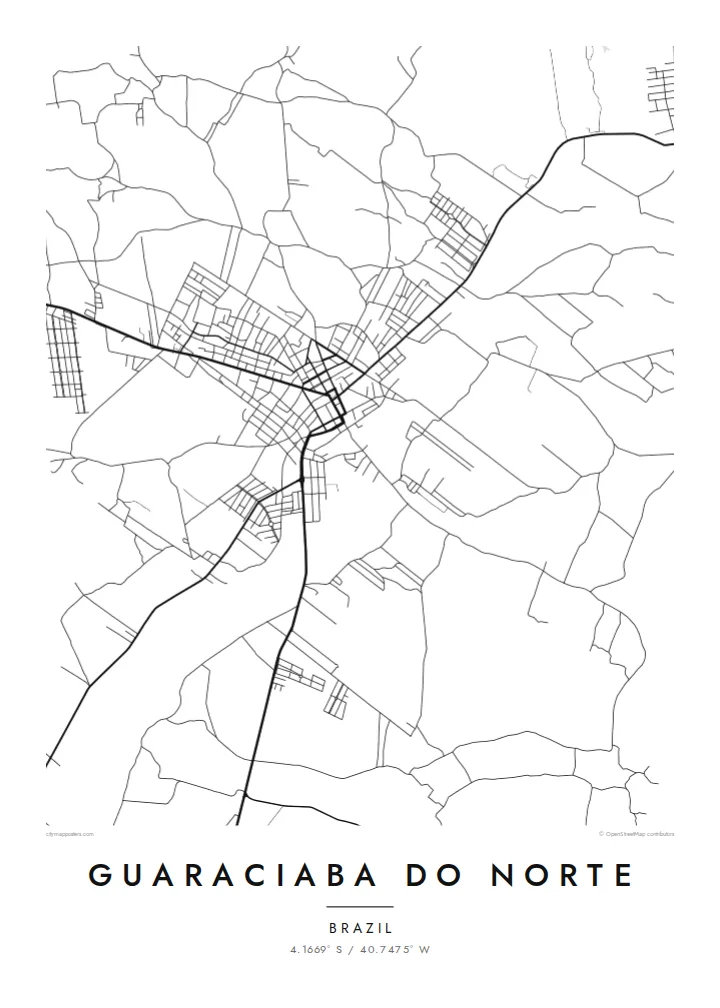
Guaraciaba do Norte sits in the northwest of Ceará, up on the Serra da Ibiapaba, the long sandstone plateau that rises above the dry backlands of the state. From above, the town is a dense core of short blocks with a main church square at its centre and roads that thin out quickly into cultivated land and scattered rural settlements.
The plateau gives the area a cooler, wetter climate than much of Ceará, and agriculture defines the surrounding landscape. On a map this shows as a fine web of minor roads and tracks spreading away from town. To the west the terrain eventually drops off along the escarpment, a boundary that shapes how the whole region is connected.
A Guaraciaba do Norte map poster keeps things plain: the grid of the centre, the arterial roads leaving it, and the looser pattern of farmland roads at the edges. At this scale the town reads as a small, orderly settlement on high ground, which is a fair portrait of the place itself.
The town lies on the Serra da Ibiapaba, a raised plateau in northwestern Ceará. Its elevation explains the milder climate and the agricultural roads fanning out across the surrounding land.
The urban core is a tight arrangement of short blocks around a central square and church, with the densest lines on the poster concentrated in a small area.
Beyond the built-up area, thin roads and tracks connect farms and villages, giving the outer parts of the map a loose, branching texture.
Fai mo oe
Faʻaopoopo se aso, se igoa po o sau lava upu, sui le sitaili, lapoʻa po o le itu.
O le preview e leai se totogi e maualalo le resolution ma iai se watermark. O lolomi ma faila HD e faia i le 300 DPI, e oo atu i le 7,200 × 10,800 px, e aunoa ma se watermark.
Aisea Guaraciaba do Norte
For people from Guaraciaba do Norte or families with roots on the Ibiapaba plateau, this is a quiet way to keep home in view. The print shows the town honestly, without landmarks added for effect, just the streets people actually walk.
You can change the title and subtitle, set a date or the coordinates line, and pick from five styles: Classic black and white, Noir, Paper, Blueprint or Sand. A free 900 px watermarked preview lets you check the framing first.
Faatau le posita Guaraciaba do Norte| Lapoʻa lolomi | Manino | Faila |
|---|---|---|
| 30 × 40 cm11.8 × 15.7″ | 3,543 × 4,724 px | PNG · PDF |
| 29.7 × 42 cm (A3)11.7 × 16.5″ | 3,508 × 4,961 px | PNG · PDF |
| 42 × 59.4 cm (A2)16.5 × 23.4″ | 4,961 × 7,016 px | PNG · PDF |
| 45.7 × 61 cm18 × 24″ | 5,400 × 7,200 px | PNG · PDF |
| 50 × 70 cm19.7 × 27.6″ | 5,906 × 8,268 px | PNG · PDF |
| 61 × 91.4 cm24 × 36″ | 7,200 × 10,800 px | PNG · PDF |
Ae faʻatusatusa, o le faʻataʻitaʻiga e leai se totogi e 900 px le lautele, e iai le faʻailoga vai ma e mo mata. O faila HD e oʻo atu i le 8× le manino i itu taʻitasi ma e lolomi manino i le lapoʻa atoa o le posta.
Filifili se sitaili i le pito i luga o le itulau, ona filifili lea o le Posita Lolomi — se lapopoa ma, afai e te fiafia, se faavaa — po o Faila HD Numera. E na o le tasi laasaga o le Checkout, ma o le a fesuia'i lou itulau o oka i le taimi lava e mae'a ai le totogi.
E lolomiina i luga o pepa matte maualuga le tulaga e 200 gsm, i se tasi o lapopoa e ono, mai le 30 × 40 cm i le 24 × 36″. E amata le tau o posita lolomi mai le $39, aofia ai le auina atu.
Ioe. Filifili se faavaa laau malosi i le lanu uliuli, sina, oak masani, po o le laau pogisa. E aofia ai se tioata e le gau ma ua saunia e tautau i luga. E amata le tau o posita faavaa mai le $99, aofia ai le auina atu.
E leai se totogi o le auina atu i atunuu e 60+. O pepa ata taʻitasi e lolomiina e le tasi o matou paaga lolomi e latalata mai i atunuu e 30+, ma e masani ona taunuu i le 3–7 aso faigaluega. E mafai ona e mulimulitaia le tulaga ma le sailiga i lalo o My Orders. O nisi atunuu e 2–5 vaiaso, ma i nofoaga e lei matou auina atu iai, e taʻu atu e le saite ia te oe a o lei totogi.
Auina mai se ata i totonu o le 14 aso talu ona taunuu, ma o le a matou toe lolomiina e leai se totogi po o le toe faafoi atu lau tupe.
Ioe. I totonu o le editor i lenei itulau, suia le ulutala, le ulutala laititi ma le laina o coordinates i soo se mea e te fiafia i ai, ma filifili se sitaili ma le lapopoa. O oka lolomi, faavaa ma numera e faaaoga uma lava lau mamanu.
Mo le $9 e te maua ai faila PNG 300 DPI ma PDF ua saunia mo le lolomi i lapopoa uma e ono, e aunoa ma se watermark, e mafai ona lolomi i soo se mea. Le mautinoa lava? Download muamua se preview e leai se totogi ma le watermark.
Latalata ane
