Parasio quarter
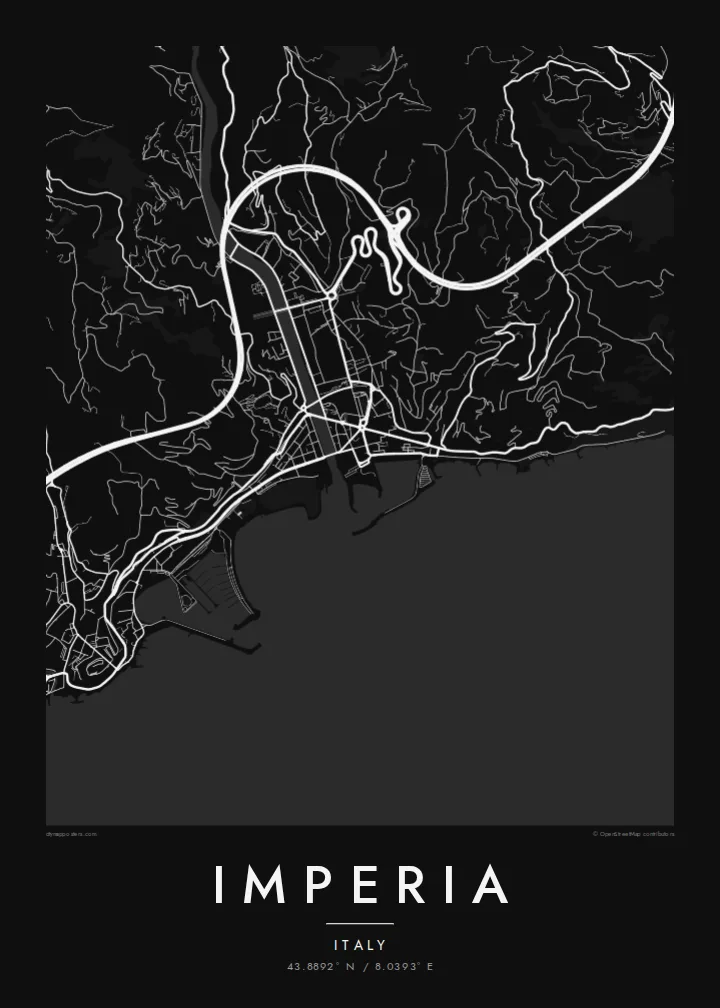
Porto Maurizio's old quarter crowns its promontory with a dense tangle of stepped lanes and alleys, one of the most intricate patches of streets on the whole poster.
Posta faʻafanua faigofie · Italy
43.8892° N / 8.0393° E
Two old towns on the Ligurian coast, Porto Maurizio and Oneglia, joined across the mouth of the Impero river.



Tasi le aai, lagona e lima
Tapi se sitaili e vaai ai i luga o le puipui. E tutusa uma le tau o sitaili — pe lolomiina, faapipiiina, pe avea ma faila HD.
 Pika Moni · Faila Lolomi 24 × 36″
Manino mo le lolomi
O se vaega atoa (100%) lenei mai le faila lolomi moni. O posita uma — pe lolomiina, faapipiiina pe download mai — e faia i luga o a matou server i le 300 DPI, e oo atu i le 7,200 × 10,800 pika, ina ia manino pea auala laiti i luga o se lolomiga 24 × 36″.
I luga o le puipui


Le faʻafanua
Imperia was created in 1923 by joining two separate towns on the western Riviera, Porto Maurizio and Oneglia, together with several smaller villages. The Impero river, which gave the new city its name, flows between them to the sea. A century later the two halves still have distinct characters, and on a map they read as two centres rather than one.
Porto Maurizio climbs a rocky promontory. Its old quarter, the Parasio, is a knot of steep lanes around the hilltop, and the large neoclassical Basilica of San Maurizio stands close by. Oneglia, to the east, is flatter and more regular, with an arcaded street, a working harbour and a history tied to olive oil and pasta-making. Terraced olive groves cover the hills above both.
An Imperia map poster brings out that double structure very clearly. Two harbours, two old centres and a river mouth between them sit along a curving stretch of Mediterranean coast, with steep hinterland behind. It is a thoughtful choice for anyone who has spent summers on the Riviera di Ponente or has family roots in either town.
Porto Maurizio's old quarter crowns its promontory with a dense tangle of stepped lanes and alleys, one of the most intricate patches of streets on the whole poster.
Oneglia's port and the arcaded streets behind it form a flatter, more orderly pattern, historically linked to the olive oil trade that shaped the town's economy.
The short river that gave the city its name reaches the sea between the two towns. It is a clear dividing line that explains Imperia's unusual two-centred shape.
Fai mo oe
Faʻaopoopo se aso, se igoa po o sau lava upu, sui le sitaili, lapoʻa po o le itu.
O le preview e leai se totogi e maualalo le resolution ma iai se watermark. O lolomi ma faila HD e faia i le 300 DPI, e oo atu i le 7,200 × 10,800 px, e aunoa ma se watermark.
Aisea Imperia
Imperia rewards people who know it well: the walk between the two harbours, the climb into the Parasio, the olive terraces above the coast. A map poster keeps all of those places together in one clean, legible image.
You can title it Imperia or name one of its two halves, add a date or a line of your own, and choose from five styles. The digital files come in six sizes, including 50×70 cm, A2 and 24×36″, with no watermark.
Faatau le posita Imperia| Lapoʻa lolomi | Manino | Faila |
|---|---|---|
| 30 × 40 cm (11.8 × 15.7″) | 3,543 × 4,724 px | PNG · PDF |
| 29.7 × 42 cm (A3, 11.7 × 16.5″) | 3,508 × 4,961 px | PNG · PDF |
| 42 × 59.4 cm (A2, 16.5 × 23.4″) | 4,961 × 7,016 px | PNG · PDF |
| 45.7 × 61 cm (18 × 24″) | 5,400 × 7,200 px | PNG · PDF |
| 50 × 70 cm (19.7 × 27.6″) | 5,906 × 8,268 px | PNG · PDF |
| 61 × 91.4 cm (24 × 36″) | 7,200 × 10,800 px | PNG · PDF |
Ae faʻatusatusa, o le faʻataʻitaʻiga e leai se totogi e 900 px le lautele, e iai le faʻailoga vai ma e mo mata. O faila HD e oʻo atu i le 8× le manino i itu taʻitasi ma e lolomi manino i le lapoʻa atoa o le posta.
Filifili se sitaili i le pito i luga o le itulau, ona filifili lea o le Posita Lolomi — se lapopoa ma, afai e te fiafia, se faavaa — po o Faila HD Numera. E na o le tasi laasaga o le Checkout, ma o le a fesuia'i lou itulau o oka i le taimi lava e mae'a ai le totogi.
E lolomiina i luga o pepa matte maualuga le tulaga e 200 gsm, i se tasi o lapopoa e ono, mai le 30 × 40 cm i le 24 × 36″. E amata le tau o posita lolomi mai le $39, aofia ai le auina atu.
Ioe. Filifili se faavaa laau malosi i le lanu uliuli, sina, oak masani, po o le laau pogisa. E aofia ai se tioata e le gau ma ua saunia e tautau i luga. E amata le tau o posita faavaa mai le $99, aofia ai le auina atu.
E leai se totogi mo le uta i le lalolagi atoa. O poster ta'itasi e lolomi e le paaga lolomi e latalata mai i matou i atunuu e 30+, ma e masani ona taunuu i aso faigaluega e 3–7. E mafai ona e mulimuli i le tulaga ma le tracking i le "Aʻu Oka". O nisi atunuu e 2–5 vaiaso, ma i atunuu matou te lei tuuina atu ai, e taʻu atu e le saite iā te oe ae e te leʻi totogiina.
Auina mai se ata i totonu o le 14 aso talu ona taunuu, ma o le a matou toe lolomiina e leai se totogi po o le toe faafoi atu lau tupe.
Ioe. I totonu o le editor i lenei itulau, suia le ulutala, le ulutala laititi ma le laina o coordinates i soo se mea e te fiafia i ai, ma filifili se sitaili ma le lapopoa. O oka lolomi, faavaa ma numera e faaaoga uma lava lau mamanu.
Mo le $9 e te maua ai faila PNG 300 DPI ma PDF ua saunia mo le lolomi i lapopoa uma e ono, e aunoa ma se watermark, e mafai ona lolomi i soo se mea. Le mautinoa lava? Download muamua se preview e leai se totogi ma le watermark.
