Mount Iriga
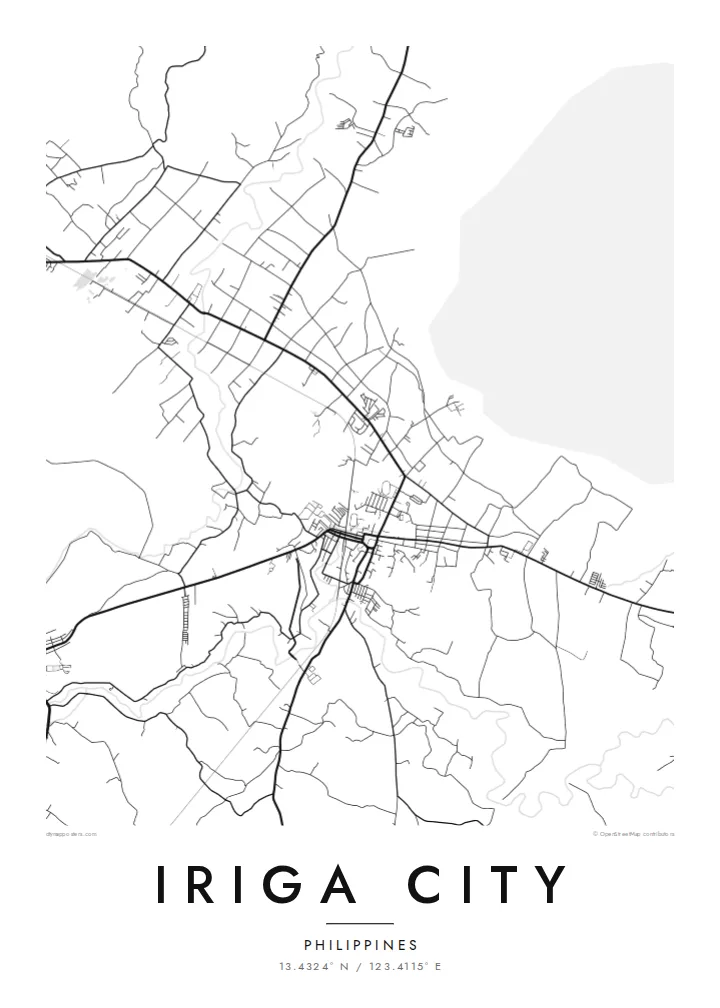
The volcano rises east of the city. Its wide lower slopes and ridges fill a large part of the map and give the flat urban area a strong natural counterweight.
Posta faʻafanua faigofie · Philippines
13.4324° N / 123.4115° E
A Bicol city on the plain below Mount Iriga, with a compact centre, rice fields and roads leading toward the volcano's slopes.


Tasi le aai, lagona e lima
Tapi se sitaili e vaai ai i luga o le puipui. E tutusa uma le tau o sitaili — pe lolomiina, faapipiiina, pe avea ma faila HD.
 Pika Moni · Faila Lolomi 24 × 36″
Manino mo le lolomi
O se vaega atoa (100%) lenei mai le faila lolomi moni. O posita uma — pe lolomiina, faapipiiina pe download mai — e faia i luga o a matou server i le 300 DPI, e oo atu i le 7,200 × 10,800 pika, ina ia manino pea auala laiti i luga o se lolomiga 24 × 36″.
I luga o le puipui


Le faʻafanua
Iriga City lies in the Rinconada area of Camarines Sur, on a fertile plain overlooked by Mount Iriga, also called Mount Asog. From above, the city appears as a dense centre of short blocks around the church and market. Main roads branch out from it through a patchwork of rice fields and villages. The mountain rises to the east, and its broad lower slopes fill much of any wider view.
Mount Iriga is a volcano with a large scar on its flank, left by a collapse long ago. On the far side of the mountain lies Lake Buhi, known for the sinarapan, one of the smallest fish in the world to be caught commercially. The mountain gives the city's landscape a clear, fixed point, and residents and visitors alike use it to find their bearings.
Iriga is also a regional crossroads, linked by road and rail to other Bicol cities such as Naga and Legazpi. An Iriga City map poster brings together the dense urban core, the surrounding farmland and the rising ground of the mountain. Together they show clearly why this corner of Bicol looks the way it does.
The volcano rises east of the city. Its wide lower slopes and ridges fill a large part of the map and give the flat urban area a strong natural counterweight.
A dense grid of short blocks around the church, plaza and market forms the heart of the city. It is the busiest and most detailed part of the poster.
Around the centre, main roads cut across a patchwork of farmland and small settlements. This gives the outer parts of the map a looser, rural rhythm.
Fai mo oe
Faʻaopoopo se aso, se igoa po o sau lava upu, sui le sitaili, lapoʻa po o le itu.
O le preview e leai se totogi e maualalo le resolution ma iai se watermark. O lolomi ma faila HD e faia i le 300 DPI, e oo atu i le 7,200 × 10,800 px, e aunoa ma se watermark.
Aisea Iriga City
Many people from Iriga now live far away, in Manila or overseas, and a map of the hometown keeps those streets close. It also makes a thoughtful gift for parents or relatives who still live under the mountain.
Add a title, subtitle and coordinates line with a family name or an important date, then choose Classic black & white, Noir, Paper, Blueprint or Sand. The digital HD files come in six print sizes, ready to print locally.
Faatau le posita Iriga City| Lapoʻa lolomi | Manino | Faila |
|---|---|---|
| 30 × 40 cm11.8 × 15.7″ | 3,543 × 4,724 px | PNG · PDF |
| 29.7 × 42 cm (A3)11.7 × 16.5″ | 3,508 × 4,961 px | PNG · PDF |
| 42 × 59.4 cm (A2)16.5 × 23.4″ | 4,961 × 7,016 px | PNG · PDF |
| 45.7 × 61 cm18 × 24″ | 5,400 × 7,200 px | PNG · PDF |
| 50 × 70 cm19.7 × 27.6″ | 5,906 × 8,268 px | PNG · PDF |
| 61 × 91.4 cm24 × 36″ | 7,200 × 10,800 px | PNG · PDF |
Ae faʻatusatusa, o le faʻataʻitaʻiga e leai se totogi e 900 px le lautele, e iai le faʻailoga vai ma e mo mata. O faila HD e oʻo atu i le 8× le manino i itu taʻitasi ma e lolomi manino i le lapoʻa atoa o le posta.
Filifili se sitaili i le pito i luga o le itulau, ona filifili lea o le Posita Lolomi — se lapopoa ma, afai e te fiafia, se faavaa — po o Faila HD Numera. E na o le tasi laasaga o le Checkout, ma o le a fesuia'i lou itulau o oka i le taimi lava e mae'a ai le totogi.
E lolomiina i luga o pepa matte maualuga le tulaga e 200 gsm, i se tasi o lapopoa e ono, mai le 30 × 40 cm i le 24 × 36″. E amata le tau o posita lolomi mai le $39, aofia ai le auina atu.
Ioe. Filifili se faavaa laau malosi i le lanu uliuli, sina, oak masani, po o le laau pogisa. E aofia ai se tioata e le gau ma ua saunia e tautau i luga. E amata le tau o posita faavaa mai le $99, aofia ai le auina atu.
E leai se totogi o le auina atu i atunuu e 60+. O pepa ata taʻitasi e lolomiina e le tasi o matou paaga lolomi e latalata mai i atunuu e 30+, ma e masani ona taunuu i le 3–7 aso faigaluega. E mafai ona e mulimulitaia le tulaga ma le sailiga i lalo o My Orders. O nisi atunuu e 2–5 vaiaso, ma i nofoaga e lei matou auina atu iai, e taʻu atu e le saite ia te oe a o lei totogi.
Auina mai se ata i totonu o le 14 aso talu ona taunuu, ma o le a matou toe lolomiina e leai se totogi po o le toe faafoi atu lau tupe.
Ioe. I totonu o le editor i lenei itulau, suia le ulutala, le ulutala laititi ma le laina o coordinates i soo se mea e te fiafia i ai, ma filifili se sitaili ma le lapopoa. O oka lolomi, faavaa ma numera e faaaoga uma lava lau mamanu.
Mo le $9 e te maua ai faila PNG 300 DPI ma PDF ua saunia mo le lolomi i lapopoa uma e ono, e aunoa ma se watermark, e mafai ona lolomi i soo se mea. Le mautinoa lava? Download muamua se preview e leai se totogi ma le watermark.
Latalata ane
