Al-Muizz Street
The long north–south spine of the Fatimid city, running between its old gates. On the map it is one of the few continuous lines through the dense district.
Posta faʻafanua faigofie · Egypt
30.0414° N / 31.2565° E
A dense historic core east of the Nile, threaded by one long medieval street and framed by the Citadel and cemeteries
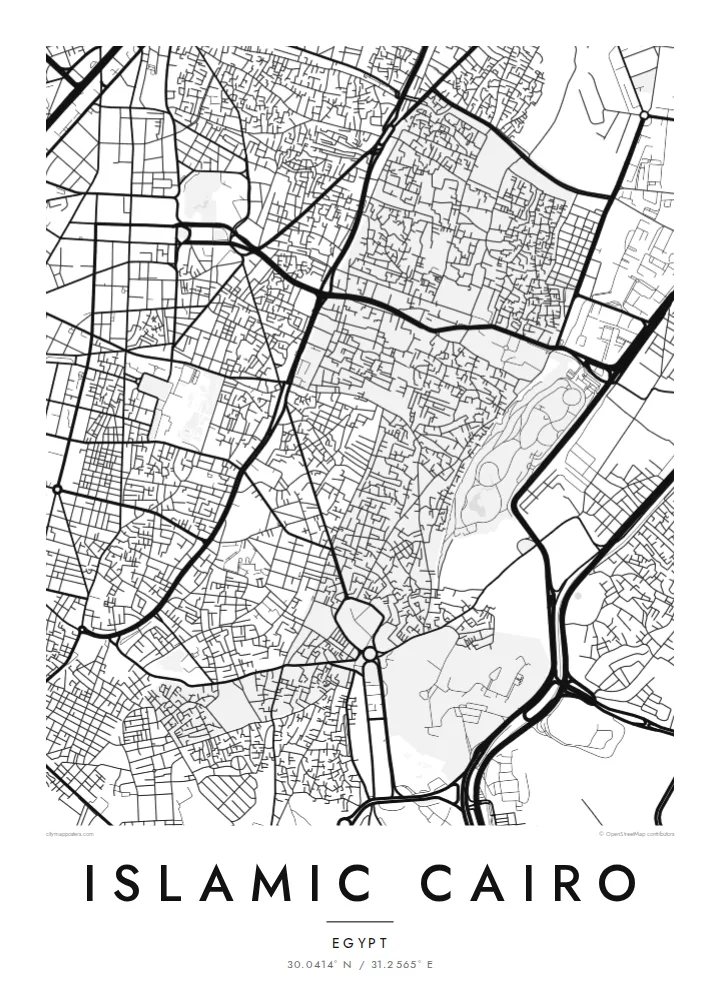
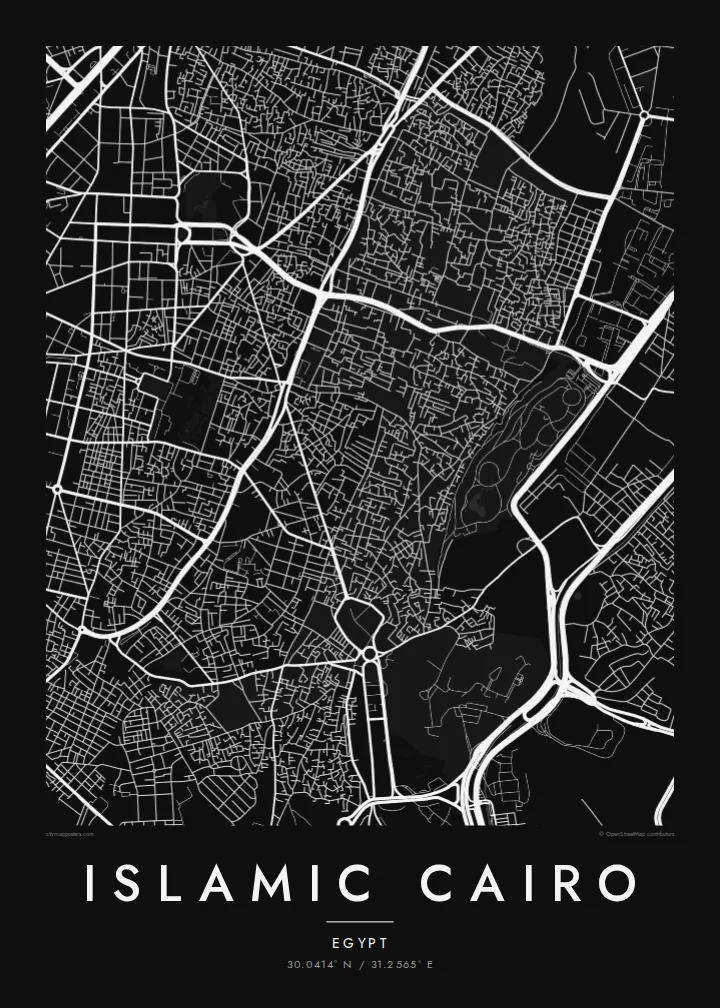
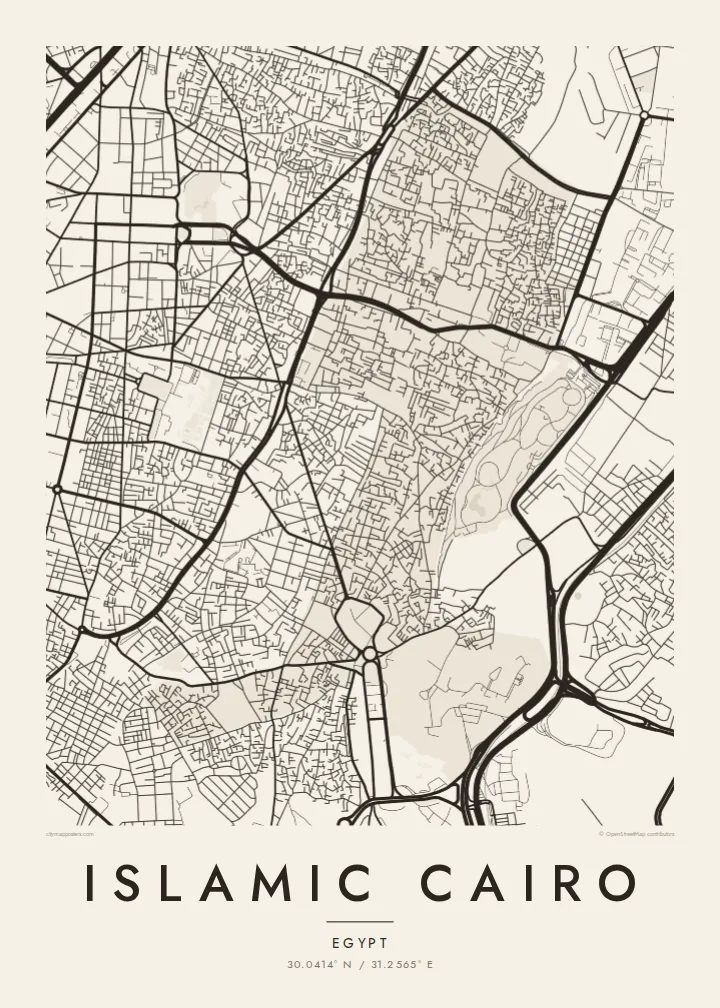

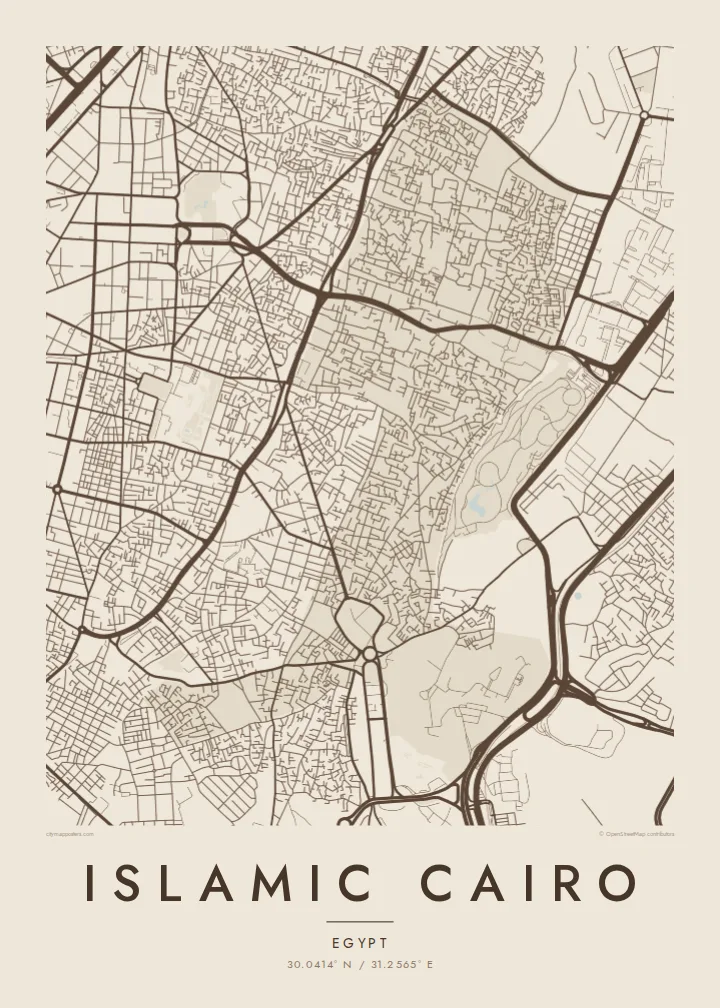
Tasi le aai, lagona e lima
Tapi se sitaili e vaai ai i luga o le puipui. E tutusa uma le tau o sitaili — pe lolomiina, faapipiiina, pe avea ma faila HD.
 Pika Moni · Faila Lolomi 24 × 36″
Manino mo le lolomi
O se vaega atoa (100%) lenei mai le faila lolomi moni. O posita uma — pe lolomiina, faapipiiina pe download mai — e faia i luga o a matou server i le 300 DPI, e oo atu i le 7,200 × 10,800 pika, ina ia manino pea auala laiti i luga o se lolomiga 24 × 36″.
I luga o le puipui


Le faʻafanua
Islamic Cairo, or Historic Cairo, is the medieval heart of the city, east of the modern centre and the Nile. From above, it is one of the densest street patterns anywhere. Narrow lanes branch and turn, crossed by only a few straighter routes. On its eastern side, the fabric gives way to the large, open cemetery areas known as the City of the Dead.
The core of the district dates back to the Fatimid foundation of al-Qahira in 969. Al-Muizz Street runs north to south through it, lined with mosques, madrasas and palaces from many dynasties. Its old city gates, including Bab Zuwayla, still stand. Al-Azhar Mosque, founded in 970, lies nearby and is linked to one of the oldest universities in the world.
To the south, the Citadel of Saladin sits on a spur of the Muqattam hills, overlooking the city. The Khan el-Khalili market fills the blocks around al-Hussein. The area was listed by UNESCO as a World Heritage Site in 1979. An Islamic Cairo map poster shows the medieval city at full density, with the Citadel and cemeteries at its edges.
The long north–south spine of the Fatimid city, running between its old gates. On the map it is one of the few continuous lines through the dense district.
Saladin's fortress stands on high ground at the south-east edge of the district. Its walled compound is clearly separated from the surrounding streets.
Large cemetery districts stretch along the eastern edge. They form a distinct pattern of enclosures and paths beside the living city.
Fai mo oe
Faʻaopoopo se aso, se igoa po o sau lava upu, sui le sitaili, lapoʻa po o le itu.
O le preview e leai se totogi e maualalo le resolution ma iai se watermark. O lolomi ma faila HD e faia i le 300 DPI, e oo atu i le 7,200 × 10,800 px, e aunoa ma se watermark.
Aisea Islamic Cairo
Islamic Cairo draws historians, travellers, architects and people whose families come from its lanes. A map captures the density that is hard to take in on the ground and gives it a calm, readable shape.
Set your own title, subtitle and coordinates, perhaps with a date or a family name. Choose one of five styles. Sand gives the medieval city a warm, desert-toned look, while Classic black & white emphasises its intricate street pattern.
Faatau le posita Islamic Cairo| Lapoʻa lolomi | Manino | Faila |
|---|---|---|
| 30 × 40 cm11.8 × 15.7″ | 3,543 × 4,724 px | PNG · PDF |
| 29.7 × 42 cm (A3)11.7 × 16.5″ | 3,508 × 4,961 px | PNG · PDF |
| 42 × 59.4 cm (A2)16.5 × 23.4″ | 4,961 × 7,016 px | PNG · PDF |
| 45.7 × 61 cm18 × 24″ | 5,400 × 7,200 px | PNG · PDF |
| 50 × 70 cm19.7 × 27.6″ | 5,906 × 8,268 px | PNG · PDF |
| 61 × 91.4 cm24 × 36″ | 7,200 × 10,800 px | PNG · PDF |
Ae faʻatusatusa, o le faʻataʻitaʻiga e leai se totogi e 900 px le lautele, e iai le faʻailoga vai ma e mo mata. O faila HD e oʻo atu i le 8× le manino i itu taʻitasi ma e lolomi manino i le lapoʻa atoa o le posta.
Filifili se sitaili i le pito i luga o le itulau, ona filifili lea o le Posita Lolomi — se lapopoa ma, afai e te fiafia, se faavaa — po o Faila HD Numera. E na o le tasi laasaga o le Checkout, ma o le a fesuia'i lou itulau o oka i le taimi lava e mae'a ai le totogi.
E lolomiina i luga o pepa matte maualuga le tulaga e 200 gsm, i se tasi o lapopoa e ono, mai le 30 × 40 cm i le 24 × 36″. E amata le tau o posita lolomi mai le $39, aofia ai le auina atu.
Ioe. Filifili se faavaa laau malosi i le lanu uliuli, sina, oak masani, po o le laau pogisa. E aofia ai se tioata e le gau ma ua saunia e tautau i luga. E amata le tau o posita faavaa mai le $99, aofia ai le auina atu.
E leai se totogi o le auina atu i atunuu e 60+. O pepa ata taʻitasi e lolomiina e le tasi o matou paaga lolomi e latalata mai i atunuu e 30+, ma e masani ona taunuu i le 3–7 aso faigaluega. E mafai ona e mulimulitaia le tulaga ma le sailiga i lalo o My Orders. O nisi atunuu e 2–5 vaiaso, ma i nofoaga e lei matou auina atu iai, e taʻu atu e le saite ia te oe a o lei totogi.
Auina mai se ata i totonu o le 14 aso talu ona taunuu, ma o le a matou toe lolomiina e leai se totogi po o le toe faafoi atu lau tupe.
Ioe. I totonu o le editor i lenei itulau, suia le ulutala, le ulutala laititi ma le laina o coordinates i soo se mea e te fiafia i ai, ma filifili se sitaili ma le lapopoa. O oka lolomi, faavaa ma numera e faaaoga uma lava lau mamanu.
Mo le $9 e te maua ai faila PNG 300 DPI ma PDF ua saunia mo le lolomi i lapopoa uma e ono, e aunoa ma se watermark, e mafai ona lolomi i soo se mea. Le mautinoa lava? Download muamua se preview e leai se totogi ma le watermark.
Latalata ane
