Walled city grid
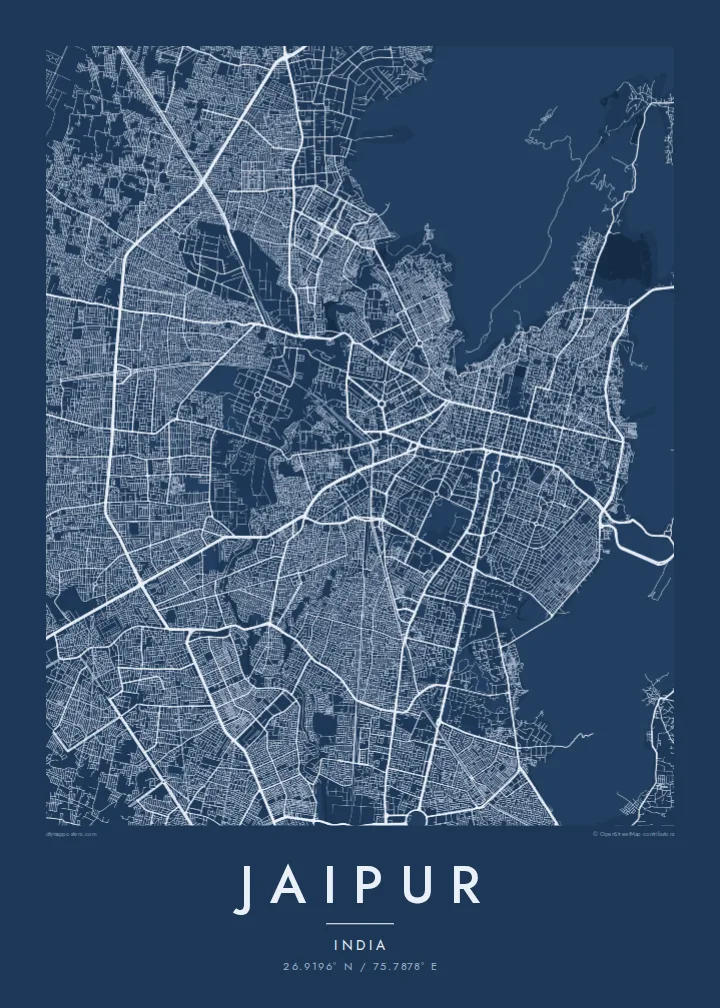
Straight, wide streets cross the old town at right angles and divide it into large blocks. It is one of the clearest planned patterns of any historic city.
Posta faʻafanua faigofie · India
26.9196° N / 75.7878° E
An eighteenth-century grid city, walled and pink, set against the Aravalli ridges with forts along the skyline.



Tasi le aai, lagona e lima
Tapi se sitaili e vaai ai i luga o le puipui. E tutusa uma le tau o sitaili — pe lolomiina, faapipiiina, pe avea ma faila HD.
 Pika Moni · Faila Lolomi 24 × 36″
Manino mo le lolomi
O se vaega atoa (100%) lenei mai le faila lolomi moni. O posita uma — pe lolomiina, faapipiiina pe download mai — e faia i luga o a matou server i le 300 DPI, e oo atu i le 7,200 × 10,800 pika, ina ia manino pea auala laiti i luga o se lolomiga 24 × 36″.
I luga o le puipui


Le faʻafanua
Jaipur was founded in 1727 by Maharaja Sawai Jai Singh II and built to a deliberate plan, one of the earliest of its kind in India. From above, the walled city is unmistakable. Wide, straight bazaar streets divide the old town into large rectangular blocks, an order rarely found in historic Indian cities, and the walled city is now a UNESCO World Heritage Site.
Its buildings are painted the terracotta pink that gives Jaipur its nickname, the Pink City. The City Palace occupies the centre. Beside it stands the Jantar Mantar, an eighteenth-century astronomical observatory and another UNESCO site, and the honeycombed facade of the Hawa Mahal faces onto one of the main streets.
To the north, the Aravalli hills close in. Nahargarh Fort runs along the ridge above the walled city, the Jal Mahal stands in Man Sagar Lake, and the road continues toward Amer Fort. A Jaipur map poster sets the grid of the old town against these hills, with the modern city spreading south and west.
Straight, wide streets cross the old town at right angles and divide it into large blocks. It is one of the clearest planned patterns of any historic city.
At the heart of the grid, the palace, its courtyards and the neighbouring Jantar Mantar form a large, distinct precinct that anchors the centre of the map.
Hills and forts rise along the north of the city, with Nahargarh on the ridge and Man Sagar Lake below. They form a natural frame for the regular streets.
Fai mo oe
Faʻaopoopo se aso, se igoa po o sau lava upu, sui le sitaili, lapoʻa po o le itu.
O le preview e leai se totogi e maualalo le resolution ma iai se watermark. O lolomi ma faila HD e faia i le 300 DPI, e oo atu i le 7,200 × 10,800 px, e aunoa ma se watermark.
Aisea Jaipur
Jaipur is hung by people who love its design as much as its history: architects, travellers and families with roots in Rajasthan. The grid of the walled city looks remarkably modern on a wall, almost like a planning drawing.
Personalise the title and subtitle, perhaps with a wedding date or a family name, and edit the coordinates. Sand and Paper suit the Pink City, while Noir, Blueprint and Classic black & white give crisper contrast. Printed posters ship from partners in 30+ countries.
Faatau le posita Jaipur| Lapoʻa lolomi | Manino | Faila |
|---|---|---|
| 30 × 40 cm11.8 × 15.7″ | 3,543 × 4,724 px | PNG · PDF |
| 29.7 × 42 cm (A3)11.7 × 16.5″ | 3,508 × 4,961 px | PNG · PDF |
| 42 × 59.4 cm (A2)16.5 × 23.4″ | 4,961 × 7,016 px | PNG · PDF |
| 45.7 × 61 cm18 × 24″ | 5,400 × 7,200 px | PNG · PDF |
| 50 × 70 cm19.7 × 27.6″ | 5,906 × 8,268 px | PNG · PDF |
| 61 × 91.4 cm24 × 36″ | 7,200 × 10,800 px | PNG · PDF |
Ae faʻatusatusa, o le faʻataʻitaʻiga e leai se totogi e 900 px le lautele, e iai le faʻailoga vai ma e mo mata. O faila HD e oʻo atu i le 8× le manino i itu taʻitasi ma e lolomi manino i le lapoʻa atoa o le posta.
Filifili se sitaili i le pito i luga o le itulau, ona filifili lea o le Posita Lolomi — se lapopoa ma, afai e te fiafia, se faavaa — po o Faila HD Numera. E na o le tasi laasaga o le Checkout, ma o le a fesuia'i lou itulau o oka i le taimi lava e mae'a ai le totogi.
E lolomiina i luga o pepa matte maualuga le tulaga e 200 gsm, i se tasi o lapopoa e ono, mai le 30 × 40 cm i le 24 × 36″. E amata le tau o posita lolomi mai le $39, aofia ai le auina atu.
Ioe. Filifili se faavaa laau malosi i le lanu uliuli, sina, oak masani, po o le laau pogisa. E aofia ai se tioata e le gau ma ua saunia e tautau i luga. E amata le tau o posita faavaa mai le $99, aofia ai le auina atu.
E leai se totogi o le auina atu i atunuu e 60+. O pepa ata taʻitasi e lolomiina e le tasi o matou paaga lolomi e latalata mai i atunuu e 30+, ma e masani ona taunuu i le 3–7 aso faigaluega. E mafai ona e mulimulitaia le tulaga ma le sailiga i lalo o My Orders. O nisi atunuu e 2–5 vaiaso, ma i nofoaga e lei matou auina atu iai, e taʻu atu e le saite ia te oe a o lei totogi.
Auina mai se ata i totonu o le 14 aso talu ona taunuu, ma o le a matou toe lolomiina e leai se totogi po o le toe faafoi atu lau tupe.
Ioe. I totonu o le editor i lenei itulau, suia le ulutala, le ulutala laititi ma le laina o coordinates i soo se mea e te fiafia i ai, ma filifili se sitaili ma le lapopoa. O oka lolomi, faavaa ma numera e faaaoga uma lava lau mamanu.
Mo le $9 e te maua ai faila PNG 300 DPI ma PDF ua saunia mo le lolomi i lapopoa uma e ono, e aunoa ma se watermark, e mafai ona lolomi i soo se mea. Le mautinoa lava? Download muamua se preview e leai se totogi ma le watermark.
Latalata ane
