The Marne loop
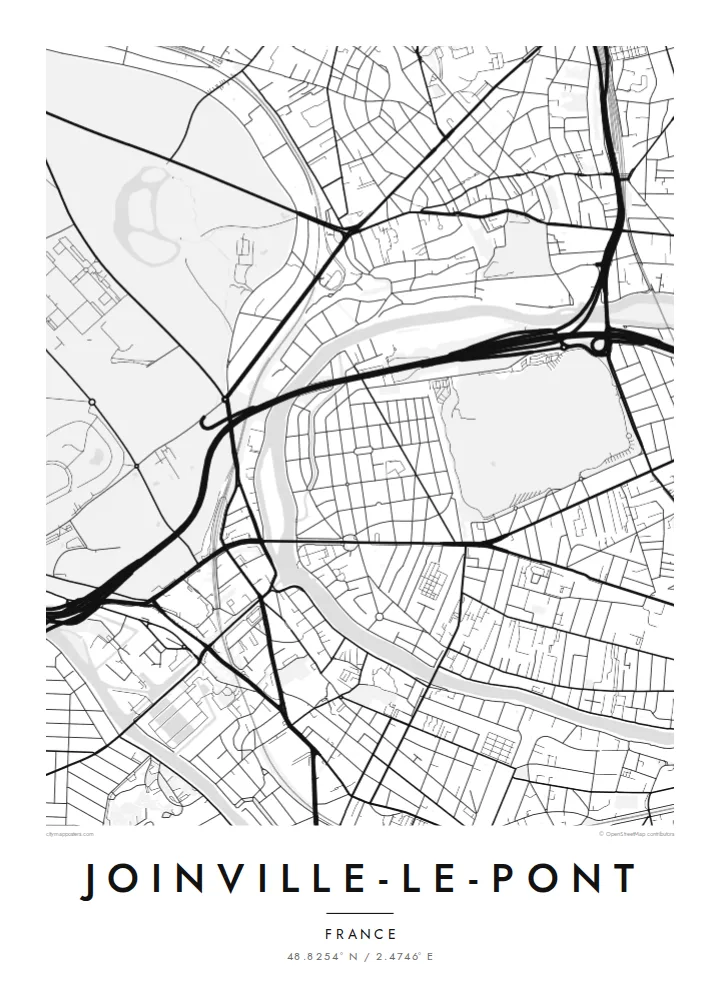
The river sweeps around the town in a broad curve, and its long islands and side channels draw a double line of water that stands out clearly in black and white.
Posta faʻafanua faigofie · France
48.8254° N / 2.4746° E
A riverside suburb folded into a bend of the Marne, with wooded parkland to the north and islands resting mid-channel


Tasi le aai, lagona e lima
Tapi se sitaili e vaai ai i luga o le puipui. E tutusa uma le tau o sitaili — pe lolomiina, faapipiiina, pe avea ma faila HD.
 Pika Moni · Faila Lolomi 24 × 36″
Manino mo le lolomi
O se vaega atoa (100%) lenei mai le faila lolomi moni. O posita uma — pe lolomiina, faapipiiina pe download mai — e faia i luga o a matou server i le 300 DPI, e oo atu i le 7,200 × 10,800 pika, ina ia manino pea auala laiti i luga o se lolomiga 24 × 36″.
I luga o le puipui


Le faʻafanua
Joinville-le-Pont sits just southeast of Paris, where the Marne makes one of its loops before joining the Seine. From above, the river is the defining stroke. It curves along the town's edge, and slim islands split the current into parallel channels. On the far side, the neighbourhoods of the next communes continue the same fine-grained street pattern.
The town takes its name from its bridge, and a crossing has stood here for centuries. In the twentieth century Joinville became known for its film studios, where a good share of French cinema was shot. The riverbanks were also known for the guinguettes, open-air dance halls where Parisians came on weekends to eat, dance and row on the water.
A Joinville-le-Pont map poster shows how tightly the town is framed. The dense greenery of the Bois de Vincennes lies to the north, the Marne wraps around the south and east, and rail and road lines cut across in between. The result is a compact, legible composition in which water, woodland and streets each take up a clear share of the sheet.
The river sweeps around the town in a broad curve, and its long islands and side channels draw a double line of water that stands out clearly in black and white.
To the north, the open mass of the Bois de Vincennes meets the street grid. It gives the map a large calm field that balances the busier residential blocks.
The crossing that gave the town its name ties both banks together, and roads converge on it from several directions like spokes.
Fai mo oe
Faʻaopoopo se aso, se igoa po o sau lava upu, sui le sitaili, lapoʻa po o le itu.
O le preview e leai se totogi e maualalo le resolution ma iai se watermark. O lolomi ma faila HD e faia i le 300 DPI, e oo atu i le 7,200 × 10,800 px, e aunoa ma se watermark.
Aisea Joinville-le-Pont
For people who grew up by the Marne or spent summer evenings along its banks, this map brings back a very specific landscape: water, trees and the short trip out from Paris. It suits a hallway or a study, where the river's curve reads well from across the room.
You can add your own title, subtitle and coordinates line, perhaps a street name or the year you moved in. Then pick one of five styles: Classic black & white, Noir, Paper, Blueprint or Sand. The digital files cost $9, and printed posters are also available.
Faatau le posita Joinville-le-Pont| Lapoʻa lolomi | Manino | Faila |
|---|---|---|
| 30 × 40 cm11.8 × 15.7″ | 3,543 × 4,724 px | PNG · PDF |
| 29.7 × 42 cm (A3)11.7 × 16.5″ | 3,508 × 4,961 px | PNG · PDF |
| 42 × 59.4 cm (A2)16.5 × 23.4″ | 4,961 × 7,016 px | PNG · PDF |
| 45.7 × 61 cm18 × 24″ | 5,400 × 7,200 px | PNG · PDF |
| 50 × 70 cm19.7 × 27.6″ | 5,906 × 8,268 px | PNG · PDF |
| 61 × 91.4 cm24 × 36″ | 7,200 × 10,800 px | PNG · PDF |
Ae faʻatusatusa, o le faʻataʻitaʻiga e leai se totogi e 900 px le lautele, e iai le faʻailoga vai ma e mo mata. O faila HD e oʻo atu i le 8× le manino i itu taʻitasi ma e lolomi manino i le lapoʻa atoa o le posta.
Filifili se sitaili i le pito i luga o le itulau, ona filifili lea o le Posita Lolomi — se lapopoa ma, afai e te fiafia, se faavaa — po o Faila HD Numera. E na o le tasi laasaga o le Checkout, ma o le a fesuia'i lou itulau o oka i le taimi lava e mae'a ai le totogi.
E lolomiina i luga o pepa matte maualuga le tulaga e 200 gsm, i se tasi o lapopoa e ono, mai le 30 × 40 cm i le 24 × 36″. E amata le tau o posita lolomi mai le $39, aofia ai le auina atu.
Ioe. Filifili se faavaa laau malosi i le lanu uliuli, sina, oak masani, po o le laau pogisa. E aofia ai se tioata e le gau ma ua saunia e tautau i luga. E amata le tau o posita faavaa mai le $99, aofia ai le auina atu.
E leai se totogi o le auina atu i atunuu e 60+. O pepa ata taʻitasi e lolomiina e le tasi o matou paaga lolomi e latalata mai i atunuu e 30+, ma e masani ona taunuu i le 3–7 aso faigaluega. E mafai ona e mulimulitaia le tulaga ma le sailiga i lalo o My Orders. O nisi atunuu e 2–5 vaiaso, ma i nofoaga e lei matou auina atu iai, e taʻu atu e le saite ia te oe a o lei totogi.
Auina mai se ata i totonu o le 14 aso talu ona taunuu, ma o le a matou toe lolomiina e leai se totogi po o le toe faafoi atu lau tupe.
Ioe. I totonu o le editor i lenei itulau, suia le ulutala, le ulutala laititi ma le laina o coordinates i soo se mea e te fiafia i ai, ma filifili se sitaili ma le lapopoa. O oka lolomi, faavaa ma numera e faaaoga uma lava lau mamanu.
Mo le $9 e te maua ai faila PNG 300 DPI ma PDF ua saunia mo le lolomi i lapopoa uma e ono, e aunoa ma se watermark, e mafai ona lolomi i soo se mea. Le mautinoa lava? Download muamua se preview e leai se totogi ma le watermark.
Latalata ane
