Mining lakes
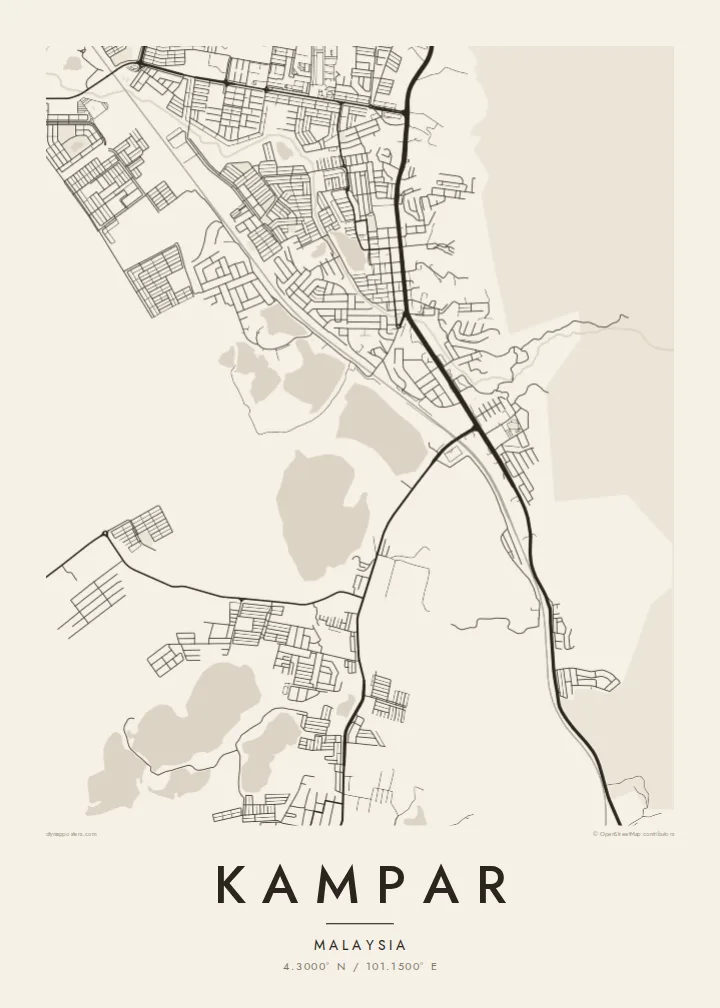
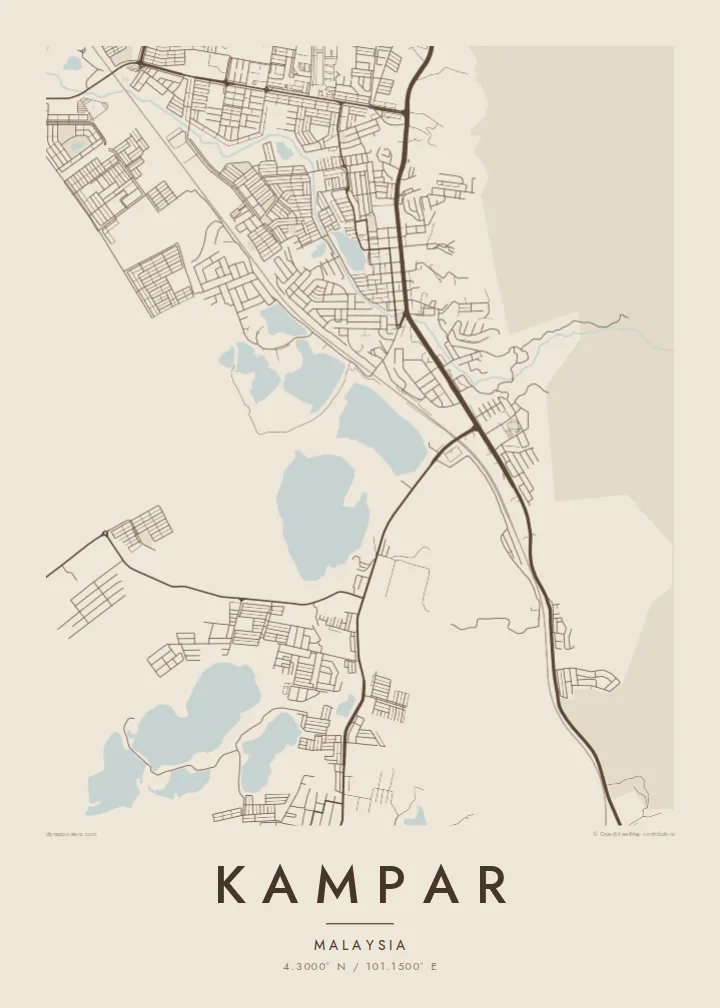
Former tin mines have become lakes of irregular shape scattered around the town. They make the print's most unusual pattern and recall Kampar's mining past.
Posta faʻafanua faigofie · Malaysia
4.3000° N / 101.1500° E
A former tin-mining town in Perak's Kinta Valley, its old shophouse streets surrounded by lakes left behind by the mines.



Tasi le aai, lagona e lima
Tapi se sitaili e vaai ai i luga o le puipui. E tutusa uma le tau o sitaili — pe lolomiina, faapipiiina, pe avea ma faila HD.
 Pika Moni · Faila Lolomi 24 × 36″
Manino mo le lolomi
O se vaega atoa (100%) lenei mai le faila lolomi moni. O posita uma — pe lolomiina, faapipiiina pe download mai — e faia i luga o a matou server i le 300 DPI, e oo atu i le 7,200 × 10,800 pika, ina ia manino pea auala laiti i luga o se lolomiga 24 × 36″.
I luga o le puipui


Le faʻafanua
Kampar lies at the southern end of the Kinta Valley in Perak, a district that grew rich from tin mining in the late nineteenth and early twentieth centuries. The mines have closed, but they left a mark on the map: the land around town is dotted with flooded mining pools, irregular lakes of many sizes that show as pale shapes on a black-and-white print.
The old town is a compact grid of shophouse streets that forms the historic commercial centre. Newer residential areas and the campus of Universiti Tunku Abdul Rahman have grown up to one side. The university brought a large student population and a new pattern of broad, planned streets that sits clearly apart from the tighter blocks of the old centre.
The forested slopes of the Main Range rise to the east, and the North–South Expressway passes nearby. A Kampar map poster captures a place reshaped twice, first by mining and then by a university, with water, old streets and new ones all visible on the same sheet.
Former tin mines have become lakes of irregular shape scattered around the town. They make the print's most unusual pattern and recall Kampar's mining past.
The historic centre is laid out as a compact grid of shophouse streets, a dense rectangular pattern that stands at the heart of the map.
The UTAR campus and its surrounding new town add wide, planned streets and larger blocks, clearly distinct from the older layout of Kampar's centre.
Fai mo oe
Faʻaopoopo se aso, se igoa po o sau lava upu, sui le sitaili, lapoʻa po o le itu.
O le preview e leai se totogi e maualalo le resolution ma iai se watermark. O lolomi ma faila HD e faia i le 300 DPI, e oo atu i le 7,200 × 10,800 px, e aunoa ma se watermark.
Aisea Kampar
Kampar means different things to different people: a hometown, a mining history, or the place where years at university were spent. A map works for all of them, and you can personalise the title, subtitle and coordinates line with a name, a graduation year or a family date.
The mining lakes look especially strong in Noir and Blueprint, and Paper and Sand soften them. Classic black & white is a clean middle ground. Get the HD files for $9 in six sizes, or order a matte printed poster shipped from a partner near you.
Faatau le posita Kampar| Lapoʻa lolomi | Manino | Faila |
|---|---|---|
| 30 × 40 cm (11.8 × 15.7″) | 3,543 × 4,724 px | PNG · PDF |
| 29.7 × 42 cm (A3, 11.7 × 16.5″) | 3,508 × 4,961 px | PNG · PDF |
| 42 × 59.4 cm (A2, 16.5 × 23.4″) | 4,961 × 7,016 px | PNG · PDF |
| 45.7 × 61 cm (18 × 24″) | 5,400 × 7,200 px | PNG · PDF |
| 50 × 70 cm (19.7 × 27.6″) | 5,906 × 8,268 px | PNG · PDF |
| 61 × 91.4 cm (24 × 36″) | 7,200 × 10,800 px | PNG · PDF |
Ae faʻatusatusa, o le faʻataʻitaʻiga e leai se totogi e 900 px le lautele, e iai le faʻailoga vai ma e mo mata. O faila HD e oʻo atu i le 8× le manino i itu taʻitasi ma e lolomi manino i le lapoʻa atoa o le posta.
Filifili se sitaili i le pito i luga o le itulau, ona filifili lea o le Posita Lolomi — se lapopoa ma, afai e te fiafia, se faavaa — po o Faila HD Numera. E na o le tasi laasaga o le Checkout, ma o le a fesuia'i lou itulau o oka i le taimi lava e mae'a ai le totogi.
E lolomiina i luga o pepa matte maualuga le tulaga e 200 gsm, i se tasi o lapopoa e ono, mai le 30 × 40 cm i le 24 × 36″. E amata le tau o posita lolomi mai le $39, aofia ai le auina atu.
Ioe. Filifili se faavaa laau malosi i le lanu uliuli, sina, oak masani, po o le laau pogisa. E aofia ai se tioata e le gau ma ua saunia e tautau i luga. E amata le tau o posita faavaa mai le $99, aofia ai le auina atu.
E leai se totogi mo le uta i le lalolagi atoa. O poster ta'itasi e lolomi e le paaga lolomi e latalata mai i matou i atunuu e 30+, ma e masani ona taunuu i aso faigaluega e 3–7. E mafai ona e mulimuli i le tulaga ma le tracking i le "Aʻu Oka". O nisi atunuu e 2–5 vaiaso, ma i atunuu matou te lei tuuina atu ai, e taʻu atu e le saite iā te oe ae e te leʻi totogiina.
Auina mai se ata i totonu o le 14 aso talu ona taunuu, ma o le a matou toe lolomiina e leai se totogi po o le toe faafoi atu lau tupe.
Ioe. I totonu o le editor i lenei itulau, suia le ulutala, le ulutala laititi ma le laina o coordinates i soo se mea e te fiafia i ai, ma filifili se sitaili ma le lapopoa. O oka lolomi, faavaa ma numera e faaaoga uma lava lau mamanu.
Mo le $9 e te maua ai faila PNG 300 DPI ma PDF ua saunia mo le lolomi i lapopoa uma e ono, e aunoa ma se watermark, e mafai ona lolomi i soo se mea. Le mautinoa lava? Download muamua se preview e leai se totogi ma le watermark.
