Bayside edge
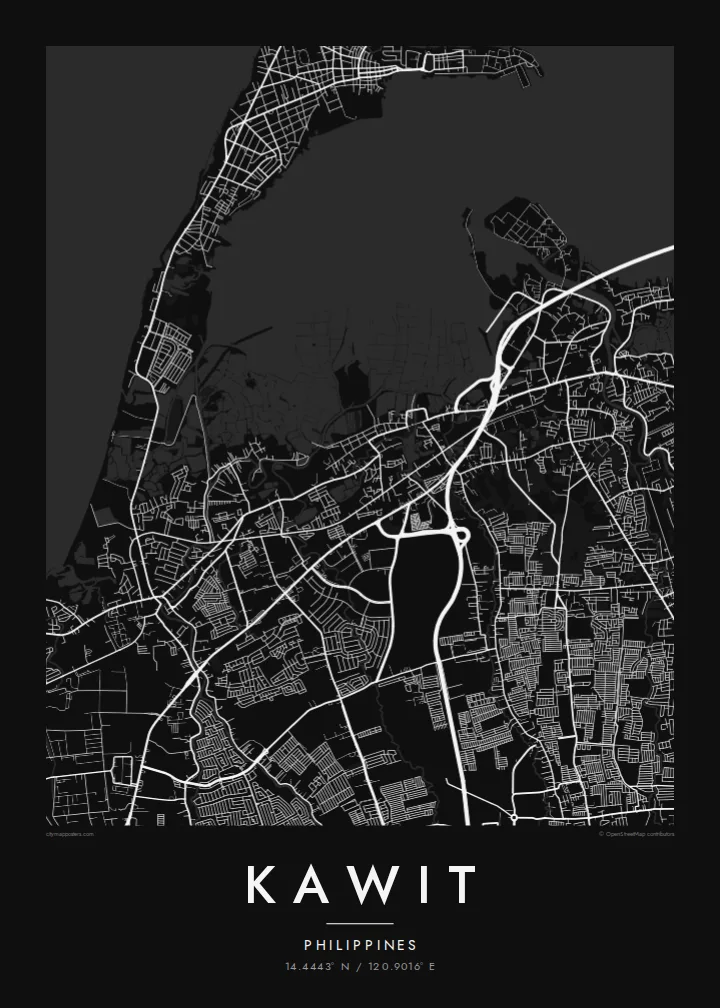
The northern side of the map dissolves into Manila Bay through channels, inlets and fishpond grids, giving the coastline a broken, layered outline instead of a single sweep.
Posta faʻafanua faigofie · Philippines
14.4443° N / 120.9016° E
A low coastal town on the southern shore of Manila Bay, where river mouths, fishponds and old roads meet the water.



Tasi le aai, lagona e lima
Tapi se sitaili e vaai ai i luga o le puipui. E tutusa uma le tau o sitaili — pe lolomiina, faapipiiina, pe avea ma faila HD.
 Pika Moni · Faila Lolomi 24 × 36″
Manino mo le lolomi
O se vaega atoa (100%) lenei mai le faila lolomi moni. O posita uma — pe lolomiina, faapipiiina pe download mai — e faia i luga o a matou server i le 300 DPI, e oo atu i le 7,200 × 10,800 pika, ina ia manino pea auala laiti i luga o se lolomiga 24 × 36″.
I luga o le puipui


Le faʻafanua
Kawit sits on the flat edge of Cavite, where the land runs out into the shallow waters of Manila Bay. From above, the town is cut by estuaries and tidal channels. Rectangular fishponds and low ground fill the space between the settled streets and the shoreline, so the coast is ragged and watery rather than a clean line.
The town is best known as the birthplace of Emilio Aguinaldo. Philippine independence was proclaimed from the balcony of his family home on 12 June 1898. That house, now the Aguinaldo Shrine, still stands in the old centre. A Kawit map poster places that date inside its real geography: a close grid of lanes near the church, set against the bay.
Further inland, the map fills with the denser, newer fabric of the Cavite corridor. Subdivisions, highways and roads toward Manila tie Kawit to the wider metropolitan region. In black and white, the contrast is easy to read. On one side sits a fine-grained coastal town. On the other, the broad strokes of roads leading north toward the capital.
The northern side of the map dissolves into Manila Bay through channels, inlets and fishpond grids, giving the coastline a broken, layered outline instead of a single sweep.
The older centre, around the Aguinaldo Shrine and the parish church, shows the tighter street pattern of a Spanish-era town, set among later growth.
Narrow rivers and creeks wind toward the bay, separating neighbourhoods and giving the poster fine white lines that pull the eye toward the coast.
Fai mo oe
Faʻaopoopo se aso, se igoa po o sau lava upu, sui le sitaili, lapoʻa po o le itu.
O le preview e leai se totogi e maualalo le resolution ma iai se watermark. O lolomi ma faila HD e faia i le 300 DPI, e oo atu i le 7,200 × 10,800 px, e aunoa ma se watermark.
Aisea Kawit
Kawit means something specific to Filipinos: independence, family roots in Cavite, or a childhood spent near the bay. A map of the town is a quiet way to keep that close without turning it into a souvenir.
You can set your own title, add a subtitle such as 1898 or a family date, and choose Classic black & white, Noir, Paper, Blueprint or Sand. It comes as a $9 HD download in six sizes, or as a printed matte poster with an optional wooden frame.
Faatau le posita Kawit| Lapoʻa lolomi | Manino | Faila |
|---|---|---|
| 30 × 40 cm11.8 × 15.7″ | 3,543 × 4,724 px | PNG · PDF |
| 29.7 × 42 cm (A3)11.7 × 16.5″ | 3,508 × 4,961 px | PNG · PDF |
| 42 × 59.4 cm (A2)16.5 × 23.4″ | 4,961 × 7,016 px | PNG · PDF |
| 45.7 × 61 cm18 × 24″ | 5,400 × 7,200 px | PNG · PDF |
| 50 × 70 cm19.7 × 27.6″ | 5,906 × 8,268 px | PNG · PDF |
| 61 × 91.4 cm24 × 36″ | 7,200 × 10,800 px | PNG · PDF |
Ae faʻatusatusa, o le faʻataʻitaʻiga e leai se totogi e 900 px le lautele, e iai le faʻailoga vai ma e mo mata. O faila HD e oʻo atu i le 8× le manino i itu taʻitasi ma e lolomi manino i le lapoʻa atoa o le posta.
Filifili se sitaili i le pito i luga o le itulau, ona filifili lea o le Posita Lolomi — se lapopoa ma, afai e te fiafia, se faavaa — po o Faila HD Numera. E na o le tasi laasaga o le Checkout, ma o le a fesuia'i lou itulau o oka i le taimi lava e mae'a ai le totogi.
E lolomiina i luga o pepa matte maualuga le tulaga e 200 gsm, i se tasi o lapopoa e ono, mai le 30 × 40 cm i le 24 × 36″. E amata le tau o posita lolomi mai le $39, aofia ai le auina atu.
Ioe. Filifili se faavaa laau malosi i le lanu uliuli, sina, oak masani, po o le laau pogisa. E aofia ai se tioata e le gau ma ua saunia e tautau i luga. E amata le tau o posita faavaa mai le $99, aofia ai le auina atu.
E leai se totogi o le auina atu i atunuu e 60+. O pepa ata taʻitasi e lolomiina e le tasi o matou paaga lolomi e latalata mai i atunuu e 30+, ma e masani ona taunuu i le 3–7 aso faigaluega. E mafai ona e mulimulitaia le tulaga ma le sailiga i lalo o My Orders. O nisi atunuu e 2–5 vaiaso, ma i nofoaga e lei matou auina atu iai, e taʻu atu e le saite ia te oe a o lei totogi.
Auina mai se ata i totonu o le 14 aso talu ona taunuu, ma o le a matou toe lolomiina e leai se totogi po o le toe faafoi atu lau tupe.
Ioe. I totonu o le editor i lenei itulau, suia le ulutala, le ulutala laititi ma le laina o coordinates i soo se mea e te fiafia i ai, ma filifili se sitaili ma le lapopoa. O oka lolomi, faavaa ma numera e faaaoga uma lava lau mamanu.
Mo le $9 e te maua ai faila PNG 300 DPI ma PDF ua saunia mo le lolomi i lapopoa uma e ono, e aunoa ma se watermark, e mafai ona lolomi i soo se mea. Le mautinoa lava? Download muamua se preview e leai se totogi ma le watermark.
