Reclaimed steelworks
The steelworks sits on a huge rectangle of reclaimed land, and its straight edges and grid of internal roads make it the most striking shape on the map.
Posta faʻafanua faigofie · South Korea
34.9753° N / 127.5892° E
A steel and port city around Gwangyang Bay, where reclaimed industrial land meets the mouth of the Seomjin River.


Tasi le aai, lagona e lima
Tapi se sitaili e vaai ai i luga o le puipui. E tutusa uma le tau o sitaili — pe lolomiina, faapipiiina, pe avea ma faila HD.
 Pika Moni · Faila Lolomi 24 × 36″
Manino mo le lolomi
O se vaega atoa (100%) lenei mai le faila lolomi moni. O posita uma — pe lolomiina, faapipiiina pe download mai — e faia i luga o a matou server i le 300 DPI, e oo atu i le 7,200 × 10,800 pika, ina ia manino pea auala laiti i luga o se lolomiga 24 × 36″.
I luga o le puipui

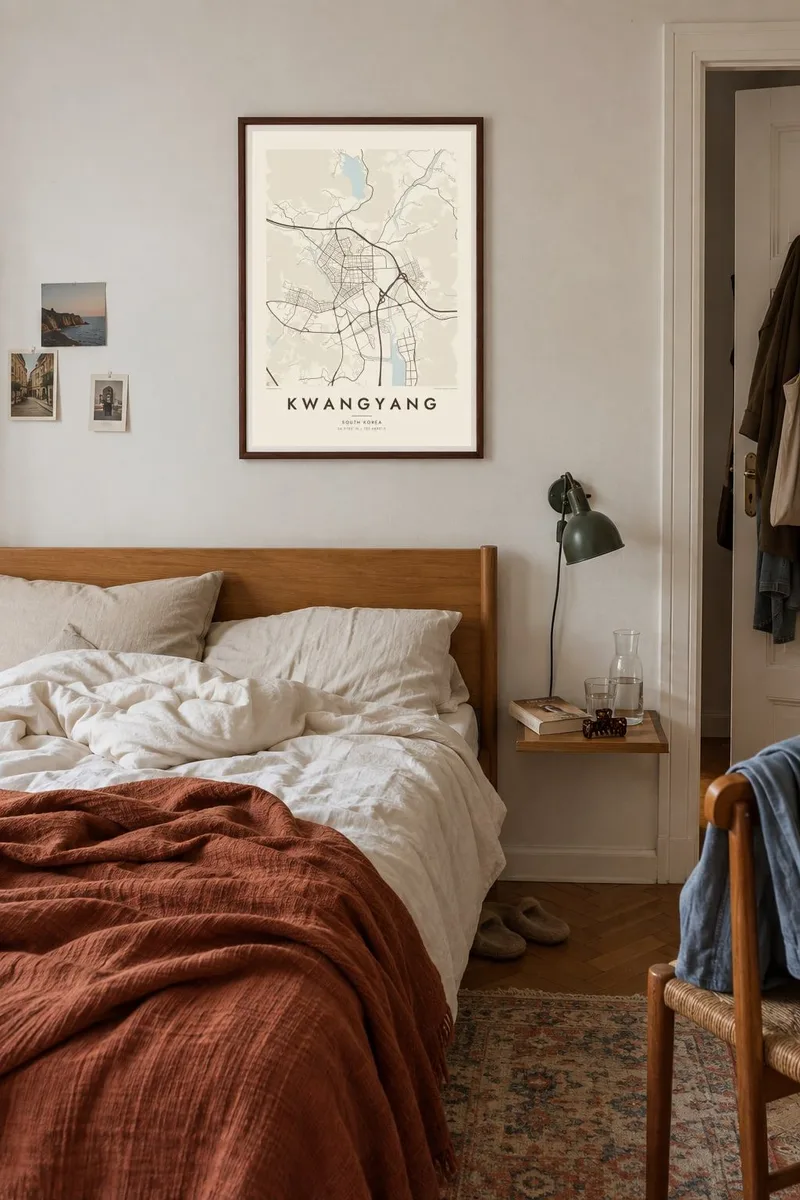

Le faʻafanua
Kwangyang, more often spelled Gwangyang, sits on the south coast of South Korea in South Jeolla province, facing a sheltered bay. It is best known for one of the world's largest steelworks, built on land reclaimed from the bay, and for a container port that handles much of the region's shipping.
That industrial side is obvious from above. The steelworks takes up a large, geometric block of flat land at the water's edge, with straight quays and roads. Across the bay, the Yi Sun-sin Bridge links Gwangyang to the Yeosu peninsula. To the east, the Seomjin River reaches the sea, and the older town and newer residential districts lie inland at the foot of the hills.
A Gwangyang map poster is unusually graphic because of that mix. Sharp reclaimed shorelines and long piers contrast with the soft line of the river and the curving streets of the residential areas. Inland, the town is also known for spring plum blossom along the Seomjin valley, which shows the gentler side of a place usually defined by steel.
The steelworks sits on a huge rectangle of reclaimed land, and its straight edges and grid of internal roads make it the most striking shape on the map.
A long suspension bridge crosses the bay toward Yeosu, a thin, precise line joining two coasts across open water.
On the eastern side, the Seomjin River widens as it meets the bay, adding a natural curve next to the engineered coastline.
Fai mo oe
Faʻaopoopo se aso, se igoa po o sau lava upu, sui le sitaili, lapoʻa po o le itu.
O le preview e leai se totogi e maualalo le resolution ma iai se watermark. O lolomi ma faila HD e faia i le 300 DPI, e oo atu i le 7,200 × 10,800 px, e aunoa ma se watermark.
Aisea Kwangyang
Gwangyang means different things to different people: steelworkers, port staff, families who moved there for work, and visitors who come for the spring blossom. Its map combines industry and landscape in a way few cities can.
Personalise the title, subtitle and coordinates line, perhaps with a start date or a family name, and choose from five styles: Classic black & white, Noir, Paper, Blueprint and Sand. Order a printed poster or download HD files for $9.
Faatau le posita Kwangyang| Lapoʻa lolomi | Manino | Faila |
|---|---|---|
| 30 × 40 cm11.8 × 15.7″ | 3,543 × 4,724 px | PNG · PDF |
| 29.7 × 42 cm (A3)11.7 × 16.5″ | 3,508 × 4,961 px | PNG · PDF |
| 42 × 59.4 cm (A2)16.5 × 23.4″ | 4,961 × 7,016 px | PNG · PDF |
| 45.7 × 61 cm18 × 24″ | 5,400 × 7,200 px | PNG · PDF |
| 50 × 70 cm19.7 × 27.6″ | 5,906 × 8,268 px | PNG · PDF |
| 61 × 91.4 cm24 × 36″ | 7,200 × 10,800 px | PNG · PDF |
Ae faʻatusatusa, o le faʻataʻitaʻiga e leai se totogi e 900 px le lautele, e iai le faʻailoga vai ma e mo mata. O faila HD e oʻo atu i le 8× le manino i itu taʻitasi ma e lolomi manino i le lapoʻa atoa o le posta.
Filifili se sitaili i le pito i luga o le itulau, ona filifili lea o le Posita Lolomi — se lapopoa ma, afai e te fiafia, se faavaa — po o Faila HD Numera. E na o le tasi laasaga o le Checkout, ma o le a fesuia'i lou itulau o oka i le taimi lava e mae'a ai le totogi.
E lolomiina i luga o pepa matte maualuga le tulaga e 200 gsm, i se tasi o lapopoa e ono, mai le 30 × 40 cm i le 24 × 36″. E amata le tau o posita lolomi mai le $39, aofia ai le auina atu.
Ioe. Filifili se faavaa laau malosi i le lanu uliuli, sina, oak masani, po o le laau pogisa. E aofia ai se tioata e le gau ma ua saunia e tautau i luga. E amata le tau o posita faavaa mai le $99, aofia ai le auina atu.
E leai se totogi o le auina atu i atunuu e 60+. O pepa ata taʻitasi e lolomiina e le tasi o matou paaga lolomi e latalata mai i atunuu e 30+, ma e masani ona taunuu i le 3–7 aso faigaluega. E mafai ona e mulimulitaia le tulaga ma le sailiga i lalo o My Orders. O nisi atunuu e 2–5 vaiaso, ma i nofoaga e lei matou auina atu iai, e taʻu atu e le saite ia te oe a o lei totogi.
Auina mai se ata i totonu o le 14 aso talu ona taunuu, ma o le a matou toe lolomiina e leai se totogi po o le toe faafoi atu lau tupe.
Ioe. I totonu o le editor i lenei itulau, suia le ulutala, le ulutala laititi ma le laina o coordinates i soo se mea e te fiafia i ai, ma filifili se sitaili ma le lapopoa. O oka lolomi, faavaa ma numera e faaaoga uma lava lau mamanu.
Mo le $9 e te maua ai faila PNG 300 DPI ma PDF ua saunia mo le lolomi i lapopoa uma e ono, e aunoa ma se watermark, e mafai ona lolomi i soo se mea. Le mautinoa lava? Download muamua se preview e leai se totogi ma le watermark.
Latalata ane
