Cité Plantagenêt
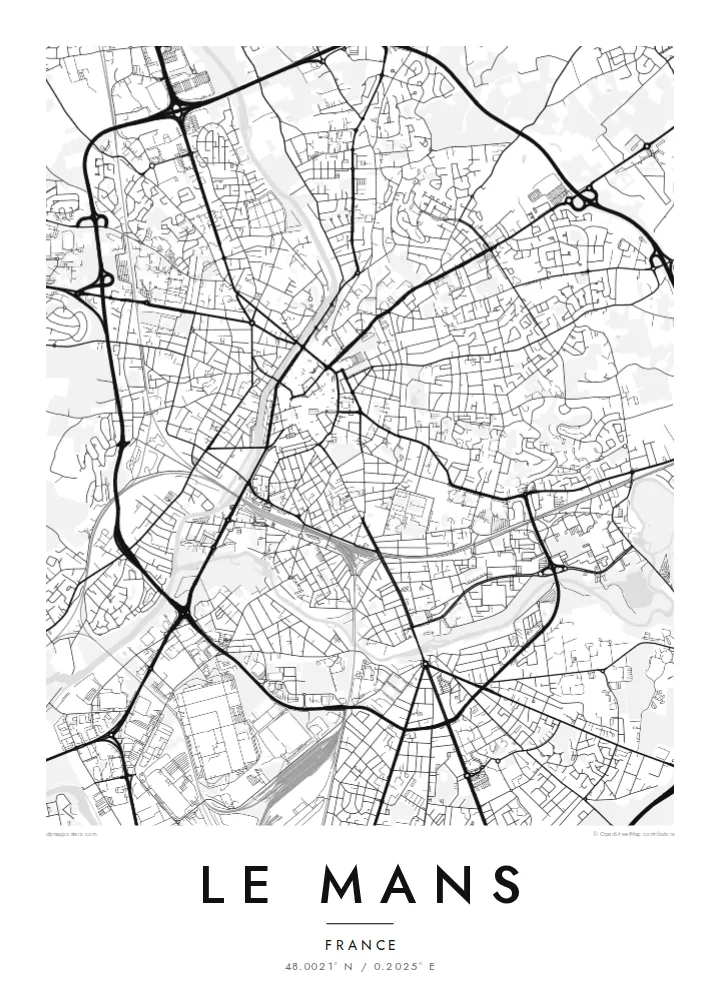
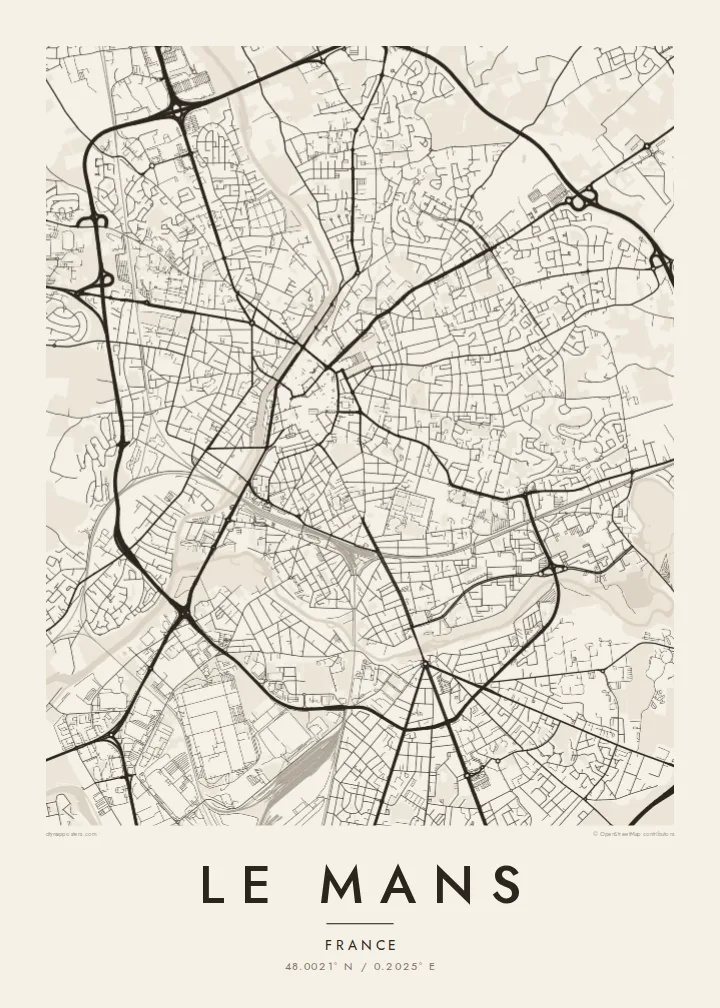
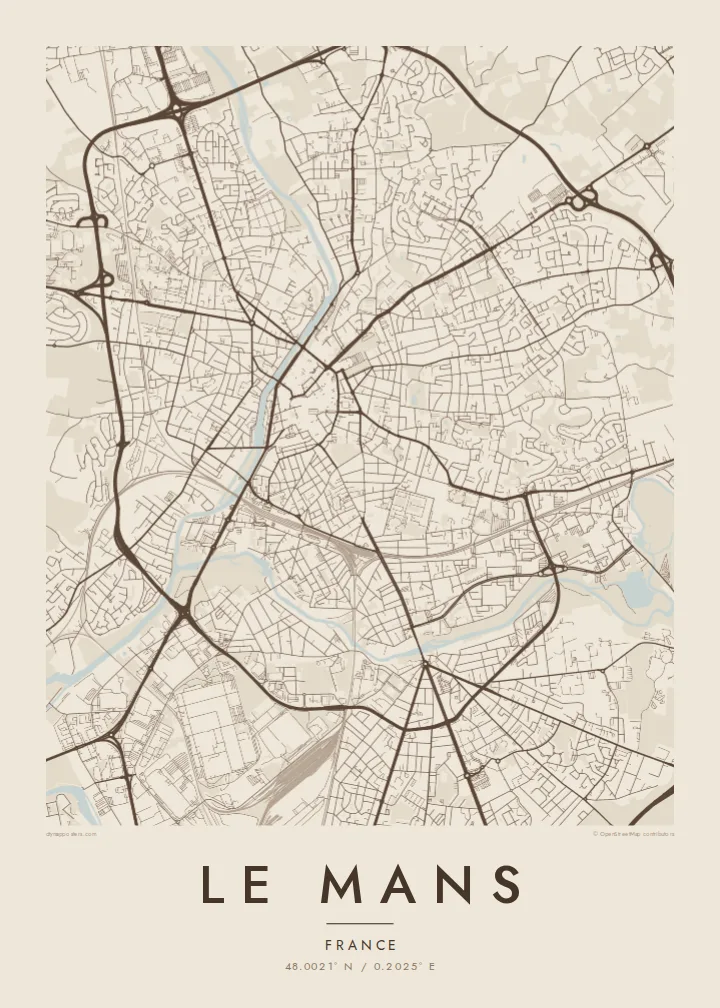
The old walled quarter forms a compact, irregular cluster of lanes on the high ground above the Sarthe, clearly different from the wider boulevards of the later city around it.
Posta faʻafanua faigofie · France
48.0021° N / 0.2025° E
A walled old town above the Sarthe, streets radiating outwards, and a racing circuit curving through the countryside to the south


Tasi le aai, lagona e lima
Tapi se sitaili e vaai ai i luga o le puipui. E tutusa uma le tau o sitaili — pe lolomiina, faapipiiina, pe avea ma faila HD.
 Pika Moni · Faila Lolomi 24 × 36″
Manino mo le lolomi
O se vaega atoa (100%) lenei mai le faila lolomi moni. O posita uma — pe lolomiina, faapipiiina pe download mai — e faia i luga o a matou server i le 300 DPI, e oo atu i le 7,200 × 10,800 pika, ina ia manino pea auala laiti i luga o se lolomiga 24 × 36″.
I luga o le puipui


Le faʻafanua
Le Mans grew on a ridge above the east bank of the Sarthe, close to where the Huisne flows in from the east. Seen from above, the old core is a tight, irregular knot of lanes on the high ground by the river. From there, boulevards and later districts spread out in rough rings, and a tram line traces a long arc through the modern city.
The Cité Plantagenêt, the medieval quarter, sits inside one of the best-preserved Gallo-Roman city walls in Europe, and the Cathédrale Saint-Julien rises at its northern end. South of the city, public roads and a permanent track together form the Circuit de la Sarthe, where the 24 Hours of Le Mans endurance race has been held since 1923.
A Le Mans map poster keeps both identities in view. The dense medieval centre and the curve of the Sarthe hold the middle of the frame, while wider views bring in the long straights and sweeping bends of the circuit at the southern edge. Bridges tie the two banks together, and the meeting of the two rivers gives the lower part of the city its shape.
The old walled quarter forms a compact, irregular cluster of lanes on the high ground above the Sarthe, clearly different from the wider boulevards of the later city around it.
The Sarthe runs north to south through the city, and the Huisne joins it from the east. Together the two rivers give Le Mans a clear watery framework.
To the south, the race circuit’s long straight and wide curves can be traced along ordinary roads. It is a well-known line for anyone who follows motorsport.
Fai mo oe
Faʻaopoopo se aso, se igoa po o sau lava upu, sui le sitaili, lapoʻa po o le itu.
O le preview e leai se totogi e maualalo le resolution ma iai se watermark. O lolomi ma faila HD e faia i le 300 DPI, e oo atu i le 7,200 × 10,800 px, e aunoa ma se watermark.
Aisea Le Mans
Some people hang Le Mans for the cathedral and the medieval lanes, others for the June race weekend. Plenty want both. The map puts the two side by side without favouring either, which suits a hallway, a study or a garage wall.
Put a race year, a family name or the coordinates of a favourite spot in the title, subtitle and coordinates line. Then choose from five styles: Classic black & white, Noir, Paper, Blueprint or Sand.
Faatau le posita Le Mans| Lapoʻa lolomi | Manino | Faila |
|---|---|---|
| 30 × 40 cm11.8 × 15.7″ | 3,543 × 4,724 px | PNG · PDF |
| 29.7 × 42 cm (A3)11.7 × 16.5″ | 3,508 × 4,961 px | PNG · PDF |
| 42 × 59.4 cm (A2)16.5 × 23.4″ | 4,961 × 7,016 px | PNG · PDF |
| 45.7 × 61 cm18 × 24″ | 5,400 × 7,200 px | PNG · PDF |
| 50 × 70 cm19.7 × 27.6″ | 5,906 × 8,268 px | PNG · PDF |
| 61 × 91.4 cm24 × 36″ | 7,200 × 10,800 px | PNG · PDF |
Ae faʻatusatusa, o le faʻataʻitaʻiga e leai se totogi e 900 px le lautele, e iai le faʻailoga vai ma e mo mata. O faila HD e oʻo atu i le 8× le manino i itu taʻitasi ma e lolomi manino i le lapoʻa atoa o le posta.
Filifili se sitaili i le pito i luga o le itulau, ona filifili lea o le Posita Lolomi — se lapopoa ma, afai e te fiafia, se faavaa — po o Faila HD Numera. E na o le tasi laasaga o le Checkout, ma o le a fesuia'i lou itulau o oka i le taimi lava e mae'a ai le totogi.
E lolomiina i luga o pepa matte maualuga le tulaga e 200 gsm, i se tasi o lapopoa e ono, mai le 30 × 40 cm i le 24 × 36″. E amata le tau o posita lolomi mai le $39, aofia ai le auina atu.
Ioe. Filifili se faavaa laau malosi i le lanu uliuli, sina, oak masani, po o le laau pogisa. E aofia ai se tioata e le gau ma ua saunia e tautau i luga. E amata le tau o posita faavaa mai le $99, aofia ai le auina atu.
E leai se totogi o le auina atu i atunuu e 60+. O pepa ata taʻitasi e lolomiina e le tasi o matou paaga lolomi e latalata mai i atunuu e 30+, ma e masani ona taunuu i le 3–7 aso faigaluega. E mafai ona e mulimulitaia le tulaga ma le sailiga i lalo o My Orders. O nisi atunuu e 2–5 vaiaso, ma i nofoaga e lei matou auina atu iai, e taʻu atu e le saite ia te oe a o lei totogi.
Auina mai se ata i totonu o le 14 aso talu ona taunuu, ma o le a matou toe lolomiina e leai se totogi po o le toe faafoi atu lau tupe.
Ioe. I totonu o le editor i lenei itulau, suia le ulutala, le ulutala laititi ma le laina o coordinates i soo se mea e te fiafia i ai, ma filifili se sitaili ma le lapopoa. O oka lolomi, faavaa ma numera e faaaoga uma lava lau mamanu.
Mo le $9 e te maua ai faila PNG 300 DPI ma PDF ua saunia mo le lolomi i lapopoa uma e ono, e aunoa ma se watermark, e mafai ona lolomi i soo se mea. Le mautinoa lava? Download muamua se preview e leai se totogi ma le watermark.
Latalata ane
