The Seine meander
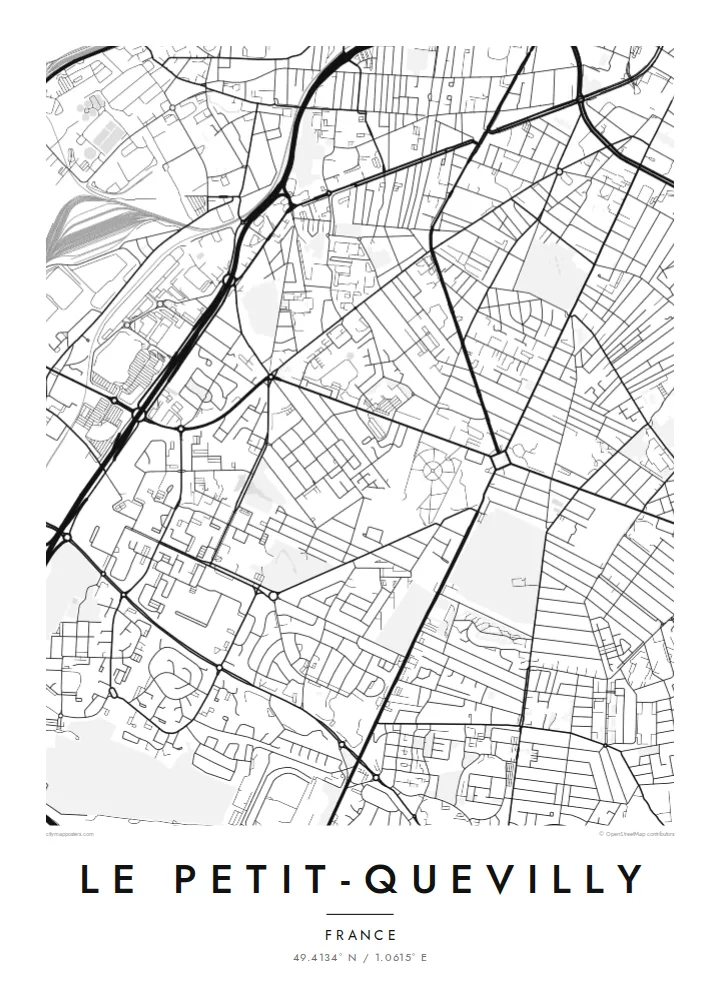
The river curves along the town's northern side, and the broad band of water with its quays anchors the composition against the dense streets.
Posta faʻafanua faigofie · France
49.4134° N / 1.0615° E
A dense Rouen suburb on the Seine's left bank, where terraced streets meet the river's industrial edge.


Tasi le aai, lagona e lima
Tapi se sitaili e vaai ai i luga o le puipui. E tutusa uma le tau o sitaili — pe lolomiina, faapipiiina, pe avea ma faila HD.
 Pika Moni · Faila Lolomi 24 × 36″
Manino mo le lolomi
O se vaega atoa (100%) lenei mai le faila lolomi moni. O posita uma — pe lolomiina, faapipiiina pe download mai — e faia i luga o a matou server i le 300 DPI, e oo atu i le 7,200 × 10,800 pika, ina ia manino pea auala laiti i luga o se lolomiga 24 × 36″.
I luga o le puipui


Le faʻafanua
Le Petit-Quevilly lies immediately south-west of central Rouen, on the left bank of the Seine. From above it reads as a continuous urban fabric: tightly packed residential streets, larger industrial plots near the river, and railway lines threading through. The Seine curves past in one of its long Normandy meanders, and the town occupies the inside of that bend.
The commune grew with Rouen's port and industry in the nineteenth century, when textile works and workshops brought workers across the river. Much of its street pattern dates from that expansion, with rows of modest houses along straight roads. The medieval Chapelle Saint-Julien, a surviving chapel with painted interiors, stands among later buildings as the town's oldest landmark.
A Le Petit-Quevilly map poster captures the texture of a working suburb: fine residential grain, heavier industrial blocks, and the broad sweep of the Seine along one edge. It suits people who live or grew up here and those who know Rouen's left bank as more than a view from the cathedral.
The river curves along the town's northern side, and the broad band of water with its quays anchors the composition against the dense streets.
Straight residential streets lined with small plots form a fine, regular grain, a pattern laid down as the town grew with Rouen's port industries.
Rail lines and large industrial parcels break up the residential fabric in bold shapes, giving the map a graphic contrast between small and large blocks.
Fai mo oe
Faʻaopoopo se aso, se igoa po o sau lava upu, sui le sitaili, lapoʻa po o le itu.
O le preview e leai se totogi e maualalo le resolution ma iai se watermark. O lolomi ma faila HD e faia i le 300 DPI, e oo atu i le 7,200 × 10,800 px, e aunoa ma se watermark.
Aisea Le Petit-Quevilly
For people from Rouen's left bank, this map is a portrait of everyday streets rather than postcard sights. The contrast between river, rail and housing makes it a striking piece for a kitchen, hallway or office.
Set a custom title and subtitle, perhaps a street name or the year you moved in, and adjust the coordinates line. Choose one of five styles, including Noir and Blueprint. Matte prints ship from partners in 30+ countries, with an optional wooden frame.
Faatau le posita Le Petit-Quevilly| Lapoʻa lolomi | Manino | Faila |
|---|---|---|
| 30 × 40 cm11.8 × 15.7″ | 3,543 × 4,724 px | PNG · PDF |
| 29.7 × 42 cm (A3)11.7 × 16.5″ | 3,508 × 4,961 px | PNG · PDF |
| 42 × 59.4 cm (A2)16.5 × 23.4″ | 4,961 × 7,016 px | PNG · PDF |
| 45.7 × 61 cm18 × 24″ | 5,400 × 7,200 px | PNG · PDF |
| 50 × 70 cm19.7 × 27.6″ | 5,906 × 8,268 px | PNG · PDF |
| 61 × 91.4 cm24 × 36″ | 7,200 × 10,800 px | PNG · PDF |
Ae faʻatusatusa, o le faʻataʻitaʻiga e leai se totogi e 900 px le lautele, e iai le faʻailoga vai ma e mo mata. O faila HD e oʻo atu i le 8× le manino i itu taʻitasi ma e lolomi manino i le lapoʻa atoa o le posta.
Filifili se sitaili i le pito i luga o le itulau, ona filifili lea o le Posita Lolomi — se lapopoa ma, afai e te fiafia, se faavaa — po o Faila HD Numera. E na o le tasi laasaga o le Checkout, ma o le a fesuia'i lou itulau o oka i le taimi lava e mae'a ai le totogi.
E lolomiina i luga o pepa matte maualuga le tulaga e 200 gsm, i se tasi o lapopoa e ono, mai le 30 × 40 cm i le 24 × 36″. E amata le tau o posita lolomi mai le $39, aofia ai le auina atu.
Ioe. Filifili se faavaa laau malosi i le lanu uliuli, sina, oak masani, po o le laau pogisa. E aofia ai se tioata e le gau ma ua saunia e tautau i luga. E amata le tau o posita faavaa mai le $99, aofia ai le auina atu.
E leai se totogi o le auina atu i atunuu e 60+. O pepa ata taʻitasi e lolomiina e le tasi o matou paaga lolomi e latalata mai i atunuu e 30+, ma e masani ona taunuu i le 3–7 aso faigaluega. E mafai ona e mulimulitaia le tulaga ma le sailiga i lalo o My Orders. O nisi atunuu e 2–5 vaiaso, ma i nofoaga e lei matou auina atu iai, e taʻu atu e le saite ia te oe a o lei totogi.
Auina mai se ata i totonu o le 14 aso talu ona taunuu, ma o le a matou toe lolomiina e leai se totogi po o le toe faafoi atu lau tupe.
Ioe. I totonu o le editor i lenei itulau, suia le ulutala, le ulutala laititi ma le laina o coordinates i soo se mea e te fiafia i ai, ma filifili se sitaili ma le lapopoa. O oka lolomi, faavaa ma numera e faaaoga uma lava lau mamanu.
Mo le $9 e te maua ai faila PNG 300 DPI ma PDF ua saunia mo le lolomi i lapopoa uma e ono, e aunoa ma se watermark, e mafai ona lolomi i soo se mea. Le mautinoa lava? Download muamua se preview e leai se totogi ma le watermark.
Latalata ane
