Markermeer dike
A long, straight dike separates the town from the open water of the Markermeer, and from here the Houtribdijk runs across the lake toward Enkhuizen.
Posta faʻafanua faigofie · Netherlands
52.5083° N / 5.4750° E
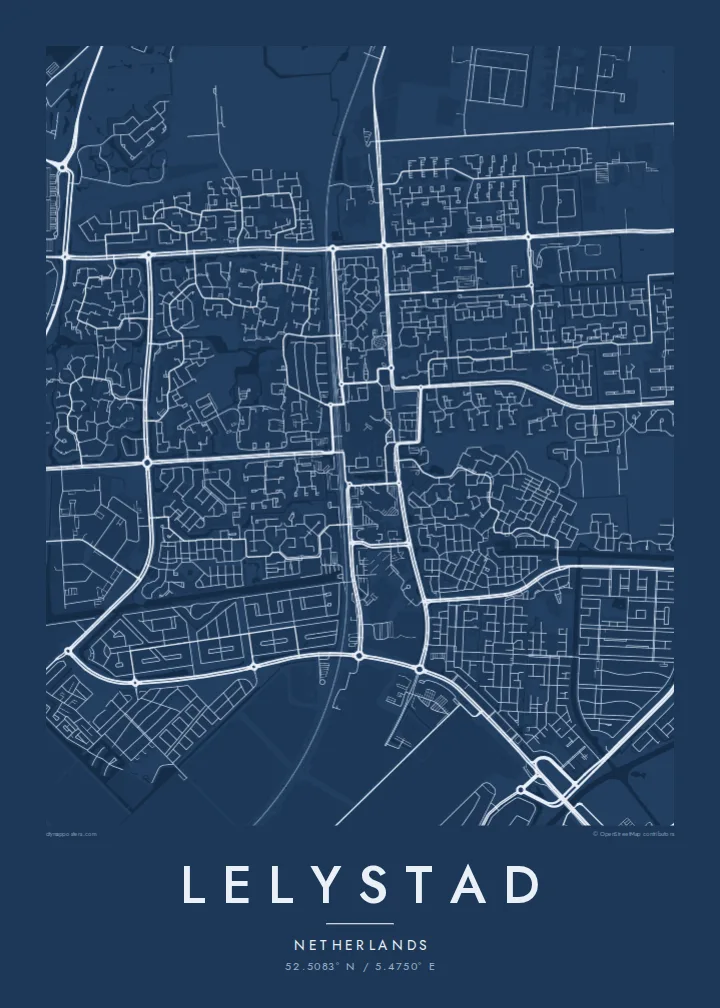
A new town on reclaimed seabed, drawn with planned districts, straight dikes and water on the edge of the Flevoland polder



Tasi le aai, lagona e lima
Tapi se sitaili e vaai ai i luga o le puipui. E tutusa uma le tau o sitaili — pe lolomiina, faapipiiina, pe avea ma faila HD.
 Pika Moni · Faila Lolomi 24 × 36″
Manino mo le lolomi
O se vaega atoa (100%) lenei mai le faila lolomi moni. O posita uma — pe lolomiina, faapipiiina pe download mai — e faia i luga o a matou server i le 300 DPI, e oo atu i le 7,200 × 10,800 pika, ina ia manino pea auala laiti i luga o se lolomiga 24 × 36″.
I luga o le puipui


Le faʻafanua
Lelystad did not exist a century ago. The ground it stands on was the bed of the Zuiderzee until the polder of Eastern Flevoland was drained in the 1950s, and the town was then built from scratch as its centre. It is named after Cornelis Lely, the engineer behind the plan to enclose and reclaim the inland sea.
From above, the planners' intentions are easy to read. Residential districts are laid out as separate units, each with its own loops and cul-de-sacs, and main roads, cycle paths and bus lanes run between them on their own routes. Straight canals and green strips divide the districts. The western edge is a hard dike line facing the Markermeer.
The waterfront holds Batavialand, where a full-size replica of the seventeenth-century ship Batavia was built, and nearby lies the Oostvaardersplassen nature reserve. A Lelystad map poster records something unusual: a complete town drawn onto land that was recently under water, with every line of its plan still showing the logic of the engineers who made it.
A long, straight dike separates the town from the open water of the Markermeer, and from here the Houtribdijk runs across the lake toward Enkhuizen.
Roads, cycle paths and bus lanes follow independent routes between the neighbourhoods, giving the map a layered pattern of parallel lines typical of Dutch new towns.
Beyond the built-up area, straight canals and rectangular fields of reclaimed land stretch away in a precise grid that frames the whole composition.
Fai mo oe
Faʻaopoopo se aso, se igoa po o sau lava upu, sui le sitaili, lapoʻa po o le itu.
O le preview e leai se totogi e maualalo le resolution ma iai se watermark. O lolomi ma faila HD e faia i le 300 DPI, e oo atu i le 7,200 × 10,800 px, e aunoa ma se watermark.
Aisea Lelystad
Lelystad is a map-lover's town: every road and canal was drawn before it was built. For residents, engineers or anyone fascinated by Dutch water management, it is a poster that explains itself the longer you look at it.
Change the title, subtitle and coordinates line to name a district, a date or the story of a move. Blueprint suits the engineered layout especially well, and Classic black & white, Noir, Paper and Sand give the same straight lines a softer or darker character.
Faatau le posita Lelystad| Lapoʻa lolomi | Manino | Faila |
|---|---|---|
| 30 × 40 cm (11.8 × 15.7″) | 3,543 × 4,724 px | PNG · PDF |
| 29.7 × 42 cm (A3, 11.7 × 16.5″) | 3,508 × 4,961 px | PNG · PDF |
| 42 × 59.4 cm (A2, 16.5 × 23.4″) | 4,961 × 7,016 px | PNG · PDF |
| 45.7 × 61 cm (18 × 24″) | 5,400 × 7,200 px | PNG · PDF |
| 50 × 70 cm (19.7 × 27.6″) | 5,906 × 8,268 px | PNG · PDF |
| 61 × 91.4 cm (24 × 36″) | 7,200 × 10,800 px | PNG · PDF |
Ae faʻatusatusa, o le faʻataʻitaʻiga e leai se totogi e 900 px le lautele, e iai le faʻailoga vai ma e mo mata. O faila HD e oʻo atu i le 8× le manino i itu taʻitasi ma e lolomi manino i le lapoʻa atoa o le posta.
Filifili se sitaili i le pito i luga o le itulau, ona filifili lea o le Posita Lolomi — se lapopoa ma, afai e te fiafia, se faavaa — po o Faila HD Numera. E na o le tasi laasaga o le Checkout, ma o le a fesuia'i lou itulau o oka i le taimi lava e mae'a ai le totogi.
E lolomiina i luga o pepa matte maualuga le tulaga e 200 gsm, i se tasi o lapopoa e ono, mai le 30 × 40 cm i le 24 × 36″. E amata le tau o posita lolomi mai le $39, aofia ai le auina atu.
Ioe. Filifili se faavaa laau malosi i le lanu uliuli, sina, oak masani, po o le laau pogisa. E aofia ai se tioata e le gau ma ua saunia e tautau i luga. E amata le tau o posita faavaa mai le $99, aofia ai le auina atu.
E leai se totogi mo le uta i le lalolagi atoa. O poster ta'itasi e lolomi e le paaga lolomi e latalata mai i matou i atunuu e 30+, ma e masani ona taunuu i aso faigaluega e 3–7. E mafai ona e mulimuli i le tulaga ma le tracking i le "Aʻu Oka". O nisi atunuu e 2–5 vaiaso, ma i atunuu matou te lei tuuina atu ai, e taʻu atu e le saite iā te oe ae e te leʻi totogiina.
Auina mai se ata i totonu o le 14 aso talu ona taunuu, ma o le a matou toe lolomiina e leai se totogi po o le toe faafoi atu lau tupe.
Ioe. I totonu o le editor i lenei itulau, suia le ulutala, le ulutala laititi ma le laina o coordinates i soo se mea e te fiafia i ai, ma filifili se sitaili ma le lapopoa. O oka lolomi, faavaa ma numera e faaaoga uma lava lau mamanu.
Mo le $9 e te maua ai faila PNG 300 DPI ma PDF ua saunia mo le lolomi i lapopoa uma e ono, e aunoa ma se watermark, e mafai ona lolomi i soo se mea. Le mautinoa lava? Download muamua se preview e leai se totogi ma le watermark.
Latalata ane
