Central plaza grid
The core follows a regular chequerboard of blocks around a main square. This colonial-era planning habit gives the poster a strong, symmetrical centre.
Posta faʻafanua faigofie · Colombia
4.8624° N / 74.9098° W
A compact street grid on the warm Tolima plain, with the slopes of the Central Cordillera rising just to the west.


Tasi le aai, lagona e lima
Tapi se sitaili e vaai ai i luga o le puipui. E tutusa uma le tau o sitaili — pe lolomiina, faapipiiina, pe avea ma faila HD.
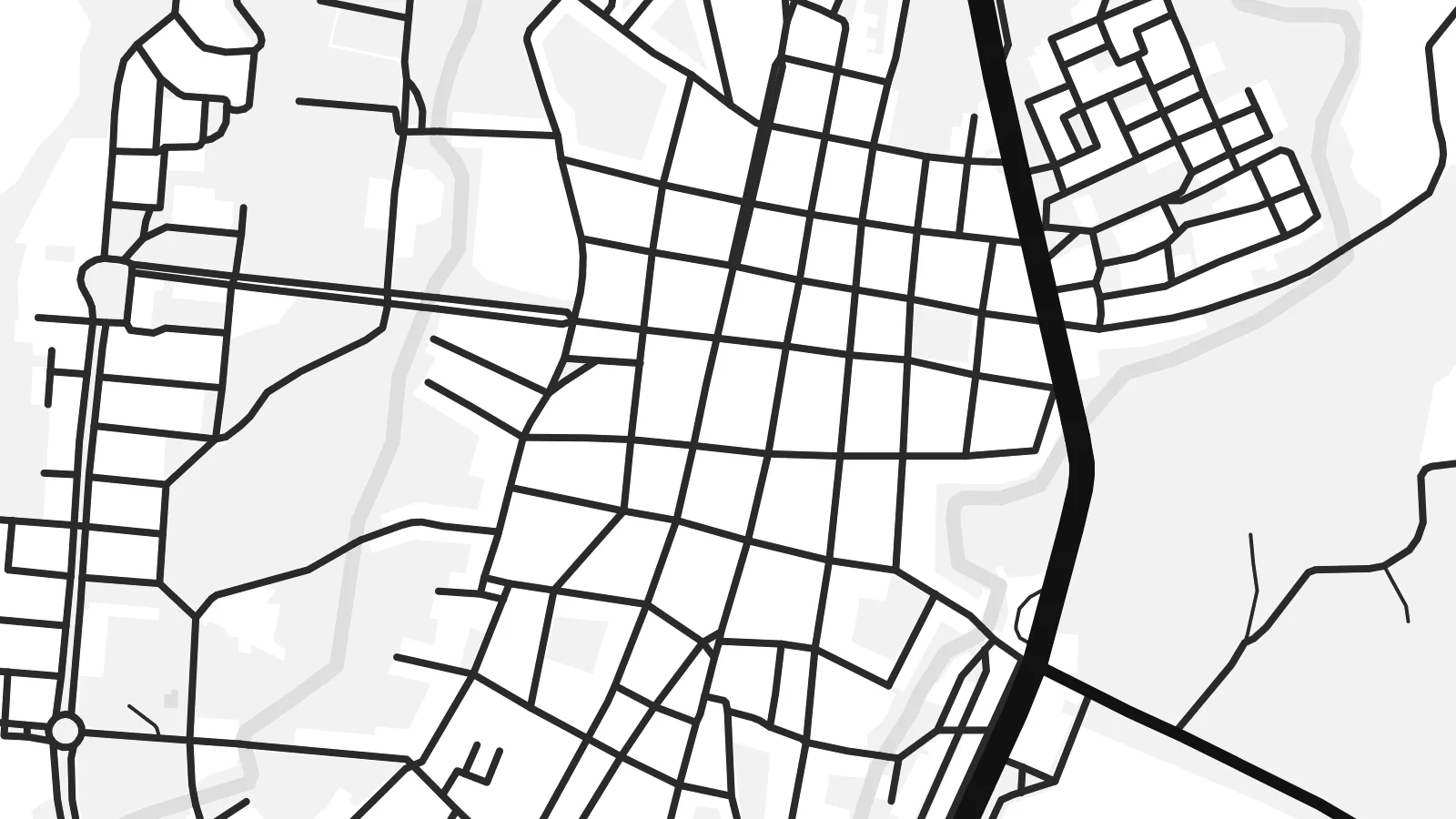 Pika Moni · Faila Lolomi 24 × 36″
Manino mo le lolomi
O se vaega atoa (100%) lenei mai le faila lolomi moni. O posita uma — pe lolomiina, faapipiiina pe download mai — e faia i luga o a matou server i le 300 DPI, e oo atu i le 7,200 × 10,800 pika, ina ia manino pea auala laiti i luga o se lolomiga 24 × 36″.
I luga o le puipui


Le faʻafanua
Lérida sits in the north of Tolima, on the flat ground between the Magdalena valley and the foothills of the Central Cordillera. From above, the town reads as a tidy block grid organised around a central plaza, a pattern shared by many towns across Colombia. Roads leave the grid toward neighbouring municipalities, and beyond the last streets the map opens into fields, pasture and scattered farm tracks.
The town's recent story is tied to the 1985 eruption of Nevado del Ruiz, whose mudflows destroyed nearby Armero. Lérida received many of the survivors, and for a lot of families it became the place where life started again. A map cannot show that history directly, but it gives a quiet, exact record of the streets that took them in.
A Lérida map poster keeps only what matters to the eye: the regular blocks, the plaza, the roads fanning out into the countryside, and the lines of streams crossing the plain. Printed in black on white, a small grid like this has a calm, almost architectural quality. It suits anyone with family roots in Tolima or memories of the hot valley towns north of Ibagué.
The core follows a regular chequerboard of blocks around a main square. This colonial-era planning habit gives the poster a strong, symmetrical centre.
West of town the flat land starts to fold into the Central Cordillera, so the road network loosens and bends as it climbs away from the plain.
Regional roads connect Lérida with Armero, Venadillo and Ibagué, drawing long lines across farmland that frame the compact town on the page.
Fai mo oe
Faʻaopoopo se aso, se igoa po o sau lava upu, sui le sitaili, lapoʻa po o le itu.
O le preview e leai se totogi e maualalo le resolution ma iai se watermark. O lolomi ma faila HD e faia i le 300 DPI, e oo atu i le 7,200 × 10,800 px, e aunoa ma se watermark.
Aisea Lérida
For people from Lérida, or whose families passed through it after 1985, the map holds the town in one frame: the square, the streets of home, the road out toward the mountains. It is modest and personal, and easy to read from across a room.
You can set your own title, subtitle and coordinates line, adding a family name or a year that matters. Choose from Classic black & white, Noir, Paper, Blueprint or Sand, then download the $9 HD files or order a matte print, framed in wood if you like.
Faatau le posita Lérida| Lapoʻa lolomi | Manino | Faila |
|---|---|---|
| 30 × 40 cm (11.8 × 15.7″) | 3,543 × 4,724 px | PNG · PDF |
| 29.7 × 42 cm (A3, 11.7 × 16.5″) | 3,508 × 4,961 px | PNG · PDF |
| 42 × 59.4 cm (A2, 16.5 × 23.4″) | 4,961 × 7,016 px | PNG · PDF |
| 45.7 × 61 cm (18 × 24″) | 5,400 × 7,200 px | PNG · PDF |
| 50 × 70 cm (19.7 × 27.6″) | 5,906 × 8,268 px | PNG · PDF |
| 61 × 91.4 cm (24 × 36″) | 7,200 × 10,800 px | PNG · PDF |
Ae faʻatusatusa, o le faʻataʻitaʻiga e leai se totogi e 900 px le lautele, e iai le faʻailoga vai ma e mo mata. O faila HD e oʻo atu i le 8× le manino i itu taʻitasi ma e lolomi manino i le lapoʻa atoa o le posta.
Filifili se sitaili i le pito i luga o le itulau, ona filifili lea o le Posita Lolomi — se lapopoa ma, afai e te fiafia, se faavaa — po o Faila HD Numera. E na o le tasi laasaga o le Checkout, ma o le a fesuia'i lou itulau o oka i le taimi lava e mae'a ai le totogi.
E lolomiina i luga o pepa matte maualuga le tulaga e 200 gsm, i se tasi o lapopoa e ono, mai le 30 × 40 cm i le 24 × 36″. E amata le tau o posita lolomi mai le $39, aofia ai le auina atu.
Ioe. Filifili se faavaa laau malosi i le lanu uliuli, sina, oak masani, po o le laau pogisa. E aofia ai se tioata e le gau ma ua saunia e tautau i luga. E amata le tau o posita faavaa mai le $99, aofia ai le auina atu.
E leai se totogi mo le uta i le lalolagi atoa. O poster ta'itasi e lolomi e le paaga lolomi e latalata mai i matou i atunuu e 30+, ma e masani ona taunuu i aso faigaluega e 3–7. E mafai ona e mulimuli i le tulaga ma le tracking i le "Aʻu Oka". O nisi atunuu e 2–5 vaiaso, ma i atunuu matou te lei tuuina atu ai, e taʻu atu e le saite iā te oe ae e te leʻi totogiina.
Auina mai se ata i totonu o le 14 aso talu ona taunuu, ma o le a matou toe lolomiina e leai se totogi po o le toe faafoi atu lau tupe.
Ioe. I totonu o le editor i lenei itulau, suia le ulutala, le ulutala laititi ma le laina o coordinates i soo se mea e te fiafia i ai, ma filifili se sitaili ma le lapopoa. O oka lolomi, faavaa ma numera e faaaoga uma lava lau mamanu.
Mo le $9 e te maua ai faila PNG 300 DPI ma PDF ua saunia mo le lolomi i lapopoa uma e ono, e aunoa ma se watermark, e mafai ona lolomi i soo se mea. Le mautinoa lava? Download muamua se preview e leai se totogi ma le watermark.
Latalata ane
