The coastline
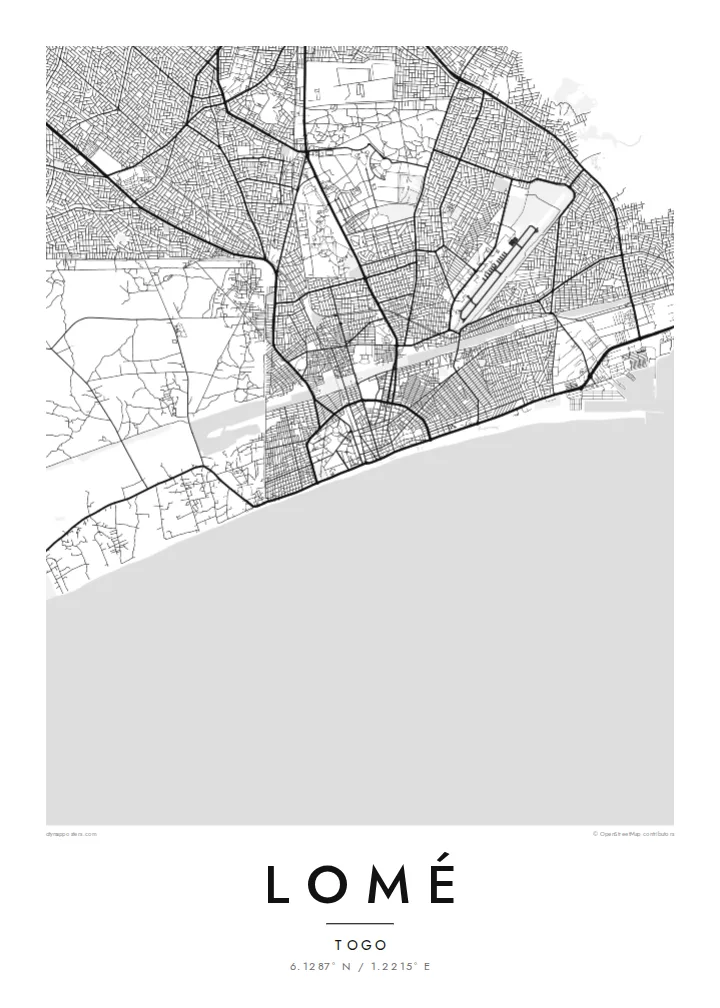
The shore of the Gulf of Guinea runs almost straight across the bottom of the map, giving the poster a calm horizon line beneath the streets.
Posta faʻafanua faigofie · Togo
6.1287° N / 1.2215° E
A capital drawn against the Gulf of Guinea, with a lagoon behind it and the Ghana border at its edge.


Tasi le aai, lagona e lima
Tapi se sitaili e vaai ai i luga o le puipui. E tutusa uma le tau o sitaili — pe lolomiina, faapipiiina, pe avea ma faila HD.
 Pika Moni · Faila Lolomi 24 × 36″
Manino mo le lolomi
O se vaega atoa (100%) lenei mai le faila lolomi moni. O posita uma — pe lolomiina, faapipiiina pe download mai — e faia i luga o a matou server i le 300 DPI, e oo atu i le 7,200 × 10,800 pika, ina ia manino pea auala laiti i luga o se lolomiga 24 × 36″.
I luga o le puipui


Le faʻafanua
Lomé is one of the few capitals in the world that sits directly on an international border. The city runs along the Atlantic coast of the Gulf of Guinea, and its western neighbourhoods end at the frontier with Ghana. On a map this gives the city a strong horizontal shape: a long shoreline at the bottom, a boundary on one side and the urban area stretching east and inland.
Behind the beach a lagoon system cuts across the city in narrow channels of water, separating the older coastal districts from the neighbourhoods further north. Main roads fan out from the centre toward the interior, and the seafront road follows the coast in an almost perfectly straight line, so the whole plan feels anchored to the water.
To the east lies the Autonomous Port of Lomé, a deep-water harbour whose breakwaters and basins stand out as crisp geometric shapes against the curve of the shore. A Lomé map poster reduces this coastal capital to its essentials: sea, lagoon, port and the web of streets between them, which together make an unusually clear composition.
The shore of the Gulf of Guinea runs almost straight across the bottom of the map, giving the poster a calm horizon line beneath the streets.
A band of lagoon water crosses the city behind the coast, forming thin ribbons that divide the street network into distinct horizontal bands.
Breakwaters and quays east of the centre form the sharpest angles on the map, a working harbour that serves Togo and the landlocked countries further inland.
Fai mo oe
Faʻaopoopo se aso, se igoa po o sau lava upu, sui le sitaili, lapoʻa po o le itu.
O le preview e leai se totogi e maualalo le resolution ma iai se watermark. O lolomi ma faila HD e faia i le 300 DPI, e oo atu i le 7,200 × 10,800 px, e aunoa ma se watermark.
Aisea Lomé
People connected to Lomé often want something that speaks of home without being a postcard. A map does that quietly: the coast, the lagoon and a familiar neighbourhood are all there, and the design stays understated enough for any room.
Every poster can carry your own title, subtitle and coordinates line, in one of five styles: Classic black & white, Noir, Paper, Blueprint or Sand. Printed versions on matte paper, with an optional wooden frame, ship from print partners in more than 30 countries.
Faatau le posita Lomé| Lapoʻa lolomi | Manino | Faila |
|---|---|---|
| 30 × 40 cm (11.8 × 15.7″) | 3,543 × 4,724 px | PNG · PDF |
| 29.7 × 42 cm (A3, 11.7 × 16.5″) | 3,508 × 4,961 px | PNG · PDF |
| 42 × 59.4 cm (A2, 16.5 × 23.4″) | 4,961 × 7,016 px | PNG · PDF |
| 45.7 × 61 cm (18 × 24″) | 5,400 × 7,200 px | PNG · PDF |
| 50 × 70 cm (19.7 × 27.6″) | 5,906 × 8,268 px | PNG · PDF |
| 61 × 91.4 cm (24 × 36″) | 7,200 × 10,800 px | PNG · PDF |
Ae faʻatusatusa, o le faʻataʻitaʻiga e leai se totogi e 900 px le lautele, e iai le faʻailoga vai ma e mo mata. O faila HD e oʻo atu i le 8× le manino i itu taʻitasi ma e lolomi manino i le lapoʻa atoa o le posta.
Filifili se sitaili i le pito i luga o le itulau, ona filifili lea o le Posita Lolomi — se lapopoa ma, afai e te fiafia, se faavaa — po o Faila HD Numera. E na o le tasi laasaga o le Checkout, ma o le a fesuia'i lou itulau o oka i le taimi lava e mae'a ai le totogi.
E lolomiina i luga o pepa matte maualuga le tulaga e 200 gsm, i se tasi o lapopoa e ono, mai le 30 × 40 cm i le 24 × 36″. E amata le tau o posita lolomi mai le $39, aofia ai le auina atu.
Ioe. Filifili se faavaa laau malosi i le lanu uliuli, sina, oak masani, po o le laau pogisa. E aofia ai se tioata e le gau ma ua saunia e tautau i luga. E amata le tau o posita faavaa mai le $99, aofia ai le auina atu.
E leai se totogi mo le uta i le lalolagi atoa. O poster ta'itasi e lolomi e le paaga lolomi e latalata mai i matou i atunuu e 30+, ma e masani ona taunuu i aso faigaluega e 3–7. E mafai ona e mulimuli i le tulaga ma le tracking i le "Aʻu Oka". O nisi atunuu e 2–5 vaiaso, ma i atunuu matou te lei tuuina atu ai, e taʻu atu e le saite iā te oe ae e te leʻi totogiina.
Auina mai se ata i totonu o le 14 aso talu ona taunuu, ma o le a matou toe lolomiina e leai se totogi po o le toe faafoi atu lau tupe.
Ioe. I totonu o le editor i lenei itulau, suia le ulutala, le ulutala laititi ma le laina o coordinates i soo se mea e te fiafia i ai, ma filifili se sitaili ma le lapopoa. O oka lolomi, faavaa ma numera e faaaoga uma lava lau mamanu.
Mo le $9 e te maua ai faila PNG 300 DPI ma PDF ua saunia mo le lolomi i lapopoa uma e ono, e aunoa ma se watermark, e mafai ona lolomi i soo se mea. Le mautinoa lava? Download muamua se preview e leai se totogi ma le watermark.
