Valley streets
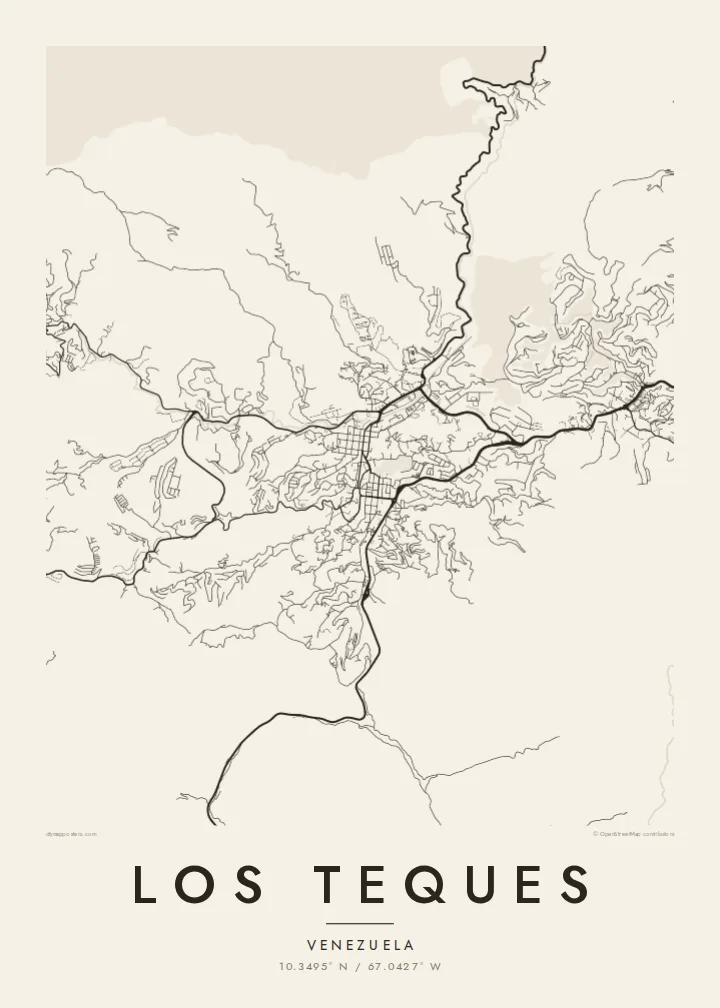
The main roads run along narrow valleys, with side streets climbing steeply away from them, creating a branching, tree-like pattern across the poster.
Posta faʻafanua faigofie · Venezuela
10.3495° N / 67.0427° W
A mountain city strung along narrow valleys and ridges in the coastal range southwest of Caracas




Tasi le aai, lagona e lima
Tapi se sitaili e vaai ai i luga o le puipui. E tutusa uma le tau o sitaili — pe lolomiina, faapipiiina, pe avea ma faila HD.
 Pika Moni · Faila Lolomi 24 × 36″
Manino mo le lolomi
O se vaega atoa (100%) lenei mai le faila lolomi moni. O posita uma — pe lolomiina, faapipiiina pe download mai — e faia i luga o a matou server i le 300 DPI, e oo atu i le 7,200 × 10,800 pika, ina ia manino pea auala laiti i luga o se lolomiga 24 × 36″.
I luga o le puipui


Le faʻafanua
Los Teques sits high in the mountains of the Cordillera de la Costa, southwest of Caracas and higher than the capital. The terrain rules the map: streets follow valley floors and hug hillsides, doubling back on themselves in tight curves, and neighbourhoods spill down slopes in patterns that look more like contour lines than a city grid.
The city takes its name from the Teques, the indigenous people led by the cacique Guaicaipuro, who resisted Spanish settlement in the sixteenth century. Today Los Teques is the capital of Miranda state, and its cooler climate has long drawn visitors from Caracas. A metro line connects it to the capital's network, a reminder of how closely the two cities are tied.
In the early twentieth century, the German-built Gran Ferrocarril de Venezuela ran through these mountains between Caracas and Valencia, and its old route is still remembered locally. A Los Teques map poster captures a city defined by slope, where roads coil around the hills and the green spaces between them carry as much weight as the streets.
The main roads run along narrow valleys, with side streets climbing steeply away from them, creating a branching, tree-like pattern across the poster.
Dense barrios cling to the slopes around the centre, their winding lanes and stairways forming intricate textures that change with every fold of the terrain.
Forested ridges separate districts and surround the city, leaving generous blank spaces on the map that emphasise how much of Los Teques is shaped by the mountains.
Fai mo oe
Faʻaopoopo se aso, se igoa po o sau lava upu, sui le sitaili, lapoʻa po o le itu.
O le preview e leai se totogi e maualalo le resolution ma iai se watermark. O lolomi ma faila HD e faia i le 300 DPI, e oo atu i le 7,200 × 10,800 px, e aunoa ma se watermark.
Aisea Los Teques
Los Teques is home for many families who commute to Caracas or have left Venezuela entirely. Its winding streets make a map that feels intimate and unmistakable, a reminder of cool evenings in the hills.
Add a title, subtitle and coordinates of your own, such as a neighbourhood name or a family date, and choose one of five styles. Classic black and white suits the dense slopes; Paper gives a softer, archival feel.
Faatau le posita Los Teques| Lapoʻa lolomi | Manino | Faila |
|---|---|---|
| 30 × 40 cm11.8 × 15.7″ | 3,543 × 4,724 px | PNG · PDF |
| 29.7 × 42 cm (A3)11.7 × 16.5″ | 3,508 × 4,961 px | PNG · PDF |
| 42 × 59.4 cm (A2)16.5 × 23.4″ | 4,961 × 7,016 px | PNG · PDF |
| 45.7 × 61 cm18 × 24″ | 5,400 × 7,200 px | PNG · PDF |
| 50 × 70 cm19.7 × 27.6″ | 5,906 × 8,268 px | PNG · PDF |
| 61 × 91.4 cm24 × 36″ | 7,200 × 10,800 px | PNG · PDF |
Ae faʻatusatusa, o le faʻataʻitaʻiga e leai se totogi e 900 px le lautele, e iai le faʻailoga vai ma e mo mata. O faila HD e oʻo atu i le 8× le manino i itu taʻitasi ma e lolomi manino i le lapoʻa atoa o le posta.
Filifili se sitaili i le pito i luga o le itulau, ona filifili lea o le Posita Lolomi — se lapopoa ma, afai e te fiafia, se faavaa — po o Faila HD Numera. E na o le tasi laasaga o le Checkout, ma o le a fesuia'i lou itulau o oka i le taimi lava e mae'a ai le totogi.
E lolomiina i luga o pepa matte maualuga le tulaga e 200 gsm, i se tasi o lapopoa e ono, mai le 30 × 40 cm i le 24 × 36″. E amata le tau o posita lolomi mai le $39, aofia ai le auina atu.
Ioe. Filifili se faavaa laau malosi i le lanu uliuli, sina, oak masani, po o le laau pogisa. E aofia ai se tioata e le gau ma ua saunia e tautau i luga. E amata le tau o posita faavaa mai le $99, aofia ai le auina atu.
E leai se totogi o le auina atu i atunuu e 60+. O pepa ata taʻitasi e lolomiina e le tasi o matou paaga lolomi e latalata mai i atunuu e 30+, ma e masani ona taunuu i le 3–7 aso faigaluega. E mafai ona e mulimulitaia le tulaga ma le sailiga i lalo o My Orders. O nisi atunuu e 2–5 vaiaso, ma i nofoaga e lei matou auina atu iai, e taʻu atu e le saite ia te oe a o lei totogi.
Auina mai se ata i totonu o le 14 aso talu ona taunuu, ma o le a matou toe lolomiina e leai se totogi po o le toe faafoi atu lau tupe.
Ioe. I totonu o le editor i lenei itulau, suia le ulutala, le ulutala laititi ma le laina o coordinates i soo se mea e te fiafia i ai, ma filifili se sitaili ma le lapopoa. O oka lolomi, faavaa ma numera e faaaoga uma lava lau mamanu.
Mo le $9 e te maua ai faila PNG 300 DPI ma PDF ua saunia mo le lolomi i lapopoa uma e ono, e aunoa ma se watermark, e mafai ona lolomi i soo se mea. Le mautinoa lava? Download muamua se preview e leai se totogi ma le watermark.
Latalata ane
