Hilltop core
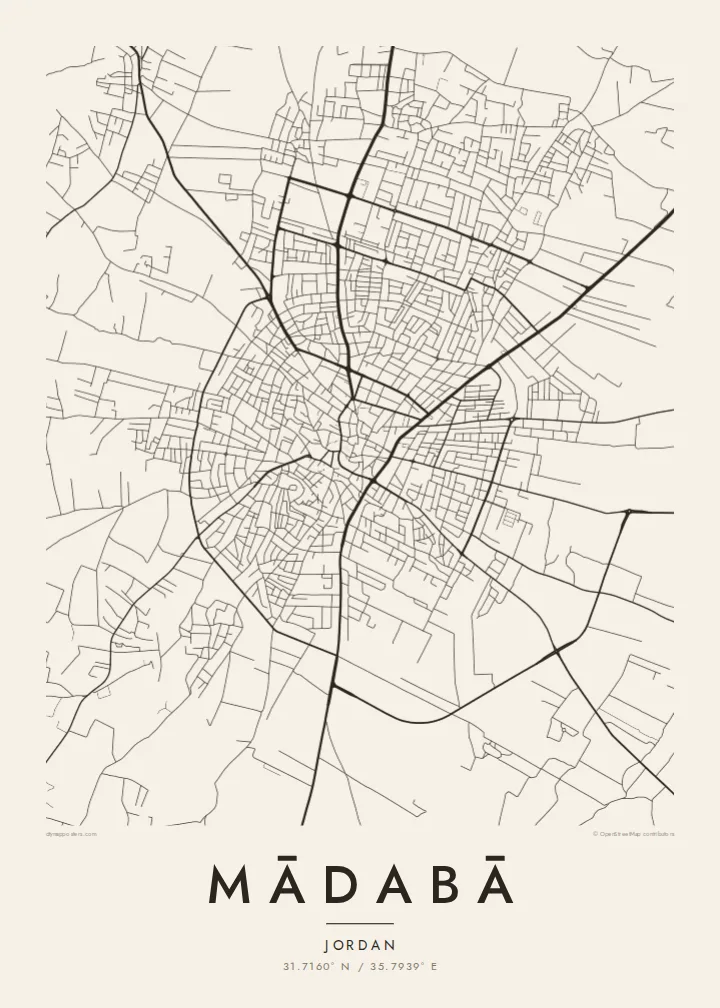
The old town sits on a rise, and its streets curve around the slope in an irregular pattern that stands out against the straighter roads of newer districts.
Posta faʻafanua faigofie · Jordan
31.7160° N / 35.7939° E
A hilltop town on the plateau above the Dead Sea, famous for the oldest surviving map of the Holy Land.




Tasi le aai, lagona e lima
Tapi se sitaili e vaai ai i luga o le puipui. E tutusa uma le tau o sitaili — pe lolomiina, faapipiiina, pe avea ma faila HD.
 Pika Moni · Faila Lolomi 24 × 36″
Manino mo le lolomi
O se vaega atoa (100%) lenei mai le faila lolomi moni. O posita uma — pe lolomiina, faapipiiina pe download mai — e faia i luga o a matou server i le 300 DPI, e oo atu i le 7,200 × 10,800 pika, ina ia manino pea auala laiti i luga o se lolomiga 24 × 36″.
I luga o le puipui


Le faʻafanua
Mādabā stands on the high plateau about thirty kilometres south-west of Amman, along the ancient King's Highway. The town is built on and around a low hill, the older core occupying the rise with streets winding outward, and the surrounding land open and agricultural before the plateau drops away westward towards the Jordan Valley and the Dead Sea.
It is known as the City of Mosaics. The most celebrated is the Madaba Map, a sixth-century floor mosaic in the Church of Saint George that depicts the region and Jerusalem in remarkable detail and is the oldest surviving map of the Holy Land. Many other mosaics from the Byzantine period survive in churches and houses across town.
Mount Nebo, where Moses is said to have seen the Promised Land, lies a short drive to the west. There is a pleasing symmetry in a Mādabā map poster: a modern map of a town whose name is already tied to one of the most famous maps ever made, drawn this time in clean black lines.
The old town sits on a rise, and its streets curve around the slope in an irregular pattern that stands out against the straighter roads of newer districts.
The ancient route passes through the town on its way south, a long line on the map that has connected settlements on the plateau for thousands of years.
West of the town the land slopes down towards Mount Nebo and the Dead Sea basin, so the roads begin to bend and follow the terrain.
Fai mo oe
Faʻaopoopo se aso, se igoa po o sau lava upu, sui le sitaili, lapoʻa po o le itu.
O le preview e leai se totogi e maualalo le resolution ma iai se watermark. O lolomi ma faila HD e faia i le 300 DPI, e oo atu i le 7,200 × 10,800 px, e aunoa ma se watermark.
Aisea Mādabā
Mādabā draws visitors who come for the mosaics and pilgrims on their way to Mount Nebo, and many want something to remember it by beyond photographs. The poster can carry your own title, a travel date in the subtitle and the exact coordinates.
Paper and Sand echo the stone and earth tones of the plateau, while Noir, Blueprint and Classic black & white give a crisper finish. Begin with a free watermarked preview, then choose the $9 HD files or a printed matte poster.
Faatau le posita Mādabā| Lapoʻa lolomi | Manino | Faila |
|---|---|---|
| 30 × 40 cm (11.8 × 15.7″) | 3,543 × 4,724 px | PNG · PDF |
| 29.7 × 42 cm (A3, 11.7 × 16.5″) | 3,508 × 4,961 px | PNG · PDF |
| 42 × 59.4 cm (A2, 16.5 × 23.4″) | 4,961 × 7,016 px | PNG · PDF |
| 45.7 × 61 cm (18 × 24″) | 5,400 × 7,200 px | PNG · PDF |
| 50 × 70 cm (19.7 × 27.6″) | 5,906 × 8,268 px | PNG · PDF |
| 61 × 91.4 cm (24 × 36″) | 7,200 × 10,800 px | PNG · PDF |
Ae faʻatusatusa, o le faʻataʻitaʻiga e leai se totogi e 900 px le lautele, e iai le faʻailoga vai ma e mo mata. O faila HD e oʻo atu i le 8× le manino i itu taʻitasi ma e lolomi manino i le lapoʻa atoa o le posta.
Filifili se sitaili i le pito i luga o le itulau, ona filifili lea o le Posita Lolomi — se lapopoa ma, afai e te fiafia, se faavaa — po o Faila HD Numera. E na o le tasi laasaga o le Checkout, ma o le a fesuia'i lou itulau o oka i le taimi lava e mae'a ai le totogi.
E lolomiina i luga o pepa matte maualuga le tulaga e 200 gsm, i se tasi o lapopoa e ono, mai le 30 × 40 cm i le 24 × 36″. E amata le tau o posita lolomi mai le $39, aofia ai le auina atu.
Ioe. Filifili se faavaa laau malosi i le lanu uliuli, sina, oak masani, po o le laau pogisa. E aofia ai se tioata e le gau ma ua saunia e tautau i luga. E amata le tau o posita faavaa mai le $99, aofia ai le auina atu.
E leai se totogi mo le uta i le lalolagi atoa. O poster ta'itasi e lolomi e le paaga lolomi e latalata mai i matou i atunuu e 30+, ma e masani ona taunuu i aso faigaluega e 3–7. E mafai ona e mulimuli i le tulaga ma le tracking i le "Aʻu Oka". O nisi atunuu e 2–5 vaiaso, ma i atunuu matou te lei tuuina atu ai, e taʻu atu e le saite iā te oe ae e te leʻi totogiina.
Auina mai se ata i totonu o le 14 aso talu ona taunuu, ma o le a matou toe lolomiina e leai se totogi po o le toe faafoi atu lau tupe.
Ioe. I totonu o le editor i lenei itulau, suia le ulutala, le ulutala laititi ma le laina o coordinates i soo se mea e te fiafia i ai, ma filifili se sitaili ma le lapopoa. O oka lolomi, faavaa ma numera e faaaoga uma lava lau mamanu.
Mo le $9 e te maua ai faila PNG 300 DPI ma PDF ua saunia mo le lolomi i lapopoa uma e ono, e aunoa ma se watermark, e mafai ona lolomi i soo se mea. Le mautinoa lava? Download muamua se preview e leai se totogi ma le watermark.
