Temple plaza
The Templo Votivo and its surrounding open grounds form a clear break in the dense residential blocks, a recognisable civic centre for the commune.
Posta faʻafanua faigofie · Chile
33.5142° S / 70.7651° W
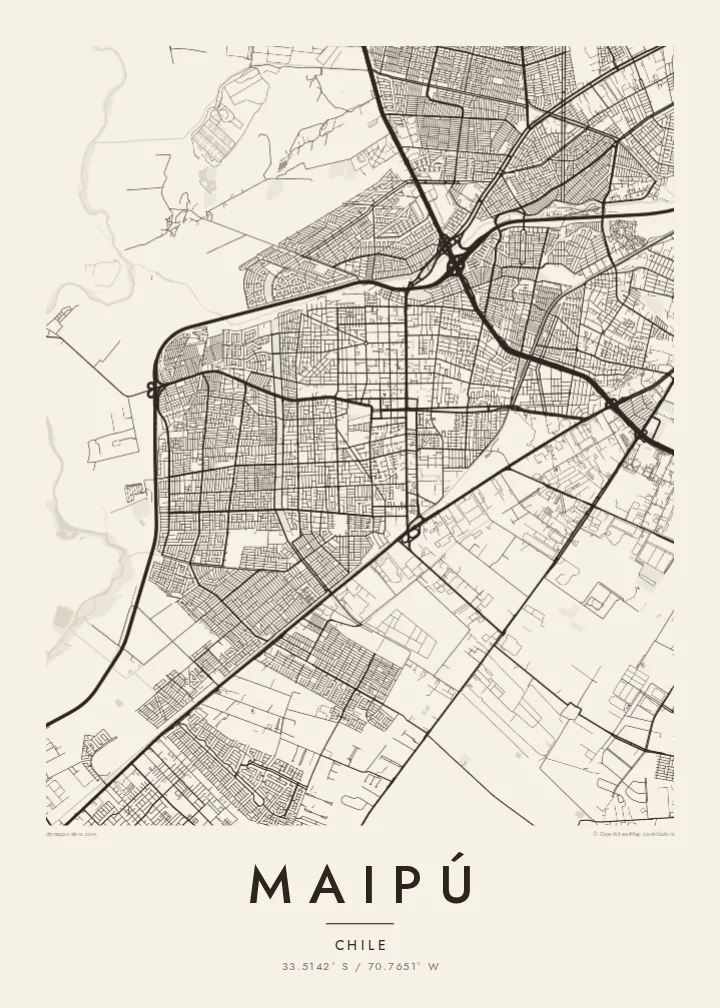
Suburban grids on Santiago's southwestern plain, centred on a national shrine and bounded by the Mapocho.




Tasi le aai, lagona e lima
Tapi se sitaili e vaai ai i luga o le puipui. E tutusa uma le tau o sitaili — pe lolomiina, faapipiiina, pe avea ma faila HD.
 Pika Moni · Faila Lolomi 24 × 36″
Manino mo le lolomi
O se vaega atoa (100%) lenei mai le faila lolomi moni. O posita uma — pe lolomiina, faapipiiina pe download mai — e faia i luga o a matou server i le 300 DPI, e oo atu i le 7,200 × 10,800 pika, ina ia manino pea auala laiti i luga o se lolomiga 24 × 36″.
I luga o le puipui


Le faʻafanua
Maipú is one of the most populous communes in the Santiago metropolitan area, and from above it reads as a large, even stretch of suburban grid on the flat floor of the central valley. Long avenues run through residential blocks with a regularity typical of planned expansion, while the Mapocho River marks part of the commune's northern edge as it flows west out of the city.
The commune's name is tied to a key moment in Chilean history. The Battle of Maipú, fought on these plains in 1818, secured the country's independence. The Templo Votivo de Maipú, a national shrine built in fulfilment of a vow made at the time, stands in a large open plaza, an unusual gap in the otherwise dense pattern of streets.
Toward the west, the grid loosens into farmland and the foothills of the coastal range, while to the east Maipú merges seamlessly with the rest of Santiago. Metro lines reach the commune, linking it to the centre. A Maipú map poster shows this broad residential landscape as it is: orderly, extensive, and set against open country and the Andes beyond.
The Templo Votivo and its surrounding open grounds form a clear break in the dense residential blocks, a recognisable civic centre for the commune.
The Mapocho River traces part of the northern boundary, a curving line that contrasts with the straight suburban avenues to its south.
On the western side, the built-up grid gives way to fields and rising ground, so the edge of the city is visible on the map.
Fai mo oe
Faʻaopoopo se aso, se igoa po o sau lava upu, sui le sitaili, lapoʻa po o le itu.
O le preview e leai se totogi e maualalo le resolution ma iai se watermark. O lolomi ma faila HD e faia i le 300 DPI, e oo atu i le 7,200 × 10,800 px, e aunoa ma se watermark.
Aisea Maipú
Maipú is where many Santiago families put down roots, and a map of it is a map of home rather than tourist sites. It is a thoughtful gift for a first flat, a new house or someone who has moved abroad.
Personalise the title, subtitle and coordinates line with a street, a family name or a year. Then choose Classic black & white, Noir, Paper, Blueprint or Sand.
Faatau le posita Maipú| Lapoʻa lolomi | Manino | Faila |
|---|---|---|
| 30 × 40 cm11.8 × 15.7″ | 3,543 × 4,724 px | PNG · PDF |
| 29.7 × 42 cm (A3)11.7 × 16.5″ | 3,508 × 4,961 px | PNG · PDF |
| 42 × 59.4 cm (A2)16.5 × 23.4″ | 4,961 × 7,016 px | PNG · PDF |
| 45.7 × 61 cm18 × 24″ | 5,400 × 7,200 px | PNG · PDF |
| 50 × 70 cm19.7 × 27.6″ | 5,906 × 8,268 px | PNG · PDF |
| 61 × 91.4 cm24 × 36″ | 7,200 × 10,800 px | PNG · PDF |
Ae faʻatusatusa, o le faʻataʻitaʻiga e leai se totogi e 900 px le lautele, e iai le faʻailoga vai ma e mo mata. O faila HD e oʻo atu i le 8× le manino i itu taʻitasi ma e lolomi manino i le lapoʻa atoa o le posta.
Filifili se sitaili i le pito i luga o le itulau, ona filifili lea o le Posita Lolomi — se lapopoa ma, afai e te fiafia, se faavaa — po o Faila HD Numera. E na o le tasi laasaga o le Checkout, ma o le a fesuia'i lou itulau o oka i le taimi lava e mae'a ai le totogi.
E lolomiina i luga o pepa matte maualuga le tulaga e 200 gsm, i se tasi o lapopoa e ono, mai le 30 × 40 cm i le 24 × 36″. E amata le tau o posita lolomi mai le $39, aofia ai le auina atu.
Ioe. Filifili se faavaa laau malosi i le lanu uliuli, sina, oak masani, po o le laau pogisa. E aofia ai se tioata e le gau ma ua saunia e tautau i luga. E amata le tau o posita faavaa mai le $99, aofia ai le auina atu.
E leai se totogi o le auina atu i atunuu e 60+. O pepa ata taʻitasi e lolomiina e le tasi o matou paaga lolomi e latalata mai i atunuu e 30+, ma e masani ona taunuu i le 3–7 aso faigaluega. E mafai ona e mulimulitaia le tulaga ma le sailiga i lalo o My Orders. O nisi atunuu e 2–5 vaiaso, ma i nofoaga e lei matou auina atu iai, e taʻu atu e le saite ia te oe a o lei totogi.
Auina mai se ata i totonu o le 14 aso talu ona taunuu, ma o le a matou toe lolomiina e leai se totogi po o le toe faafoi atu lau tupe.
Ioe. I totonu o le editor i lenei itulau, suia le ulutala, le ulutala laititi ma le laina o coordinates i soo se mea e te fiafia i ai, ma filifili se sitaili ma le lapopoa. O oka lolomi, faavaa ma numera e faaaoga uma lava lau mamanu.
Mo le $9 e te maua ai faila PNG 300 DPI ma PDF ua saunia mo le lolomi i lapopoa uma e ono, e aunoa ma se watermark, e mafai ona lolomi i soo se mea. Le mautinoa lava? Download muamua se preview e leai se totogi ma le watermark.
