Historic grid
The old centre follows a compact, rectangular layout inherited from its castle-town past, lined with storehouses and traditional shop houses.
Posta faʻafanua faigofie · Japan
36.2667° N / 140.1000° E
An old merchant town at the foot of Mount Tsukuba, its lanes of storehouses set among the rice fields of Ibaraki.


Tasi le aai, lagona e lima
Tapi se sitaili e vaai ai i luga o le puipui. E tutusa uma le tau o sitaili — pe lolomiina, faapipiiina, pe avea ma faila HD.
 Pika Moni · Faila Lolomi 24 × 36″
Manino mo le lolomi
O se vaega atoa (100%) lenei mai le faila lolomi moni. O posita uma — pe lolomiina, faapipiiina pe download mai — e faia i luga o a matou server i le 300 DPI, e oo atu i le 7,200 × 10,800 pika, ina ia manino pea auala laiti i luga o se lolomiga 24 × 36″.
I luga o le puipui


Le faʻafanua
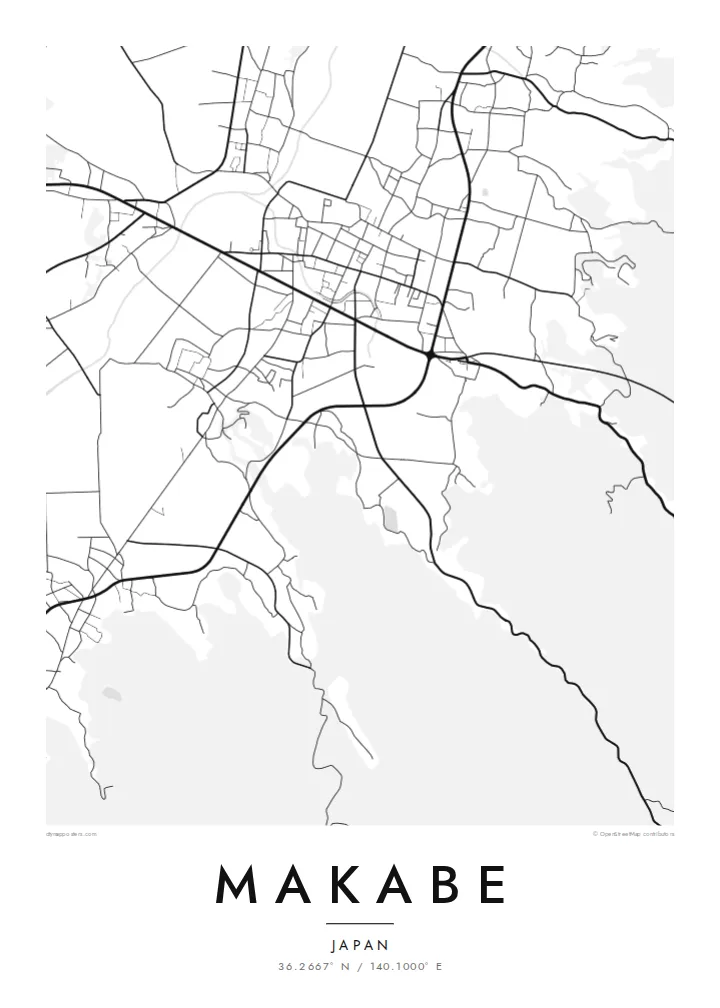
Makabe was a town in Ibaraki Prefecture until 2005, when it merged into the city of Sakuragawa, and it remains a distinct district with its own character. It lies on the northern side of Mount Tsukuba, where the Kanto Plain begins to meet the hills. From above the old centre is a compact grid of streets surrounded by rice paddies, farmhouses and the slopes rising to the south.
The town developed as a castle town and later as a merchant centre, and many traditional buildings survive, including storehouses and shop houses. The area is also known for its granite and stone carving. The historic district is protected as a preservation area for groups of traditional buildings, and on a map it reads as a tidy, rectangular pattern set within open fields.
Each year in late winter the district holds a Hina doll festival, when residents display dolls in the windows of old houses and shops and visitors walk the preserved streets. A Makabe map poster frames the historic centre with the fields and the northern slopes of Tsukuba around it, capturing both the town and its setting.
The old centre follows a compact, rectangular layout inherited from its castle-town past, lined with storehouses and traditional shop houses.
Flat fields surround the town in small rectangular plots, giving the map a fine, regular texture that frames the built-up area.
To the south the land rises toward Mount Tsukuba, one of the best-known mountains of the Kanto region, adding contour and depth to a wider view.
Fai mo oe
Faʻaopoopo se aso, se igoa po o sau lava upu, sui le sitaili, lapoʻa po o le itu.
O le preview e leai se totogi e maualalo le resolution ma iai se watermark. O lolomi ma faila HD e faia i le 300 DPI, e oo atu i le 7,200 × 10,800 px, e aunoa ma se watermark.
Aisea Makabe
Makabe suits anyone who has walked its old streets during the doll festival, grew up in the district or has family in Sakuragawa. Its compact centre and the fields around it make an elegant, balanced composition on any wall.
Set the title and subtitle, perhaps 'Makabe, Sakuragawa' or a family name and date, and edit the coordinates line. All five styles, Classic black & white, Noir, Paper, Blueprint and Sand, suit the fine grid, and Paper gives it a quiet, printed-book feel.
Faatau le posita Makabe| Lapoʻa lolomi | Manino | Faila |
|---|---|---|
| 30 × 40 cm (11.8 × 15.7″) | 3,543 × 4,724 px | PNG · PDF |
| 29.7 × 42 cm (A3, 11.7 × 16.5″) | 3,508 × 4,961 px | PNG · PDF |
| 42 × 59.4 cm (A2, 16.5 × 23.4″) | 4,961 × 7,016 px | PNG · PDF |
| 45.7 × 61 cm (18 × 24″) | 5,400 × 7,200 px | PNG · PDF |
| 50 × 70 cm (19.7 × 27.6″) | 5,906 × 8,268 px | PNG · PDF |
| 61 × 91.4 cm (24 × 36″) | 7,200 × 10,800 px | PNG · PDF |
Ae faʻatusatusa, o le faʻataʻitaʻiga e leai se totogi e 900 px le lautele, e iai le faʻailoga vai ma e mo mata. O faila HD e oʻo atu i le 8× le manino i itu taʻitasi ma e lolomi manino i le lapoʻa atoa o le posta.
Filifili se sitaili i le pito i luga o le itulau, ona filifili lea o le Posita Lolomi — se lapopoa ma, afai e te fiafia, se faavaa — po o Faila HD Numera. E na o le tasi laasaga o le Checkout, ma o le a fesuia'i lou itulau o oka i le taimi lava e mae'a ai le totogi.
E lolomiina i luga o pepa matte maualuga le tulaga e 200 gsm, i se tasi o lapopoa e ono, mai le 30 × 40 cm i le 24 × 36″. E amata le tau o posita lolomi mai le $39, aofia ai le auina atu.
Ioe. Filifili se faavaa laau malosi i le lanu uliuli, sina, oak masani, po o le laau pogisa. E aofia ai se tioata e le gau ma ua saunia e tautau i luga. E amata le tau o posita faavaa mai le $99, aofia ai le auina atu.
E leai se totogi mo le uta i le lalolagi atoa. O poster ta'itasi e lolomi e le paaga lolomi e latalata mai i matou i atunuu e 30+, ma e masani ona taunuu i aso faigaluega e 3–7. E mafai ona e mulimuli i le tulaga ma le tracking i le "Aʻu Oka". O nisi atunuu e 2–5 vaiaso, ma i atunuu matou te lei tuuina atu ai, e taʻu atu e le saite iā te oe ae e te leʻi totogiina.
Auina mai se ata i totonu o le 14 aso talu ona taunuu, ma o le a matou toe lolomiina e leai se totogi po o le toe faafoi atu lau tupe.
Ioe. I totonu o le editor i lenei itulau, suia le ulutala, le ulutala laititi ma le laina o coordinates i soo se mea e te fiafia i ai, ma filifili se sitaili ma le lapopoa. O oka lolomi, faavaa ma numera e faaaoga uma lava lau mamanu.
Mo le $9 e te maua ai faila PNG 300 DPI ma PDF ua saunia mo le lolomi i lapopoa uma e ono, e aunoa ma se watermark, e mafai ona lolomi i soo se mea. Le mautinoa lava? Download muamua se preview e leai se totogi ma le watermark.
Latalata ane
