Murghab River
The river flows north through the city in a gentle curve. It divides the urban area and supplies the water on which the whole oasis depends.
Posta faʻafanua faigofie · Turkmenistan
37.5938° N / 61.8303° E
An oasis city on the Murghab River in Turkmenistan's Karakum Desert, a short drive from the ruins of ancient Merv.


Tasi le aai, lagona e lima
Tapi se sitaili e vaai ai i luga o le puipui. E tutusa uma le tau o sitaili — pe lolomiina, faapipiiina, pe avea ma faila HD.
 Pika Moni · Faila Lolomi 24 × 36″
Manino mo le lolomi
O se vaega atoa (100%) lenei mai le faila lolomi moni. O posita uma — pe lolomiina, faapipiiina pe download mai — e faia i luga o a matou server i le 300 DPI, e oo atu i le 7,200 × 10,800 pika, ina ia manino pea auala laiti i luga o se lolomiga 24 × 36″.
I luga o le puipui


Le faʻafanua
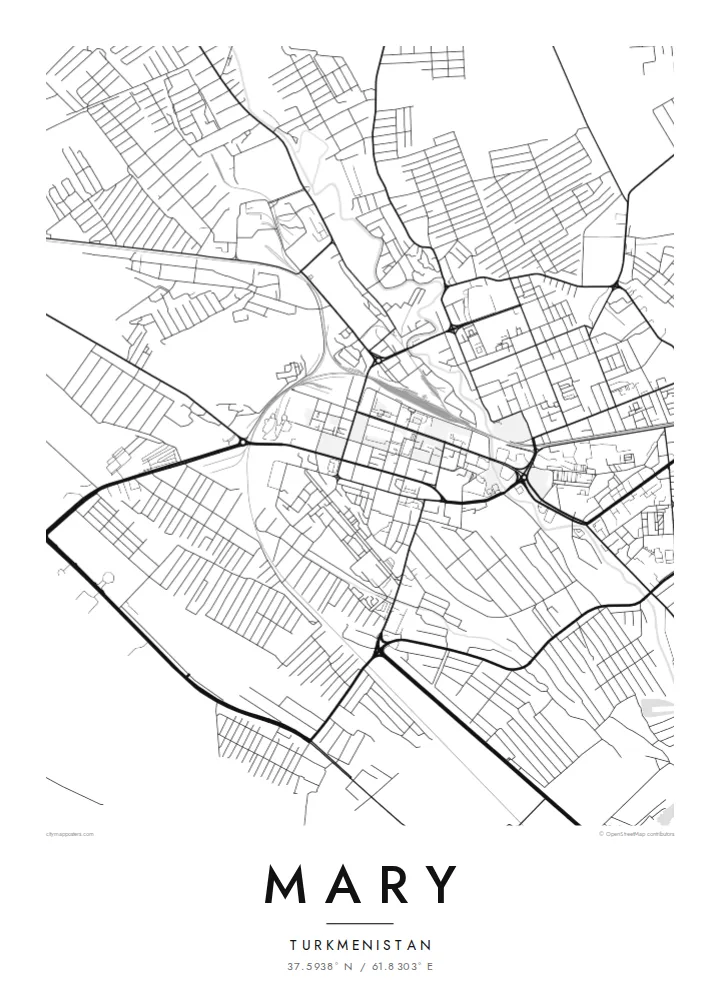
Mary grew up on the Murghab River in south-eastern Turkmenistan, in an oasis surrounded by the Karakum Desert. The modern city was founded in the 1880s, and its centre follows a fairly regular pattern of straight streets and blocks. Irrigation channels, fed in part by the Karakum Canal crossing the oasis, bring water to the cotton fields and gardens around the town.
Mary is the successor of Merv, one of the great cities of the Silk Road. The ruins of Merv lie about 30 kilometres to the east and are listed by UNESCO as the State Historical and Cultural Park Ancient Merv. The province around Mary is also central to Turkmenistan's natural gas industry, and the large Galkynysh field lies within it.
A Mary map poster shows the geometry of a desert oasis: a clear urban grid, the curve of the Murghab running through it, and irrigated farmland stretching out in orderly strips until it gives way to empty desert. The contrast between dense, watered land and the open space beyond gives the print a strong, simple structure.
The river flows north through the city in a gentle curve. It divides the urban area and supplies the water on which the whole oasis depends.
The central districts follow a regular layout of straight streets and rectangular blocks, first laid out in the late nineteenth century and extended in later decades.
Canals and field boundaries around the city create long parallel lines and patchwork shapes. They end abruptly where the desert begins at the edge of the oasis.
Fai mo oe
Faʻaopoopo se aso, se igoa po o sau lava upu, sui le sitaili, lapoʻa po o le itu.
O le preview e leai se totogi e maualalo le resolution ma iai se watermark. O lolomi ma faila HD e faia i le 300 DPI, e oo atu i le 7,200 × 10,800 px, e aunoa ma se watermark.
Aisea Mary
For people from Mary, or travellers who came to see ancient Merv, a map of the modern city holds the memory of the oasis and the desert around it. You can personalise the title, subtitle and coordinates, for example with the city's name in Turkmen or a travel date.
The Sand style fits the desert setting, while Classic black & white, Noir, Paper and Blueprint offer other moods. A free 900 px preview is available. For $9 you receive six print sizes as 300 DPI PNG and PDF files, with no watermark.
Faatau le posita Mary| Lapoʻa lolomi | Manino | Faila |
|---|---|---|
| 30 × 40 cm11.8 × 15.7″ | 3,543 × 4,724 px | PNG · PDF |
| 29.7 × 42 cm (A3)11.7 × 16.5″ | 3,508 × 4,961 px | PNG · PDF |
| 42 × 59.4 cm (A2)16.5 × 23.4″ | 4,961 × 7,016 px | PNG · PDF |
| 45.7 × 61 cm18 × 24″ | 5,400 × 7,200 px | PNG · PDF |
| 50 × 70 cm19.7 × 27.6″ | 5,906 × 8,268 px | PNG · PDF |
| 61 × 91.4 cm24 × 36″ | 7,200 × 10,800 px | PNG · PDF |
Ae faʻatusatusa, o le faʻataʻitaʻiga e leai se totogi e 900 px le lautele, e iai le faʻailoga vai ma e mo mata. O faila HD e oʻo atu i le 8× le manino i itu taʻitasi ma e lolomi manino i le lapoʻa atoa o le posta.
Filifili se sitaili i le pito i luga o le itulau, ona filifili lea o le Posita Lolomi — se lapopoa ma, afai e te fiafia, se faavaa — po o Faila HD Numera. E na o le tasi laasaga o le Checkout, ma o le a fesuia'i lou itulau o oka i le taimi lava e mae'a ai le totogi.
E lolomiina i luga o pepa matte maualuga le tulaga e 200 gsm, i se tasi o lapopoa e ono, mai le 30 × 40 cm i le 24 × 36″. E amata le tau o posita lolomi mai le $39, aofia ai le auina atu.
Ioe. Filifili se faavaa laau malosi i le lanu uliuli, sina, oak masani, po o le laau pogisa. E aofia ai se tioata e le gau ma ua saunia e tautau i luga. E amata le tau o posita faavaa mai le $99, aofia ai le auina atu.
E leai se totogi mo le uta i le lalolagi atoa. O poster ta'itasi e lolomi e le paaga lolomi e latalata mai i matou i atunuu e 30+, ma e masani ona taunuu i aso faigaluega e 3–7. E mafai ona e mulimuli i le tulaga ma le tracking i le "Aʻu Oka". O nisi atunuu e 2–5 vaiaso, ma i atunuu matou te lei tuuina atu ai, e taʻu atu e le saite iā te oe ae e te leʻi totogiina.
Auina mai se ata i totonu o le 14 aso talu ona taunuu, ma o le a matou toe lolomiina e leai se totogi po o le toe faafoi atu lau tupe.
Ioe. I totonu o le editor i lenei itulau, suia le ulutala, le ulutala laititi ma le laina o coordinates i soo se mea e te fiafia i ai, ma filifili se sitaili ma le lapopoa. O oka lolomi, faavaa ma numera e faaaoga uma lava lau mamanu.
Mo le $9 e te maua ai faila PNG 300 DPI ma PDF ua saunia mo le lolomi i lapopoa uma e ono, e aunoa ma se watermark, e mafai ona lolomi i soo se mea. Le mautinoa lava? Download muamua se preview e leai se totogi ma le watermark.
