Shrine at the centre
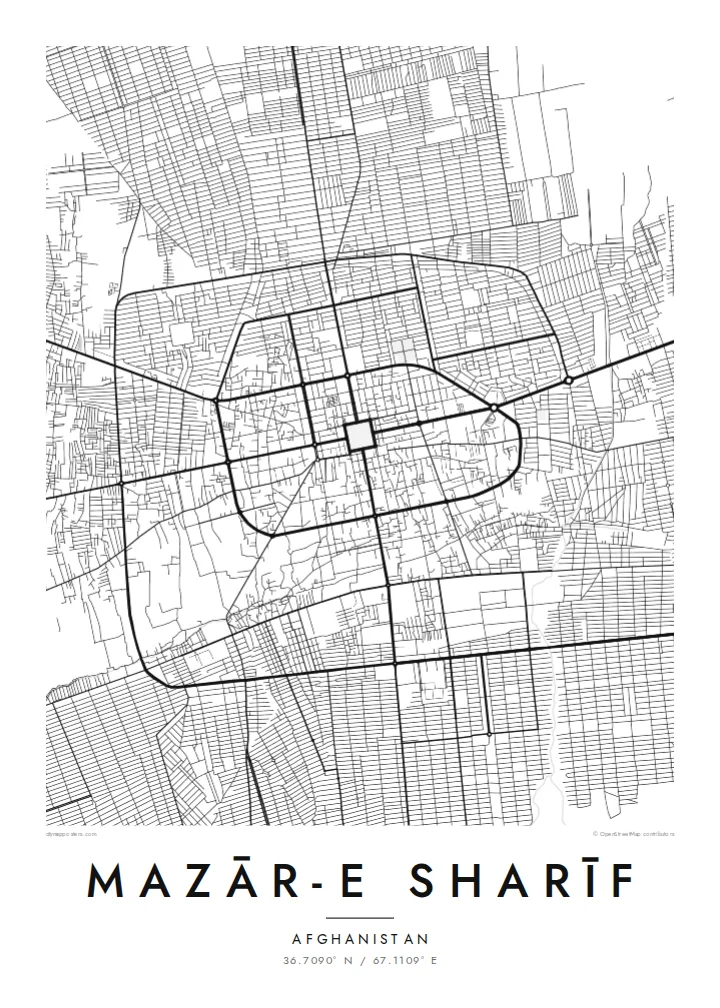
The walled grounds of the Blue Mosque form a large rectangle in the middle of the map, the point around which the city's main streets and markets are organised.
Posta faʻafanua faigofie · Afghanistan
36.7090° N / 67.1109° E
A plains city in northern Afghanistan organised around a single great shrine, with open ground stretching north toward the Amu Darya.


Tasi le aai, lagona e lima
Tapi se sitaili e vaai ai i luga o le puipui. E tutusa uma le tau o sitaili — pe lolomiina, faapipiiina, pe avea ma faila HD.
 Pika Moni · Faila Lolomi 24 × 36″
Manino mo le lolomi
O se vaega atoa (100%) lenei mai le faila lolomi moni. O posita uma — pe lolomiina, faapipiiina pe download mai — e faia i luga o a matou server i le 300 DPI, e oo atu i le 7,200 × 10,800 pika, ina ia manino pea auala laiti i luga o se lolomiga 24 × 36″.
I luga o le puipui


Le faʻafanua
Mazār-e Sharīf is the largest city in northern Afghanistan. It sits on a flat plain between the foothills of the Hindu Kush to the south and the Amu Darya to the north. Its name means the noble shrine. The city grew around the Shrine of Ali, widely known as the Blue Mosque, whose walled grounds sit at the centre of the street map.
Main avenues lead away from the shrine enclosure toward the edges of the city, and the surrounding blocks form a dense pattern of markets and low houses. Beyond them the built-up area gives way to irrigated fields and then open, dry ground. About twenty kilometres to the west lie the ruins of ancient Balkh, once one of Central Asia's great cities.
A Mazār-e Sharīf map poster reads almost like a diagram: a central enclosure, a tight block pattern around it and straight roads leaving for Balkh, Hairatan and the south. It is a strong, balanced subject, and the plain around it is so simple that the city's shape stands out clearly at any size.
The walled grounds of the Blue Mosque form a large rectangle in the middle of the map, the point around which the city's main streets and markets are organised.
Straight highways leave the city toward Balkh in the west and the Amu Darya border crossing at Hairatan in the north, drawing clean lines across open ground.
Canals and field boundaries surround the built-up area, a fine pattern of lines that gradually fades into the dry plain as the frame widens.
Fai mo oe
Faʻaopoopo se aso, se igoa po o sau lava upu, sui le sitaili, lapoʻa po o le itu.
O le preview e leai se totogi e maualalo le resolution ma iai se watermark. O lolomi ma faila HD e faia i le 300 DPI, e oo atu i le 7,200 × 10,800 px, e aunoa ma se watermark.
Aisea Mazār-e Sharīf
For Afghans abroad, Mazār-e Sharīf is often remembered through Nowruz at the shrine and the white pigeons in its courtyard. A map of the city is a quiet, personal way to keep that place close without relying on photographs.
Set the title, subtitle and coordinates line in your own words, perhaps a family name or a year. Choose Classic black & white, Noir, Paper, Blueprint or Sand, then download the HD files for $9 or order a printed poster on matte paper.
Faatau le posita Mazār-e Sharīf| Lapoʻa lolomi | Manino | Faila |
|---|---|---|
| 30 × 40 cm11.8 × 15.7″ | 3,543 × 4,724 px | PNG · PDF |
| 29.7 × 42 cm (A3)11.7 × 16.5″ | 3,508 × 4,961 px | PNG · PDF |
| 42 × 59.4 cm (A2)16.5 × 23.4″ | 4,961 × 7,016 px | PNG · PDF |
| 45.7 × 61 cm18 × 24″ | 5,400 × 7,200 px | PNG · PDF |
| 50 × 70 cm19.7 × 27.6″ | 5,906 × 8,268 px | PNG · PDF |
| 61 × 91.4 cm24 × 36″ | 7,200 × 10,800 px | PNG · PDF |
Ae faʻatusatusa, o le faʻataʻitaʻiga e leai se totogi e 900 px le lautele, e iai le faʻailoga vai ma e mo mata. O faila HD e oʻo atu i le 8× le manino i itu taʻitasi ma e lolomi manino i le lapoʻa atoa o le posta.
Filifili se sitaili i le pito i luga o le itulau, ona filifili lea o le Posita Lolomi — se lapopoa ma, afai e te fiafia, se faavaa — po o Faila HD Numera. E na o le tasi laasaga o le Checkout, ma o le a fesuia'i lou itulau o oka i le taimi lava e mae'a ai le totogi.
E lolomiina i luga o pepa matte maualuga le tulaga e 200 gsm, i se tasi o lapopoa e ono, mai le 30 × 40 cm i le 24 × 36″. E amata le tau o posita lolomi mai le $39, aofia ai le auina atu.
Ioe. Filifili se faavaa laau malosi i le lanu uliuli, sina, oak masani, po o le laau pogisa. E aofia ai se tioata e le gau ma ua saunia e tautau i luga. E amata le tau o posita faavaa mai le $99, aofia ai le auina atu.
E leai se totogi o le auina atu i atunuu e 60+. O pepa ata taʻitasi e lolomiina e le tasi o matou paaga lolomi e latalata mai i atunuu e 30+, ma e masani ona taunuu i le 3–7 aso faigaluega. E mafai ona e mulimulitaia le tulaga ma le sailiga i lalo o My Orders. O nisi atunuu e 2–5 vaiaso, ma i nofoaga e lei matou auina atu iai, e taʻu atu e le saite ia te oe a o lei totogi.
Auina mai se ata i totonu o le 14 aso talu ona taunuu, ma o le a matou toe lolomiina e leai se totogi po o le toe faafoi atu lau tupe.
Ioe. I totonu o le editor i lenei itulau, suia le ulutala, le ulutala laititi ma le laina o coordinates i soo se mea e te fiafia i ai, ma filifili se sitaili ma le lapopoa. O oka lolomi, faavaa ma numera e faaaoga uma lava lau mamanu.
Mo le $9 e te maua ai faila PNG 300 DPI ma PDF ua saunia mo le lolomi i lapopoa uma e ono, e aunoa ma se watermark, e mafai ona lolomi i soo se mea. Le mautinoa lava? Download muamua se preview e leai se totogi ma le watermark.
Latalata ane
