The railway
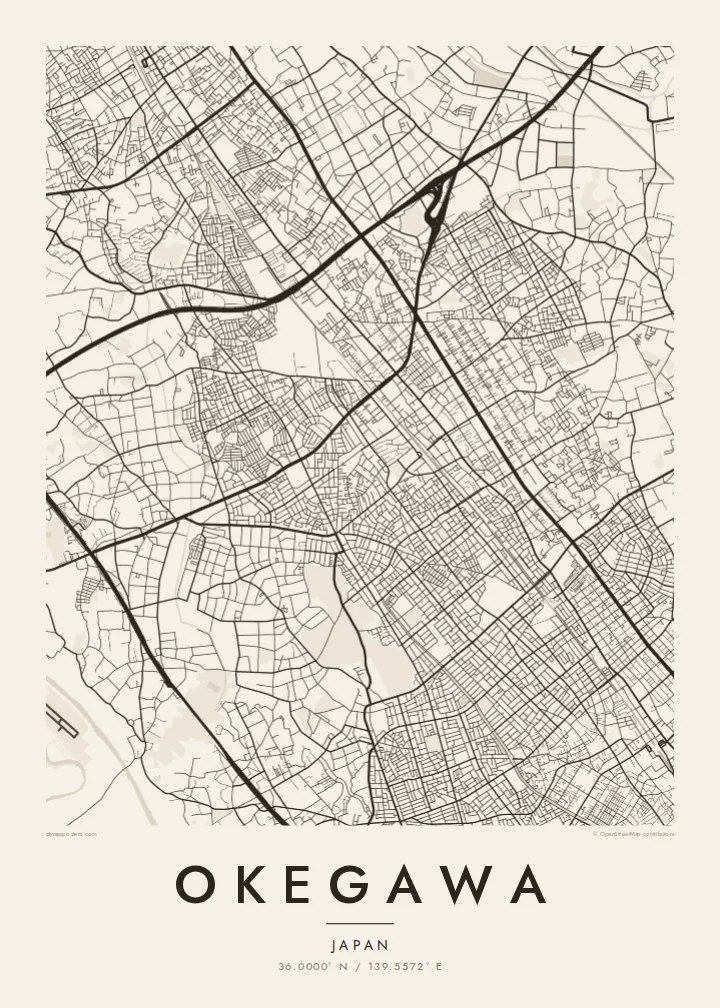
The JR Takasaki Line cuts a straight line through Okegawa, with the station area at its centre. On the print it acts as the spine that holds the town together.
Posta faʻafanua faigofie · Japan
36.0000° N / 139.5572° E
A Saitama commuter town along the old Nakasendō, its streets spreading out from a railway station into rice fields




Tasi le aai, lagona e lima
Tapi se sitaili e vaai ai i luga o le puipui. E tutusa uma le tau o sitaili — pe lolomiina, faapipiiina, pe avea ma faila HD.
 Pika Moni · Faila Lolomi 24 × 36″
Manino mo le lolomi
O se vaega atoa (100%) lenei mai le faila lolomi moni. O posita uma — pe lolomiina, faapipiiina pe download mai — e faia i luga o a matou server i le 300 DPI, e oo atu i le 7,200 × 10,800 pika, ina ia manino pea auala laiti i luga o se lolomiga 24 × 36″.
I luga o le puipui


Le faʻafanua
Okegawa is in central Saitama Prefecture, north of Tokyo, on the flat Kanto Plain. From above, the town is organised around the JR Takasaki Line, which runs through it roughly north-south, with the station area as its densest point. Residential streets spread out on both sides in a close, fine pattern, and patches of farmland and rice paddies still appear at the edges.
Before the railway, Okegawa was a post town on the Nakasendō, one of the old highways linking Edo and Kyoto, and the route still runs through the town. In the Edo period the area was known for safflower, grown for red dye, and the flower remains a local symbol. Today it is mostly a quiet commuter town for people working in Saitama and Tokyo.
An Okegawa map poster shows the typical layers of a Japanese suburban town: the straight railway, the older highway alongside it, the maze of small streets between, and the geometric shapes of fields at the edges. It is a detailed, finely textured map that rewards a close look.
The JR Takasaki Line cuts a straight line through Okegawa, with the station area at its centre. On the print it acts as the spine that holds the town together.
The historic highway runs through the town near the railway. Its route, once lined with inns for travellers, is still part of Okegawa's street network.
On the outskirts, residential streets give way to rectangular farm plots and paddies, a lighter, geometric texture that frames the denser centre.
Fai mo oe
Faʻaopoopo se aso, se igoa po o sau lava upu, sui le sitaili, lapoʻa po o le itu.
O le preview e leai se totogi e maualalo le resolution ma iai se watermark. O lolomi ma faila HD e faia i le 300 DPI, e oo atu i le 7,200 × 10,800 px, e aunoa ma se watermark.
Aisea Okegawa
Okegawa is the kind of place people call home for decades: close to Tokyo, but calm. A map of its streets suits a family moving house, a grandparent's birthday or someone remembering where they grew up.
Add a title, subtitle and coordinates line in your own words, and choose Classic black & white, Noir, Paper, Blueprint or Sand. The digital files cost $9, and printed posters on matte paper are shipped from partners around the world.
Faatau le posita Okegawa| Lapoʻa lolomi | Manino | Faila |
|---|---|---|
| 30 × 40 cm11.8 × 15.7″ | 3,543 × 4,724 px | PNG · PDF |
| 29.7 × 42 cm (A3)11.7 × 16.5″ | 3,508 × 4,961 px | PNG · PDF |
| 42 × 59.4 cm (A2)16.5 × 23.4″ | 4,961 × 7,016 px | PNG · PDF |
| 45.7 × 61 cm18 × 24″ | 5,400 × 7,200 px | PNG · PDF |
| 50 × 70 cm19.7 × 27.6″ | 5,906 × 8,268 px | PNG · PDF |
| 61 × 91.4 cm24 × 36″ | 7,200 × 10,800 px | PNG · PDF |
Ae faʻatusatusa, o le faʻataʻitaʻiga e leai se totogi e 900 px le lautele, e iai le faʻailoga vai ma e mo mata. O faila HD e oʻo atu i le 8× le manino i itu taʻitasi ma e lolomi manino i le lapoʻa atoa o le posta.
Filifili se sitaili i le pito i luga o le itulau, ona filifili lea o le Posita Lolomi — se lapopoa ma, afai e te fiafia, se faavaa — po o Faila HD Numera. E na o le tasi laasaga o le Checkout, ma o le a fesuia'i lou itulau o oka i le taimi lava e mae'a ai le totogi.
E lolomiina i luga o pepa matte maualuga le tulaga e 200 gsm, i se tasi o lapopoa e ono, mai le 30 × 40 cm i le 24 × 36″. E amata le tau o posita lolomi mai le $39, aofia ai le auina atu.
Ioe. Filifili se faavaa laau malosi i le lanu uliuli, sina, oak masani, po o le laau pogisa. E aofia ai se tioata e le gau ma ua saunia e tautau i luga. E amata le tau o posita faavaa mai le $99, aofia ai le auina atu.
E leai se totogi o le auina atu i atunuu e 60+. O pepa ata taʻitasi e lolomiina e le tasi o matou paaga lolomi e latalata mai i atunuu e 30+, ma e masani ona taunuu i le 3–7 aso faigaluega. E mafai ona e mulimulitaia le tulaga ma le sailiga i lalo o My Orders. O nisi atunuu e 2–5 vaiaso, ma i nofoaga e lei matou auina atu iai, e taʻu atu e le saite ia te oe a o lei totogi.
Auina mai se ata i totonu o le 14 aso talu ona taunuu, ma o le a matou toe lolomiina e leai se totogi po o le toe faafoi atu lau tupe.
Ioe. I totonu o le editor i lenei itulau, suia le ulutala, le ulutala laititi ma le laina o coordinates i soo se mea e te fiafia i ai, ma filifili se sitaili ma le lapopoa. O oka lolomi, faavaa ma numera e faaaoga uma lava lau mamanu.
Mo le $9 e te maua ai faila PNG 300 DPI ma PDF ua saunia mo le lolomi i lapopoa uma e ono, e aunoa ma se watermark, e mafai ona lolomi i soo se mea. Le mautinoa lava? Download muamua se preview e leai se totogi ma le watermark.
Latalata ane
