White Nile bank
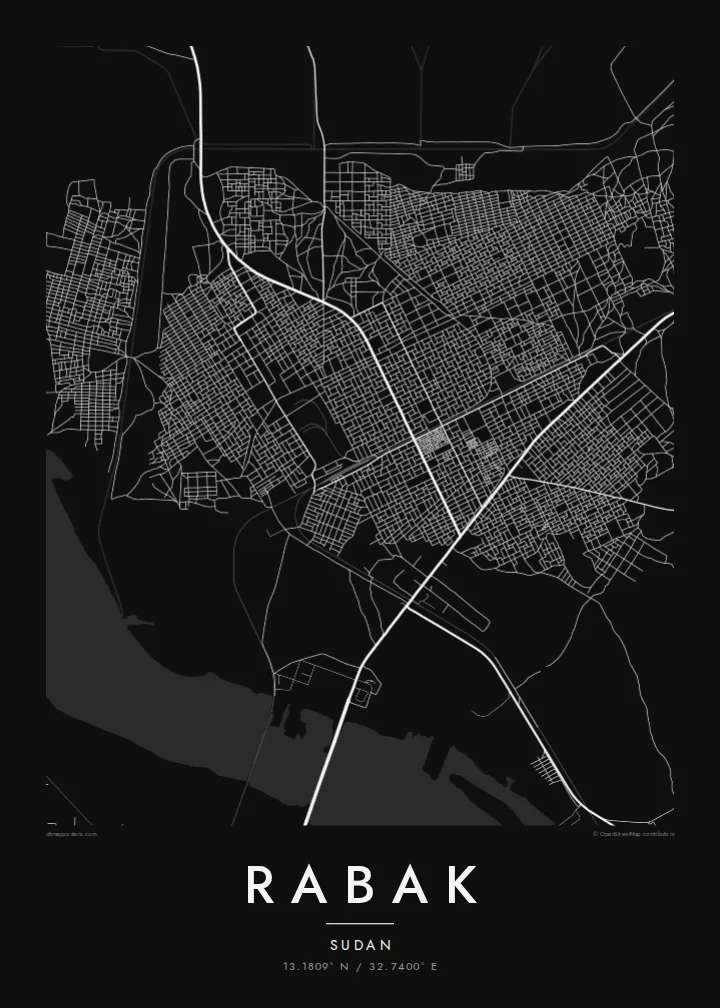
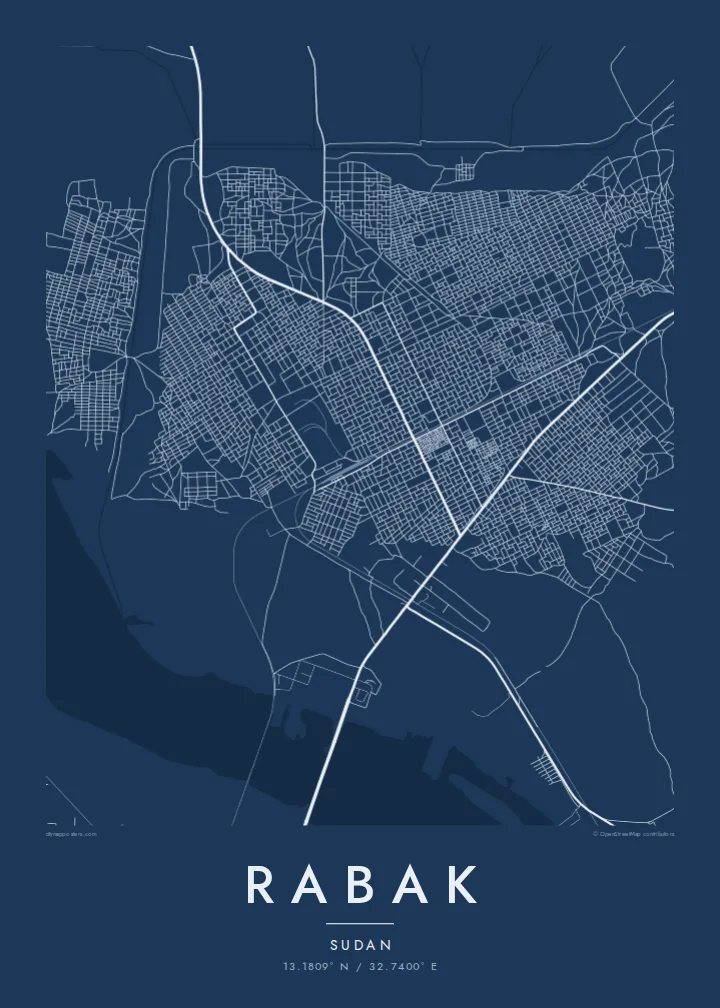
The river forms the western edge of Rabak. It is a broad band that separates the town from its neighbour and sets the direction of its main streets.
Posta faʻafanua faigofie · Sudan
13.1809° N / 32.7400° E
A flat town on the east bank of the White Nile, facing its twin, Kosti, across a broad and slow river.



Tasi le aai, lagona e lima
Tapi se sitaili e vaai ai i luga o le puipui. E tutusa uma le tau o sitaili — pe lolomiina, faapipiiina, pe avea ma faila HD.
 Pika Moni · Faila Lolomi 24 × 36″
Manino mo le lolomi
O se vaega atoa (100%) lenei mai le faila lolomi moni. O posita uma — pe lolomiina, faapipiiina pe download mai — e faia i luga o a matou server i le 300 DPI, e oo atu i le 7,200 × 10,800 pika, ina ia manino pea auala laiti i luga o se lolomiga 24 × 36″.
I luga o le puipui


Le faʻafanua
Rabak is the capital of White Nile State in Sudan and sits on the eastern bank of the White Nile, south of Khartoum. The land here is almost perfectly level. From above, the town reads as a loose grid of low blocks and wide streets that spread back from the river onto the clay plain, with very little relief to interrupt the pattern.
Across the water lies Kosti, the larger twin town and a long-established river port. Bridges link the two banks. The White Nile is broad and slow at this point, with islands and wetlands along its margins. Irrigated farmland and sugar estates in the surrounding region carry the geometry of fields and canals outward from the settlement.
A Rabak map poster shows a quieter part of the Nile story, far from the famous confluence at Khartoum. The composition is simple and strong: a wide river, a town laid out on open ground beside it, and roads striking off across the plain. It is a map about scale and flatness, and it reads well in any of the monochrome styles.
The river forms the western edge of Rabak. It is a broad band that separates the town from its neighbour and sets the direction of its main streets.
Bridges link Rabak to Kosti on the opposite bank. Framed wide enough, the map shows the two towns as a pair facing each other across the water.
Away from the river, the streets form a loose rectangular pattern on level ground. The generous blocks give the map a light, airy texture.
Fai mo oe
Faʻaopoopo se aso, se igoa po o sau lava upu, sui le sitaili, lapoʻa po o le itu.
O le preview e leai se totogi e maualalo le resolution ma iai se watermark. O lolomi ma faila HD e faia i le 300 DPI, e oo atu i le 7,200 × 10,800 px, e aunoa ma se watermark.
Aisea Rabak
Sudanese families from White Nile State, including many now living far from home, rarely see Rabak on a printed map at street scale. A poster of the town is a quiet way to keep it on the wall, with the river and the crossing to Kosti included.
You can write your own title, add a subtitle with a date or family name, and adjust the coordinates line. Choose Classic black & white, Noir, Paper, Blueprint or Sand and check the free 900 px preview. Then download the HD files for $9 or order a printed poster.
Faatau le posita Rabak| Lapoʻa lolomi | Manino | Faila |
|---|---|---|
| 30 × 40 cm (11.8 × 15.7″) | 3,543 × 4,724 px | PNG · PDF |
| 29.7 × 42 cm (A3, 11.7 × 16.5″) | 3,508 × 4,961 px | PNG · PDF |
| 42 × 59.4 cm (A2, 16.5 × 23.4″) | 4,961 × 7,016 px | PNG · PDF |
| 45.7 × 61 cm (18 × 24″) | 5,400 × 7,200 px | PNG · PDF |
| 50 × 70 cm (19.7 × 27.6″) | 5,906 × 8,268 px | PNG · PDF |
| 61 × 91.4 cm (24 × 36″) | 7,200 × 10,800 px | PNG · PDF |
Ae faʻatusatusa, o le faʻataʻitaʻiga e leai se totogi e 900 px le lautele, e iai le faʻailoga vai ma e mo mata. O faila HD e oʻo atu i le 8× le manino i itu taʻitasi ma e lolomi manino i le lapoʻa atoa o le posta.
Filifili se sitaili i le pito i luga o le itulau, ona filifili lea o le Posita Lolomi — se lapopoa ma, afai e te fiafia, se faavaa — po o Faila HD Numera. E na o le tasi laasaga o le Checkout, ma o le a fesuia'i lou itulau o oka i le taimi lava e mae'a ai le totogi.
E lolomiina i luga o pepa matte maualuga le tulaga e 200 gsm, i se tasi o lapopoa e ono, mai le 30 × 40 cm i le 24 × 36″. E amata le tau o posita lolomi mai le {printFrom}, aofia ai le auina atu.
Ioe. Filifili se faavaa laau malosi i le lanu uliuli, sina, oak masani, po o le laau pogisa. E aofia ai se tioata e le gau ma ua saunia e tautau i luga. E amata le tau o posita faavaa mai le {framedFrom}, aofia ai le auina atu.
E leai se totogi mo le uta i le lalolagi atoa. O poster ta'itasi e lolomi e le paaga lolomi e latalata mai i matou i atunuu e 30+, ma e masani ona taunuu i aso faigaluega e 3–7. E mafai ona e mulimuli i le tulaga ma le tracking i le "Aʻu Oka". O nisi atunuu e 2–5 vaiaso, ma i atunuu matou te lei tuuina atu ai, e taʻu atu e le saite iā te oe ae e te leʻi totogiina.
Auina mai se ata i totonu o le 14 aso talu ona taunuu, ma o le a matou toe lolomiina e leai se totogi po o le toe faafoi atu lau tupe.
Ioe. I totonu o le editor i lenei itulau, suia le ulutala, le ulutala laititi ma le laina o coordinates i soo se mea e te fiafia i ai, ma filifili se sitaili ma le lapopoa. O oka lolomi, faavaa ma numera e faaaoga uma lava lau mamanu.
Mo le $9 e te maua ai faila PNG 300 DPI ma PDF ua saunia mo le lolomi i lapopoa uma e ono, e aunoa ma se watermark, e mafai ona lolomi i soo se mea. Le mautinoa lava? Download muamua se preview e leai se totogi ma le watermark.
