Neighbourhood clusters
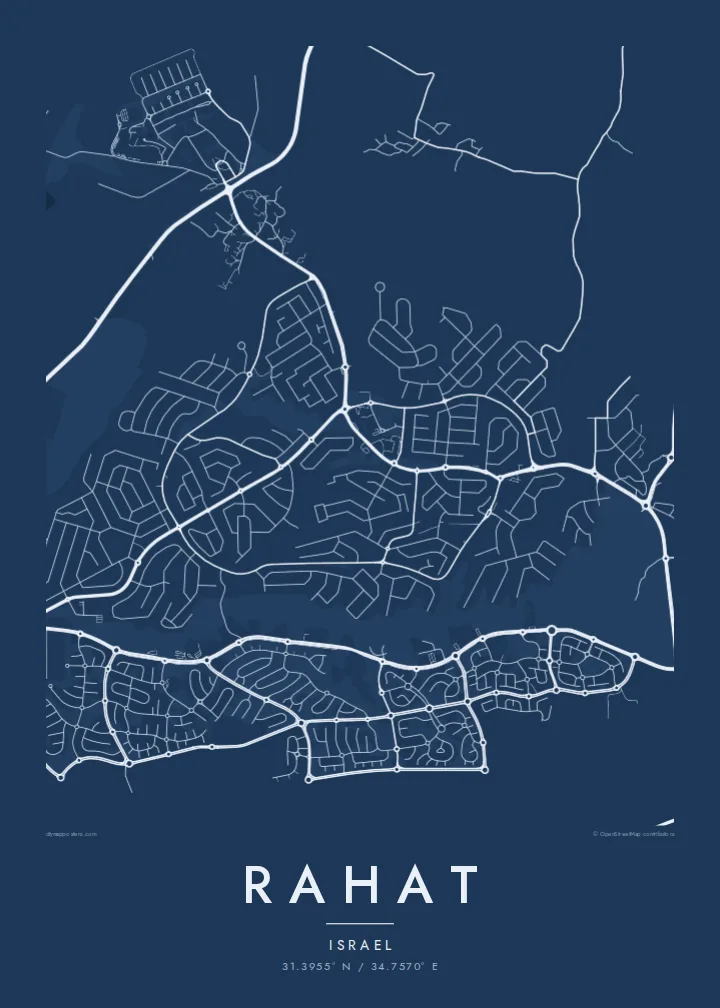
The city is organised into separate neighbourhoods, often numbered. On the map they appear as distinct groups of streets linked by main roads.
Posta faʻafanua faigofie · Israel
31.3955° N / 34.7570° E
A planned Negev town of numbered neighbourhoods laid out in distinct clusters across the desert plain north of Beersheba.



Tasi le aai, lagona e lima
Tapi se sitaili e vaai ai i luga o le puipui. E tutusa uma le tau o sitaili — pe lolomiina, faapipiiina, pe avea ma faila HD.
 Pika Moni · Faila Lolomi 24 × 36″
Manino mo le lolomi
O se vaega atoa (100%) lenei mai le faila lolomi moni. O posita uma — pe lolomiina, faapipiiina pe download mai — e faia i luga o a matou server i le 300 DPI, e oo atu i le 7,200 × 10,800 pika, ina ia manino pea auala laiti i luga o se lolomiga 24 × 36″.
I luga o le puipui


Le faʻafanua
Rahat lies in the northern Negev, a short distance north of Beersheba. It is the largest Bedouin city in Israel and was established as a planned town in the early 1970s. It received city status in 1994. Its layout reflects that planning: the town is divided into separate neighbourhoods, many identified by number, each forming its own cluster of streets.
From above, Rahat looks like a group of distinct residential units connected by main roads, with open ground between some of them. Around the town, the Negev landscape is dry and open, crossed by roads, wadis and agricultural plots. The contrast between the organised neighbourhood clusters and the surrounding land is the defining feature of the map.
A Rahat map poster captures a city that grew quickly from a planned beginning into a significant urban centre in southern Israel. Printed in black and white, the neighbourhood pattern becomes a striking modular composition. For residents and families connected to Rahat, each cluster represents a specific place and a specific set of people.
The city is organised into separate neighbourhoods, often numbered. On the map they appear as distinct groups of streets linked by main roads.
Rahat was founded as a planned town in the 1970s, and its structured layout shows clearly compared with older, more organic settlements.
Open, arid land surrounds the city, crossed by roads and dry watercourses, which gives the map generous empty space around its edges.
Fai mo oe
Faʻaopoopo se aso, se igoa po o sau lava upu, sui le sitaili, lapoʻa po o le itu.
O le preview e leai se totogi e maualalo le resolution ma iai se watermark. O lolomi ma faila HD e faia i le 300 DPI, e oo atu i le 7,200 × 10,800 px, e aunoa ma se watermark.
Aisea Rahat
For families from Rahat and the wider Negev Bedouin community, this map is a portrait of home drawn at the scale of neighbourhoods. Its modular pattern also makes it a strong, distinctive graphic piece.
Set a title, a subtitle and the coordinates line, and choose from five styles. Sand suits the desert setting especially well. HD files cost $9 for six sizes, and printed posters on matte paper can be ordered with or without a frame.
Faatau le posita Rahat| Lapoʻa lolomi | Manino | Faila |
|---|---|---|
| 30 × 40 cm11.8 × 15.7″ | 3,543 × 4,724 px | PNG · PDF |
| 29.7 × 42 cm (A3)11.7 × 16.5″ | 3,508 × 4,961 px | PNG · PDF |
| 42 × 59.4 cm (A2)16.5 × 23.4″ | 4,961 × 7,016 px | PNG · PDF |
| 45.7 × 61 cm18 × 24″ | 5,400 × 7,200 px | PNG · PDF |
| 50 × 70 cm19.7 × 27.6″ | 5,906 × 8,268 px | PNG · PDF |
| 61 × 91.4 cm24 × 36″ | 7,200 × 10,800 px | PNG · PDF |
Ae faʻatusatusa, o le faʻataʻitaʻiga e leai se totogi e 900 px le lautele, e iai le faʻailoga vai ma e mo mata. O faila HD e oʻo atu i le 8× le manino i itu taʻitasi ma e lolomi manino i le lapoʻa atoa o le posta.
Filifili se sitaili i le pito i luga o le itulau, ona filifili lea o le Posita Lolomi — se lapopoa ma, afai e te fiafia, se faavaa — po o Faila HD Numera. E na o le tasi laasaga o le Checkout, ma o le a fesuia'i lou itulau o oka i le taimi lava e mae'a ai le totogi.
E lolomiina i luga o pepa matte maualuga le tulaga e 200 gsm, i se tasi o lapopoa e ono, mai le 30 × 40 cm i le 24 × 36″. E amata le tau o posita lolomi mai le $39, aofia ai le auina atu.
Ioe. Filifili se faavaa laau malosi i le lanu uliuli, sina, oak masani, po o le laau pogisa. E aofia ai se tioata e le gau ma ua saunia e tautau i luga. E amata le tau o posita faavaa mai le $99, aofia ai le auina atu.
E leai se totogi o le auina atu i atunuu e 60+. O pepa ata taʻitasi e lolomiina e le tasi o matou paaga lolomi e latalata mai i atunuu e 30+, ma e masani ona taunuu i le 3–7 aso faigaluega. E mafai ona e mulimulitaia le tulaga ma le sailiga i lalo o My Orders. O nisi atunuu e 2–5 vaiaso, ma i nofoaga e lei matou auina atu iai, e taʻu atu e le saite ia te oe a o lei totogi.
Auina mai se ata i totonu o le 14 aso talu ona taunuu, ma o le a matou toe lolomiina e leai se totogi po o le toe faafoi atu lau tupe.
Ioe. I totonu o le editor i lenei itulau, suia le ulutala, le ulutala laititi ma le laina o coordinates i soo se mea e te fiafia i ai, ma filifili se sitaili ma le lapopoa. O oka lolomi, faavaa ma numera e faaaoga uma lava lau mamanu.
Mo le $9 e te maua ai faila PNG 300 DPI ma PDF ua saunia mo le lolomi i lapopoa uma e ono, e aunoa ma se watermark, e mafai ona lolomi i soo se mea. Le mautinoa lava? Download muamua se preview e leai se totogi ma le watermark.
Latalata ane
