Village core
The church and square anchor a small, irregular grid of streets, the densest part of a village that otherwise opens out onto farmland.
Posta faʻafanua faigofie · Mexico
19.1865° N / 99.0736° W
A hillside village in Milpa Alta, its streets climbing volcanic slopes above the southern edge of Mexico City
Tasi le aai, lagona e lima
Tapi se sitaili e vaai ai i luga o le puipui. E tutusa uma le tau o sitaili — pe lolomiina, faapipiiina, pe avea ma faila HD.
 Pika Moni · Faila Lolomi 24 × 36″
Manino mo le lolomi
O se vaega atoa (100%) lenei mai le faila lolomi moni. O posita uma — pe lolomiina, faapipiiina pe download mai — e faia i luga o a matou server i le 300 DPI, e oo atu i le 7,200 × 10,800 pika, ina ia manino pea auala laiti i luga o se lolomiga 24 × 36″.
I luga o le puipui


Le faʻafanua
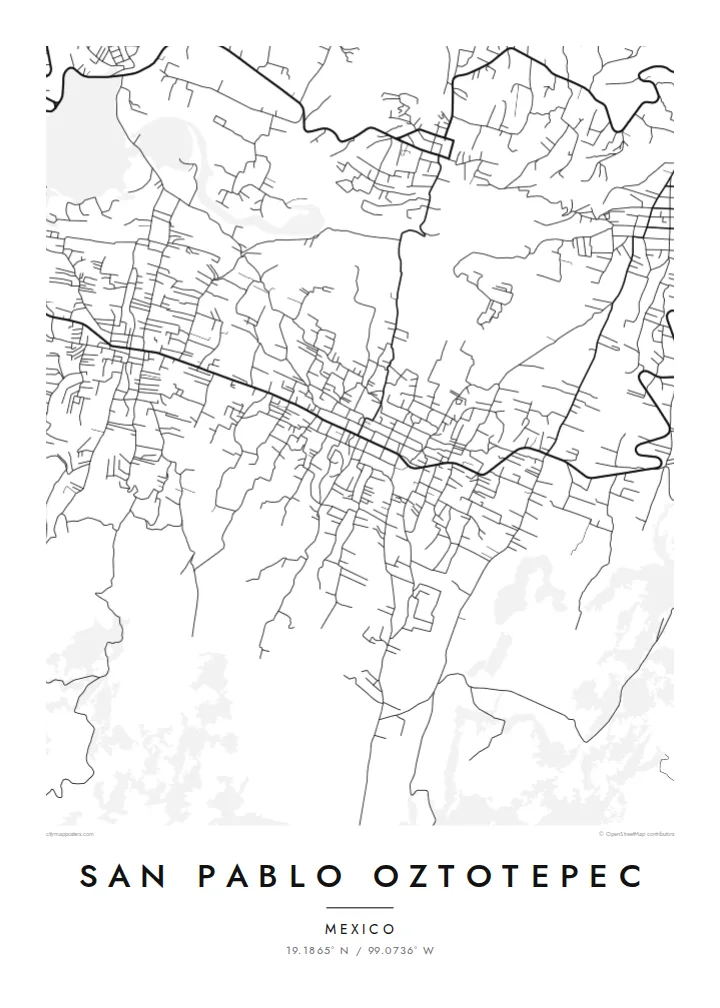
San Pablo Oztotepec is one of the villages of Milpa Alta, the most rural borough of Mexico City, on the mountainous southern edge of the capital. The name comes from Nahuatl and is usually translated as hill of caves. On a map, the village sits on sloping volcanic ground, with streets bending to follow the terrain around the church and main square.
Milpa Alta is known for growing nopal cactus, and the land around the village is divided into small cultivated plots that climb toward wooded peaks. San Pablo Oztotepec also has a place in revolutionary history: in 1914, Zapatista leaders gathered here to ratify the Plan de Ayala, the manifesto of their agrarian movement.
A San Pablo Oztotepec map poster shows a very different Mexico City from the dense grid of the centre. The village core is small and irregular, the surrounding fields form a fine mosaic, and the roads wind up and down the slopes. It is a quiet, detailed composition with a strong sense of the land underneath.
The church and square anchor a small, irregular grid of streets, the densest part of a village that otherwise opens out onto farmland.
Around the village, small cultivated parcels, many planted with nopal, cover the slopes and appear as a fine patchwork on the map.
The ground rises toward the southern mountains, and winding roads and tracks follow the contours between the village and the forested heights.
Fai mo oe
Faʻaopoopo se aso, se igoa po o sau lava upu, sui le sitaili, lapoʻa po o le itu.
O le preview e leai se totogi e maualalo le resolution ma iai se watermark. O lolomi ma faila HD e faia i le 300 DPI, e oo atu i le 7,200 × 10,800 px, e aunoa ma se watermark.
Aisea San Pablo Oztotepec
For families from Milpa Alta or anyone interested in the rural side of Mexico City, this map shows a village with deep roots and a distinct identity. The hillside pattern makes a thoughtful print, far from the usual city skyline.
The title, subtitle and coordinates line can be changed, perhaps to add the village name in Nahuatl or a family date. Choose from Classic black & white, Noir, Paper, Blueprint or Sand, and download all six sizes for $9, without watermark.
Faatau le posita San Pablo Oztotepec| Lapoʻa lolomi | Manino | Faila |
|---|---|---|
| 30 × 40 cm11.8 × 15.7″ | 3,543 × 4,724 px | PNG · PDF |
| 29.7 × 42 cm (A3)11.7 × 16.5″ | 3,508 × 4,961 px | PNG · PDF |
| 42 × 59.4 cm (A2)16.5 × 23.4″ | 4,961 × 7,016 px | PNG · PDF |
| 45.7 × 61 cm18 × 24″ | 5,400 × 7,200 px | PNG · PDF |
| 50 × 70 cm19.7 × 27.6″ | 5,906 × 8,268 px | PNG · PDF |
| 61 × 91.4 cm24 × 36″ | 7,200 × 10,800 px | PNG · PDF |
Ae faʻatusatusa, o le faʻataʻitaʻiga e leai se totogi e 900 px le lautele, e iai le faʻailoga vai ma e mo mata. O faila HD e oʻo atu i le 8× le manino i itu taʻitasi ma e lolomi manino i le lapoʻa atoa o le posta.
Filifili se sitaili i le pito i luga o le itulau, ona filifili lea o le Posita Lolomi — se lapopoa ma, afai e te fiafia, se faavaa — po o Faila HD Numera. E na o le tasi laasaga o le Checkout, ma o le a fesuia'i lou itulau o oka i le taimi lava e mae'a ai le totogi.
E lolomiina i luga o pepa matte maualuga le tulaga e 200 gsm, i se tasi o lapopoa e ono, mai le 30 × 40 cm i le 24 × 36″. E amata le tau o posita lolomi mai le $39, aofia ai le auina atu.
Ioe. Filifili se faavaa laau malosi i le lanu uliuli, sina, oak masani, po o le laau pogisa. E aofia ai se tioata e le gau ma ua saunia e tautau i luga. E amata le tau o posita faavaa mai le $99, aofia ai le auina atu.
E leai se totogi o le auina atu i atunuu e 60+. O pepa ata taʻitasi e lolomiina e le tasi o matou paaga lolomi e latalata mai i atunuu e 30+, ma e masani ona taunuu i le 3–7 aso faigaluega. E mafai ona e mulimulitaia le tulaga ma le sailiga i lalo o My Orders. O nisi atunuu e 2–5 vaiaso, ma i nofoaga e lei matou auina atu iai, e taʻu atu e le saite ia te oe a o lei totogi.
Auina mai se ata i totonu o le 14 aso talu ona taunuu, ma o le a matou toe lolomiina e leai se totogi po o le toe faafoi atu lau tupe.
Ioe. I totonu o le editor i lenei itulau, suia le ulutala, le ulutala laititi ma le laina o coordinates i soo se mea e te fiafia i ai, ma filifili se sitaili ma le lapopoa. O oka lolomi, faavaa ma numera e faaaoga uma lava lau mamanu.
Mo le $9 e te maua ai faila PNG 300 DPI ma PDF ua saunia mo le lolomi i lapopoa uma e ono, e aunoa ma se watermark, e mafai ona lolomi i soo se mea. Le mautinoa lava? Download muamua se preview e leai se totogi ma le watermark.
Latalata ane
