The BR-316 axis
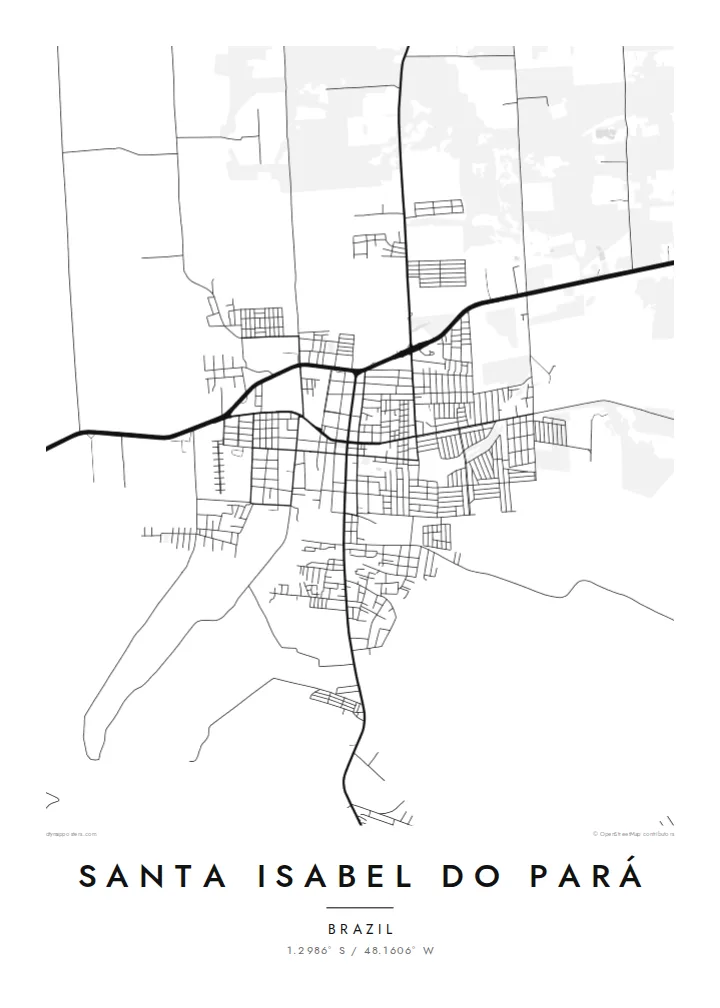
The highway draws a firm diagonal through the town. Most of the street network hangs from it like branches from a stem, which gives the poster a clear sense of direction.
Posta faʻafanua faigofie · Brazil
1.2986° S / 48.1606° W
A town strung along the BR-316 east of Belém, where roadside blocks give way to creeks and dense green lowland


Tasi le aai, lagona e lima
Tapi se sitaili e vaai ai i luga o le puipui. E tutusa uma le tau o sitaili — pe lolomiina, faapipiiina, pe avea ma faila HD.
 Pika Moni · Faila Lolomi 24 × 36″
Manino mo le lolomi
O se vaega atoa (100%) lenei mai le faila lolomi moni. O posita uma — pe lolomiina, faapipiiina pe download mai — e faia i luga o a matou server i le 300 DPI, e oo atu i le 7,200 × 10,800 pika, ina ia manino pea auala laiti i luga o se lolomiga 24 × 36″.
I luga o le puipui


Le faʻafanua
Santa Isabel do Pará lies on the eastern edge of Greater Belém, in the humid lowlands near the Amazon estuary. The BR-316, the main highway toward the northeast of the state, runs straight through it, and much of the town has grown along that road. From above this gives the place a strong central spine. Neighbourhoods branch off to either side before thinning into forest and small farms.
The land is flat and laced with streams, so many streets bend around low, wet ground instead of following a strict grid. At the margins, small waterways feeding the region's larger river systems appear as thin, winding lines. A Santa Isabel do Pará map poster captures this meeting of a road-built town and a watery landscape in one balanced frame.
Its place in the metropolitan area makes the town both a commuter base and a gateway to the interior of Pará. The rivers in the surrounding countryside are popular for weekend outings from the capital. On paper the map becomes a quiet study of growth: one clear axis, a spread of side streets, and soft, uneven edges where the town meets the Amazonian green.
The highway draws a firm diagonal through the town. Most of the street network hangs from it like branches from a stem, which gives the poster a clear sense of direction.
Narrow streams wind through the outskirts. Around them the street pattern loosens and curves, showing how the water-shaped ground has guided building.
On one side the map shows the steady spread of Greater Belém, and on the other the open green of rural Pará. The town sits exactly where the two meet.
Fai mo oe
Faʻaopoopo se aso, se igoa po o sau lava upu, sui le sitaili, lapoʻa po o le itu.
O le preview e leai se totogi e maualalo le resolution ma iai se watermark. O lolomi ma faila HD e faia i le 300 DPI, e oo atu i le 7,200 × 10,800 px, e aunoa ma se watermark.
Aisea Santa Isabel do Pará
The poster suits anyone who commutes along the BR-316, grew up on these streets or has family in Pará. Put the town name in the title, a date or dedication in the subtitle, and keep the coordinates line as a precise marker of home.
Noir turns the winding creeks and branching streets into bright lines on black. Paper gives them a softer, printed-page feel. For $9 the digital files cover six sizes, from 30×40 cm to 24×36″, with no watermark. A free 900 px preview lets you check the layout first.
Faatau le posita Santa Isabel do Pará| Lapoʻa lolomi | Manino | Faila |
|---|---|---|
| 30 × 40 cm11.8 × 15.7″ | 3,543 × 4,724 px | PNG · PDF |
| 29.7 × 42 cm (A3)11.7 × 16.5″ | 3,508 × 4,961 px | PNG · PDF |
| 42 × 59.4 cm (A2)16.5 × 23.4″ | 4,961 × 7,016 px | PNG · PDF |
| 45.7 × 61 cm18 × 24″ | 5,400 × 7,200 px | PNG · PDF |
| 50 × 70 cm19.7 × 27.6″ | 5,906 × 8,268 px | PNG · PDF |
| 61 × 91.4 cm24 × 36″ | 7,200 × 10,800 px | PNG · PDF |
Ae faʻatusatusa, o le faʻataʻitaʻiga e leai se totogi e 900 px le lautele, e iai le faʻailoga vai ma e mo mata. O faila HD e oʻo atu i le 8× le manino i itu taʻitasi ma e lolomi manino i le lapoʻa atoa o le posta.
Filifili se sitaili i le pito i luga o le itulau, ona filifili lea o le Posita Lolomi — se lapopoa ma, afai e te fiafia, se faavaa — po o Faila HD Numera. E na o le tasi laasaga o le Checkout, ma o le a fesuia'i lou itulau o oka i le taimi lava e mae'a ai le totogi.
E lolomiina i luga o pepa matte maualuga le tulaga e 200 gsm, i se tasi o lapopoa e ono, mai le 30 × 40 cm i le 24 × 36″. E amata le tau o posita lolomi mai le $39, aofia ai le auina atu.
Ioe. Filifili se faavaa laau malosi i le lanu uliuli, sina, oak masani, po o le laau pogisa. E aofia ai se tioata e le gau ma ua saunia e tautau i luga. E amata le tau o posita faavaa mai le $99, aofia ai le auina atu.
E leai se totogi o le auina atu i atunuu e 60+. O pepa ata taʻitasi e lolomiina e le tasi o matou paaga lolomi e latalata mai i atunuu e 30+, ma e masani ona taunuu i le 3–7 aso faigaluega. E mafai ona e mulimulitaia le tulaga ma le sailiga i lalo o My Orders. O nisi atunuu e 2–5 vaiaso, ma i nofoaga e lei matou auina atu iai, e taʻu atu e le saite ia te oe a o lei totogi.
Auina mai se ata i totonu o le 14 aso talu ona taunuu, ma o le a matou toe lolomiina e leai se totogi po o le toe faafoi atu lau tupe.
Ioe. I totonu o le editor i lenei itulau, suia le ulutala, le ulutala laititi ma le laina o coordinates i soo se mea e te fiafia i ai, ma filifili se sitaili ma le lapopoa. O oka lolomi, faavaa ma numera e faaaoga uma lava lau mamanu.
Mo le $9 e te maua ai faila PNG 300 DPI ma PDF ua saunia mo le lolomi i lapopoa uma e ono, e aunoa ma se watermark, e mafai ona lolomi i soo se mea. Le mautinoa lava? Download muamua se preview e leai se totogi ma le watermark.
Latalata ane
