Corridor to the south
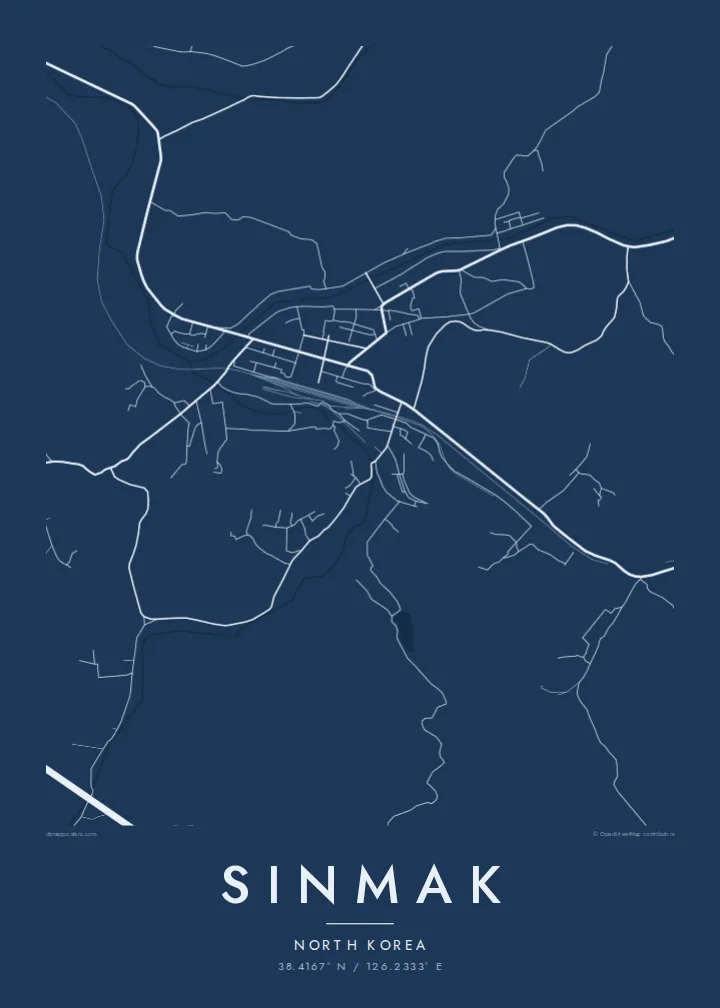
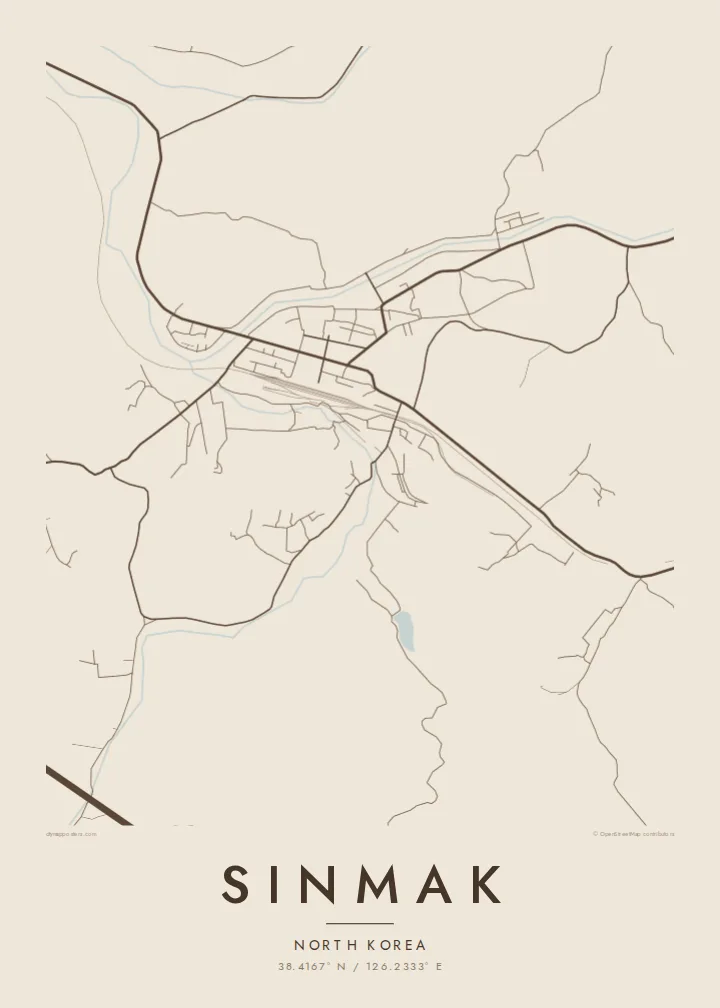
Road and rail heading from Pyongyang towards Kaesong run through the area, and their long, steady lines are the strongest strokes on the map.
Posta faʻafanua faigofie · North Korea
38.4167° N / 126.2333° E
A small inland town strung along road and rail, with river valleys and folded hills pressing in from every side.


Tasi le aai, lagona e lima
Tapi se sitaili e vaai ai i luga o le puipui. E tutusa uma le tau o sitaili — pe lolomiina, faapipiiina, pe avea ma faila HD.
 Pika Moni · Faila Lolomi 24 × 36″
Manino mo le lolomi
O se vaega atoa (100%) lenei mai le faila lolomi moni. O posita uma — pe lolomiina, faapipiiina pe download mai — e faia i luga o a matou server i le 300 DPI, e oo atu i le 7,200 × 10,800 pika, ina ia manino pea auala laiti i luga o se lolomiga 24 × 36″.
I luga o le puipui


Le faʻafanua
Sinmak sits in North Hwanghae province, in the hilly interior of southern North Korea. From above, the town reads as a compact cluster of blocks gathered where the valley floors widen enough to hold streets, while the land around it quickly breaks into ridges and narrow drainage lines. The contrast between the dense centre and the empty, contoured country around it gives the map a clear, almost diagrammatic structure.
The town lies on the main transport corridor running south from Pyongyang towards Kaesong, and that corridor shapes the plan: a railway and a highway pass through or close to the settlement, drawing long lines across an otherwise irregular landscape. On paper these straight routes act like a spine, and the smaller streets hang off them in short, practical branches rather than a formal grid.
Detailed information about the town is limited, so a Sinmak map poster is best understood as a portrait of form rather than of landmarks. It shows the way a settlement fits into its terrain, the lines of movement that connect it to the rest of the country, and the quiet geometry of streets in a landscape where hills fill most of the frame.
Road and rail heading from Pyongyang towards Kaesong run through the area, and their long, steady lines are the strongest strokes on the map.
The built-up area follows the flatter valley ground, so the edges of the town are set by the rise of the land rather than by walls or ring roads.
Beyond the last streets, ridges and small watercourses fill the frame, giving the poster a wide margin of fine, irregular linework.
Fai mo oe
Faʻaopoopo se aso, se igoa po o sau lava upu, sui le sitaili, lapoʻa po o le itu.
O le preview e leai se totogi e maualalo le resolution ma iai se watermark. O lolomi ma faila HD e faia i le 300 DPI, e oo atu i le 7,200 × 10,800 px, e aunoa ma se watermark.
Aisea Sinmak
This print suits someone with a family connection to the region, a traveller interested in the geography of the Korean peninsula, or anyone drawn to maps where a small town is held within a large landscape. It is a reserved, graphic image that works well in a study or hallway.
You can change the title, subtitle and coordinates line, for example to add a family name or a year, and choose from Classic black & white, Noir, Paper, Blueprint or Sand. The digital files cost $9 and cover six print sizes, or a printed poster can be shipped with an optional wooden frame.
Faatau le posita Sinmak| Lapoʻa lolomi | Manino | Faila |
|---|---|---|
| 30 × 40 cm11.8 × 15.7″ | 3,543 × 4,724 px | PNG · PDF |
| 29.7 × 42 cm (A3)11.7 × 16.5″ | 3,508 × 4,961 px | PNG · PDF |
| 42 × 59.4 cm (A2)16.5 × 23.4″ | 4,961 × 7,016 px | PNG · PDF |
| 45.7 × 61 cm18 × 24″ | 5,400 × 7,200 px | PNG · PDF |
| 50 × 70 cm19.7 × 27.6″ | 5,906 × 8,268 px | PNG · PDF |
| 61 × 91.4 cm24 × 36″ | 7,200 × 10,800 px | PNG · PDF |
Ae faʻatusatusa, o le faʻataʻitaʻiga e leai se totogi e 900 px le lautele, e iai le faʻailoga vai ma e mo mata. O faila HD e oʻo atu i le 8× le manino i itu taʻitasi ma e lolomi manino i le lapoʻa atoa o le posta.
Filifili se sitaili i le pito i luga o le itulau, ona filifili lea o le Posita Lolomi — se lapopoa ma, afai e te fiafia, se faavaa — po o Faila HD Numera. E na o le tasi laasaga o le Checkout, ma o le a fesuia'i lou itulau o oka i le taimi lava e mae'a ai le totogi.
E lolomiina i luga o pepa matte maualuga le tulaga e 200 gsm, i se tasi o lapopoa e ono, mai le 30 × 40 cm i le 24 × 36″. E amata le tau o posita lolomi mai le $39, aofia ai le auina atu.
Ioe. Filifili se faavaa laau malosi i le lanu uliuli, sina, oak masani, po o le laau pogisa. E aofia ai se tioata e le gau ma ua saunia e tautau i luga. E amata le tau o posita faavaa mai le $99, aofia ai le auina atu.
E leai se totogi o le auina atu i atunuu e 60+. O pepa ata taʻitasi e lolomiina e le tasi o matou paaga lolomi e latalata mai i atunuu e 30+, ma e masani ona taunuu i le 3–7 aso faigaluega. E mafai ona e mulimulitaia le tulaga ma le sailiga i lalo o My Orders. O nisi atunuu e 2–5 vaiaso, ma i nofoaga e lei matou auina atu iai, e taʻu atu e le saite ia te oe a o lei totogi.
Auina mai se ata i totonu o le 14 aso talu ona taunuu, ma o le a matou toe lolomiina e leai se totogi po o le toe faafoi atu lau tupe.
Ioe. I totonu o le editor i lenei itulau, suia le ulutala, le ulutala laititi ma le laina o coordinates i soo se mea e te fiafia i ai, ma filifili se sitaili ma le lapopoa. O oka lolomi, faavaa ma numera e faaaoga uma lava lau mamanu.
Mo le $9 e te maua ai faila PNG 300 DPI ma PDF ua saunia mo le lolomi i lapopoa uma e ono, e aunoa ma se watermark, e mafai ona lolomi i soo se mea. Le mautinoa lava? Download muamua se preview e leai se totogi ma le watermark.
