The Tapi bend
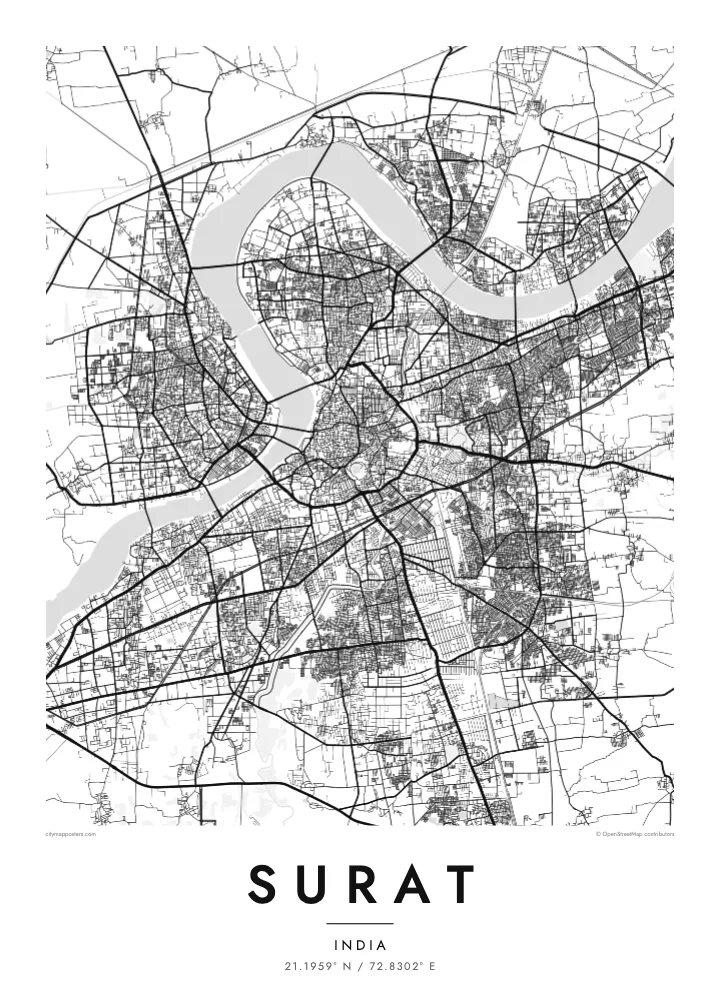
The river curves around the old city in a wide arc, forming the most prominent line on the map and dividing older and newer Surat.
Posta faʻafanua faigofie · India
21.1959° N / 72.8302° E
A city built around a wide bend of the Tapi River, with ring roads circling the old centre on the south bank.


Tasi le aai, lagona e lima
Tapi se sitaili e vaai ai i luga o le puipui. E tutusa uma le tau o sitaili — pe lolomiina, faapipiiina, pe avea ma faila HD.
 Pika Moni · Faila Lolomi 24 × 36″
Manino mo le lolomi
O se vaega atoa (100%) lenei mai le faila lolomi moni. O posita uma — pe lolomiina, faapipiiina pe download mai — e faia i luga o a matou server i le 300 DPI, e oo atu i le 7,200 × 10,800 pika, ina ia manino pea auala laiti i luga o se lolomiga 24 × 36″.
I luga o le puipui


Le faʻafanua
Surat takes its shape from the Tapi River, which sweeps through the city in a broad curve on its way to the Arabian Sea. The older city sits on the southern bank inside that bend, and its dense, irregular streets reflect centuries of trade. Several bridges cross the river, linking it to newer districts that have grown quickly to the north and west.
Around the historic centre, a series of ring roads encircles the city at increasing distances, giving the map a layered, concentric structure. Surat Castle, a sixteenth-century fort, stands beside the river near the old core. Toward the coast, the land becomes flatter and more open, with industrial areas reaching out toward Hazira.
In the seventeenth century Surat was one of the most important ports of Mughal India, and the English and Dutch both established trading posts here. Today it is known worldwide as a centre for cutting and polishing diamonds and for textiles. A Surat map poster traces a city whose outline is set by its river and its circling roads.
The river curves around the old city in a wide arc, forming the most prominent line on the map and dividing older and newer Surat.
Concentric ring roads circle the centre at intervals, giving the street network a clear, almost target-like structure that reads well in a minimal print.
The riverside fort, built in the sixteenth century, sits at the edge of the old city where the dense street pattern meets the water.
Fai mo oe
Faʻaopoopo se aso, se igoa po o sau lava upu, sui le sitaili, lapoʻa po o le itu.
O le preview e leai se totogi e maualalo le resolution ma iai se watermark. O lolomi ma faila HD e faia i le 300 DPI, e oo atu i le 7,200 × 10,800 px, e aunoa ma se watermark.
Aisea Surat
Surat has grown and changed quickly, and for people who have watched it happen, a map is a way to hold the city still for a moment. The river and the rings of road give it a clear, graphic character that works well in a small or large print.
Personalise the title, subtitle and coordinates line to mark a home, a business or a year. Choose from Classic black & white, Noir, Paper, Blueprint and Sand, and receive 300 DPI files for $9 or a printed poster on matte paper.
Faatau le posita Surat| Lapoʻa lolomi | Manino | Faila |
|---|---|---|
| 30 × 40 cm (11.8 × 15.7″) | 3,543 × 4,724 px | PNG · PDF |
| 29.7 × 42 cm (A3, 11.7 × 16.5″) | 3,508 × 4,961 px | PNG · PDF |
| 42 × 59.4 cm (A2, 16.5 × 23.4″) | 4,961 × 7,016 px | PNG · PDF |
| 45.7 × 61 cm (18 × 24″) | 5,400 × 7,200 px | PNG · PDF |
| 50 × 70 cm (19.7 × 27.6″) | 5,906 × 8,268 px | PNG · PDF |
| 61 × 91.4 cm (24 × 36″) | 7,200 × 10,800 px | PNG · PDF |
Ae faʻatusatusa, o le faʻataʻitaʻiga e leai se totogi e 900 px le lautele, e iai le faʻailoga vai ma e mo mata. O faila HD e oʻo atu i le 8× le manino i itu taʻitasi ma e lolomi manino i le lapoʻa atoa o le posta.
Filifili se sitaili i le pito i luga o le itulau, ona filifili lea o le Posita Lolomi — se lapopoa ma, afai e te fiafia, se faavaa — po o Faila HD Numera. E na o le tasi laasaga o le Checkout, ma o le a fesuia'i lou itulau o oka i le taimi lava e mae'a ai le totogi.
E lolomiina i luga o pepa matte maualuga le tulaga e 200 gsm, i se tasi o lapopoa e ono, mai le 30 × 40 cm i le 24 × 36″. E amata le tau o posita lolomi mai le $39, aofia ai le auina atu.
Ioe. Filifili se faavaa laau malosi i le lanu uliuli, sina, oak masani, po o le laau pogisa. E aofia ai se tioata e le gau ma ua saunia e tautau i luga. E amata le tau o posita faavaa mai le $99, aofia ai le auina atu.
E leai se totogi mo le uta i le lalolagi atoa. O poster ta'itasi e lolomi e le paaga lolomi e latalata mai i matou i atunuu e 30+, ma e masani ona taunuu i aso faigaluega e 3–7. E mafai ona e mulimuli i le tulaga ma le tracking i le "Aʻu Oka". O nisi atunuu e 2–5 vaiaso, ma i atunuu matou te lei tuuina atu ai, e taʻu atu e le saite iā te oe ae e te leʻi totogiina.
Auina mai se ata i totonu o le 14 aso talu ona taunuu, ma o le a matou toe lolomiina e leai se totogi po o le toe faafoi atu lau tupe.
Ioe. I totonu o le editor i lenei itulau, suia le ulutala, le ulutala laititi ma le laina o coordinates i soo se mea e te fiafia i ai, ma filifili se sitaili ma le lapopoa. O oka lolomi, faavaa ma numera e faaaoga uma lava lau mamanu.
Mo le $9 e te maua ai faila PNG 300 DPI ma PDF ua saunia mo le lolomi i lapopoa uma e ono, e aunoa ma se watermark, e mafai ona lolomi i soo se mea. Le mautinoa lava? Download muamua se preview e leai se totogi ma le watermark.
Latalata ane
