Tabriz Bazaar
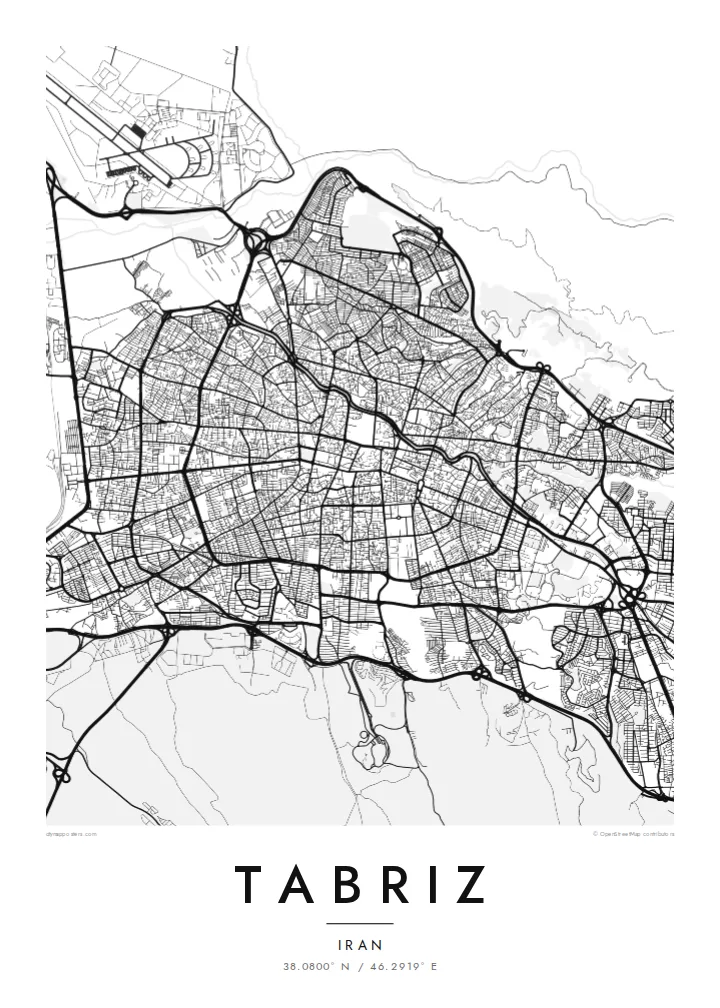
The covered bazaar forms a dense block of narrow passages and courtyards in the old centre, its fine texture standing out from the wider modern streets around it.
Posta faʻafanua faigofie · Iran
38.0800° N / 46.2919° E
A high basin city between two mountains, its covered bazaar at the core and a river channel cutting straight through.


Tasi le aai, lagona e lima
Tapi se sitaili e vaai ai i luga o le puipui. E tutusa uma le tau o sitaili — pe lolomiina, faapipiiina, pe avea ma faila HD.
 Pika Moni · Faila Lolomi 24 × 36″
Manino mo le lolomi
O se vaega atoa (100%) lenei mai le faila lolomi moni. O posita uma — pe lolomiina, faapipiiina pe download mai — e faia i luga o a matou server i le 300 DPI, e oo atu i le 7,200 × 10,800 pika, ina ia manino pea auala laiti i luga o se lolomiga 24 × 36″.
I luga o le puipui


Le faʻafanua
Tabriz lies in a broad basin in north-western Iran, with the bare ridge of Eynali rising to the north and the massive Sahand volcano to the south. The city fills the ground between them, spreading east to west along the valley. On a map, the hills to the north show as a clear edge where the dense street pattern suddenly stops.
Running through the middle is the Quri Chay, a river confined to a long, straight channel that divides the city into northern and southern halves. Beside it sits the historic centre, where the Tabriz Bazaar spreads as a vast network of vaulted passages, caravanserais and courtyards. It is a UNESCO World Heritage site and one of the largest covered bazaars in the world.
Tabriz served as a capital under several dynasties, including the Ilkhanids and the early Safavids, and traces of that status remain in the massive brick walls of the Arg and the tiled ruins of the Blue Mosque. To the south-east, El Goli park frames an artificial lake with a pavilion at its centre. A Tabriz map poster holds all of this within a single frame.
The covered bazaar forms a dense block of narrow passages and courtyards in the old centre, its fine texture standing out from the wider modern streets around it.
The river runs through the city in a straightened channel, drawing a long line from east to west that divides the map into two clear halves.
A square artificial lake set within terraced gardens on the south-eastern edge of the city, with a pavilion on an island at its centre, instantly recognisable from above.
Fai mo oe
Faʻaopoopo se aso, se igoa po o sau lava upu, sui le sitaili, lapoʻa po o le itu.
O le preview e leai se totogi e maualalo le resolution ma iai se watermark. O lolomi ma faila HD e faia i le 300 DPI, e oo atu i le 7,200 × 10,800 px, e aunoa ma se watermark.
Aisea Tabriz
Tabriz carries deep meaning for Azerbaijani and Iranian families at home and abroad, and a print of its streets can be a strong connection to a place far away. The mountains and the bazaar give the map a distinctive, balanced shape.
Spell the city's name in the title the way you prefer, add a subtitle with a family name or year, and choose one of five styles. Order it printed on matte paper, with or without a wooden frame, from print partners in more than 30 countries.
Faatau le posita Tabriz| Lapoʻa lolomi | Manino | Faila |
|---|---|---|
| 30 × 40 cm (11.8 × 15.7″) | 3,543 × 4,724 px | PNG · PDF |
| 29.7 × 42 cm (A3, 11.7 × 16.5″) | 3,508 × 4,961 px | PNG · PDF |
| 42 × 59.4 cm (A2, 16.5 × 23.4″) | 4,961 × 7,016 px | PNG · PDF |
| 45.7 × 61 cm (18 × 24″) | 5,400 × 7,200 px | PNG · PDF |
| 50 × 70 cm (19.7 × 27.6″) | 5,906 × 8,268 px | PNG · PDF |
| 61 × 91.4 cm (24 × 36″) | 7,200 × 10,800 px | PNG · PDF |
Ae faʻatusatusa, o le faʻataʻitaʻiga e leai se totogi e 900 px le lautele, e iai le faʻailoga vai ma e mo mata. O faila HD e oʻo atu i le 8× le manino i itu taʻitasi ma e lolomi manino i le lapoʻa atoa o le posta.
Filifili se sitaili i le pito i luga o le itulau, ona filifili lea o le Posita Lolomi — se lapopoa ma, afai e te fiafia, se faavaa — po o Faila HD Numera. E na o le tasi laasaga o le Checkout, ma o le a fesuia'i lou itulau o oka i le taimi lava e mae'a ai le totogi.
E lolomiina i luga o pepa matte maualuga le tulaga e 200 gsm, i se tasi o lapopoa e ono, mai le 30 × 40 cm i le 24 × 36″. E amata le tau o posita lolomi mai le {printFrom}, aofia ai le auina atu.
Ioe. Filifili se faavaa laau malosi i le lanu uliuli, sina, oak masani, po o le laau pogisa. E aofia ai se tioata e le gau ma ua saunia e tautau i luga. E amata le tau o posita faavaa mai le {framedFrom}, aofia ai le auina atu.
E fua le auina atu i le lalolagi atoa. E lolomiina pusita taitasi e le paaga lolomi e sili ona latalata i totonu o le silia ma le 30 atunuu, ma e masani ona taunuu i totonu o le 3–7 aso faigaluega. E mafai ona e siaki lona tulaga ma le tulimatai i lalo o My Orders.
Auina mai se ata i totonu o le 14 aso talu ona taunuu, ma o le a matou toe lolomiina e leai se totogi po o le toe faafoi atu lau tupe.
Ioe. I totonu o le editor i lenei itulau, suia le ulutala, le ulutala laititi ma le laina o coordinates i soo se mea e te fiafia i ai, ma filifili se sitaili ma le lapopoa. O oka lolomi, faavaa ma numera e faaaoga uma lava lau mamanu.
Mo le $9 e te maua ai faila PNG 300 DPI ma PDF ua saunia mo le lolomi i lapopoa uma e ono, e aunoa ma se watermark, e mafai ona lolomi i soo se mea. Le mautinoa lava? Download muamua se preview e leai se totogi ma le watermark.
Latalata ane
