Gulf coastline
The shore of the Gulf of Gabès forms the eastern edge of the map, a long, gentle line that anchors the whole composition and sets the town firmly beside the sea.
Posta faʻafanua faigofie · Tunisia
33.8455° N / 10.1142° E
A low coastal settlement on the Gulf of Gabès, where palm groves, farm plots and the shoreline meet on flat ground




Tasi le aai, lagona e lima
Tapi se sitaili e vaai ai i luga o le puipui. E tutusa uma le tau o sitaili — pe lolomiina, faapipiiina, pe avea ma faila HD.
 Pika Moni · Faila Lolomi 24 × 36″
Manino mo le lolomi
O se vaega atoa (100%) lenei mai le faila lolomi moni. O posita uma — pe lolomiina, faapipiiina pe download mai — e faia i luga o a matou server i le 300 DPI, e oo atu i le 7,200 × 10,800 pika, ina ia manino pea auala laiti i luga o se lolomiga 24 × 36″.
I luga o le puipui


Le faʻafanua
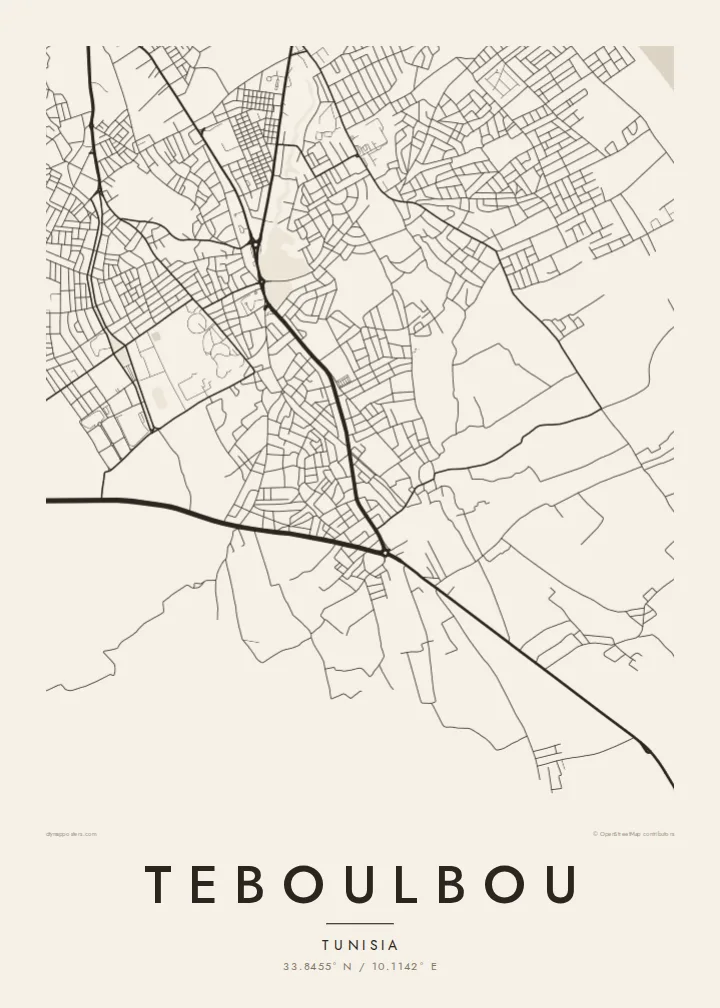
Teboulbou lies just south of the city of Gabès, on the flat coastal plain that runs along the Gulf of Gabès in southeastern Tunisia. On a map, the town reads as a loose spread of streets and compounds instead of a dense core. Irrigated garden plots, palm groves and open ground sit between the built blocks, and the coastline stays close on the eastern edge.
The Gabès area is known for its maritime oasis, where date palms grow within reach of the Mediterranean, which is rare anywhere in the world. Around Teboulbou that relationship shows up in the drawing as a patchwork: narrow lanes running between cultivated parcels, tracks heading down toward the water, and roads that link the settlement north to Gabès and on along the coast.
A Teboulbou map poster turns that mixed ground into fine black lines on white. Because the town has no single monumental centre, the composition rests on texture: the rhythm of small streets, the long line of the coast and the way building gives way to gardens. It suits a wall that needs something quiet and detailed rather than a bold graphic statement.
The shore of the Gulf of Gabès forms the eastern edge of the map, a long, gentle line that anchors the whole composition and sets the town firmly beside the sea.
Garden plots and palm groves break up the streets into an irregular mosaic, which gives this part of the Gabès coast its distinctive texture from above.
A main route runs north toward the city of Gabès, tying Teboulbou into the wider coastal plain and giving the drawing a clear direction.
Fai mo oe
Faʻaopoopo se aso, se igoa po o sau lava upu, sui le sitaili, lapoʻa po o le itu.
O le preview e leai se totogi e maualalo le resolution ma iai se watermark. O lolomi ma faila HD e faia i le 300 DPI, e oo atu i le 7,200 × 10,800 px, e aunoa ma se watermark.
Aisea Teboulbou
People hang this map because they have family roots in the Gabès region, because they spent time on this stretch of coast, or because they like the meeting of oasis and sea. It is a personal place, and the poster treats it with restraint.
You can change the title, subtitle and coordinates line, for example to add a family name or a year, and choose from Classic black & white, Noir, Paper, Blueprint or Sand. The digital files cost $9 and come in six print sizes.
Faatau le posita Teboulbou| Lapoʻa lolomi | Manino | Faila |
|---|---|---|
| 30 × 40 cm11.8 × 15.7″ | 3,543 × 4,724 px | PNG · PDF |
| 29.7 × 42 cm (A3)11.7 × 16.5″ | 3,508 × 4,961 px | PNG · PDF |
| 42 × 59.4 cm (A2)16.5 × 23.4″ | 4,961 × 7,016 px | PNG · PDF |
| 45.7 × 61 cm18 × 24″ | 5,400 × 7,200 px | PNG · PDF |
| 50 × 70 cm19.7 × 27.6″ | 5,906 × 8,268 px | PNG · PDF |
| 61 × 91.4 cm24 × 36″ | 7,200 × 10,800 px | PNG · PDF |
Ae faʻatusatusa, o le faʻataʻitaʻiga e leai se totogi e 900 px le lautele, e iai le faʻailoga vai ma e mo mata. O faila HD e oʻo atu i le 8× le manino i itu taʻitasi ma e lolomi manino i le lapoʻa atoa o le posta.
Filifili se sitaili i le pito i luga o le itulau, ona filifili lea o le Posita Lolomi — se lapopoa ma, afai e te fiafia, se faavaa — po o Faila HD Numera. E na o le tasi laasaga o le Checkout, ma o le a fesuia'i lou itulau o oka i le taimi lava e mae'a ai le totogi.
E lolomiina i luga o pepa matte maualuga le tulaga e 200 gsm, i se tasi o lapopoa e ono, mai le 30 × 40 cm i le 24 × 36″. E amata le tau o posita lolomi mai le $39, aofia ai le auina atu.
Ioe. Filifili se faavaa laau malosi i le lanu uliuli, sina, oak masani, po o le laau pogisa. E aofia ai se tioata e le gau ma ua saunia e tautau i luga. E amata le tau o posita faavaa mai le $99, aofia ai le auina atu.
E leai se totogi o le auina atu i atunuu e 60+. O pepa ata taʻitasi e lolomiina e le tasi o matou paaga lolomi e latalata mai i atunuu e 30+, ma e masani ona taunuu i le 3–7 aso faigaluega. E mafai ona e mulimulitaia le tulaga ma le sailiga i lalo o My Orders. O nisi atunuu e 2–5 vaiaso, ma i nofoaga e lei matou auina atu iai, e taʻu atu e le saite ia te oe a o lei totogi.
Auina mai se ata i totonu o le 14 aso talu ona taunuu, ma o le a matou toe lolomiina e leai se totogi po o le toe faafoi atu lau tupe.
Ioe. I totonu o le editor i lenei itulau, suia le ulutala, le ulutala laititi ma le laina o coordinates i soo se mea e te fiafia i ai, ma filifili se sitaili ma le lapopoa. O oka lolomi, faavaa ma numera e faaaoga uma lava lau mamanu.
Mo le $9 e te maua ai faila PNG 300 DPI ma PDF ua saunia mo le lolomi i lapopoa uma e ono, e aunoa ma se watermark, e mafai ona lolomi i soo se mea. Le mautinoa lava? Download muamua se preview e leai se totogi ma le watermark.
Latalata ane
