BR-101 corridor
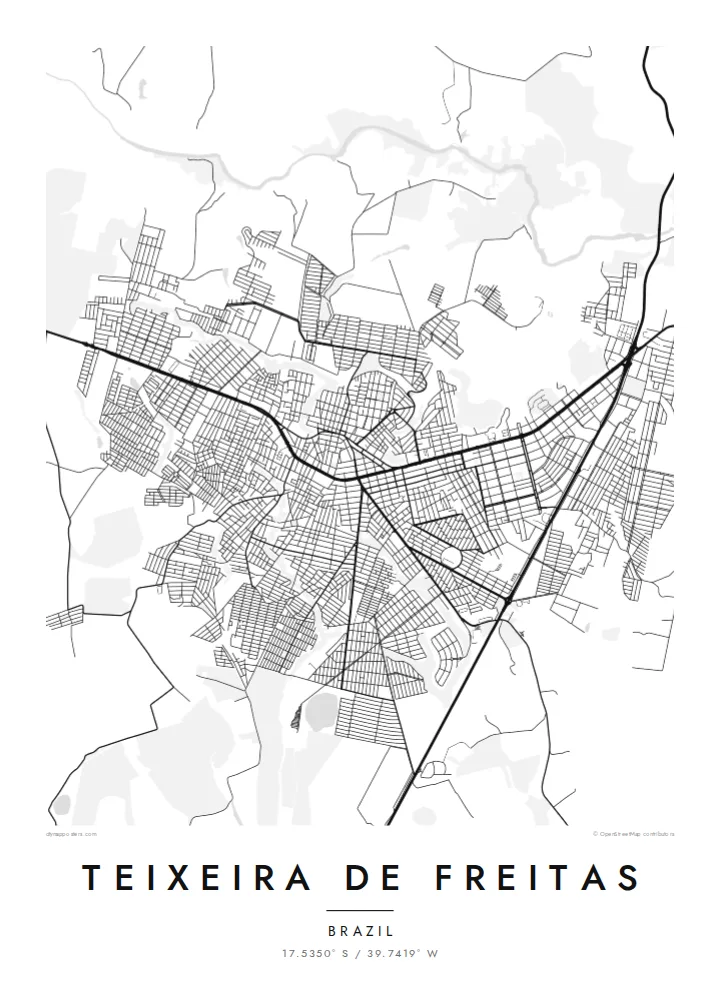
The main coastal highway runs through the city. On the poster it is a long, straight line from edge to edge, with much of the urban grid organised around it.
Posta faʻafanua faigofie · Brazil
17.5350° S / 39.7419° W
A young, fast-growing city in the far south of Bahia, its broad grid spreading along the BR-101 highway through open countryside.
Tasi le aai, lagona e lima
Tapi se sitaili e vaai ai i luga o le puipui. E tutusa uma le tau o sitaili — pe lolomiina, faapipiiina, pe avea ma faila HD.
 Pika Moni · Faila Lolomi 24 × 36″
Manino mo le lolomi
O se vaega atoa (100%) lenei mai le faila lolomi moni. O posita uma — pe lolomiina, faapipiiina pe download mai — e faia i luga o a matou server i le 300 DPI, e oo atu i le 7,200 × 10,800 pika, ina ia manino pea auala laiti i luga o se lolomiga 24 × 36″.
I luga o le puipui


Le faʻafanua
Teixeira de Freitas lies in the extreme south of Bahia, a short distance inland from the Atlantic coast. It is a young city, having become a separate municipality only in 1985, and the map reflects that recent growth. Streets form a broad, fairly regular grid that extends in every direction, and the federal highway BR-101, the main road along Brazil's east coast, passes through the urban area.
The city is named after Mário Augusto Teixeira de Freitas, a Bahian statistician who was one of the founders of Brazil's national statistics institute. Today it serves as a commercial and service centre for the surrounding region, a landscape of cattle ranches and large eucalyptus plantations, with the coastal towns and the Abrolhos archipelago further to the east.
A Teixeira de Freitas map poster shows a city still in the process of taking shape. The central grid is tight and busy, and newer neighbourhoods extend outward along the main roads before the frame opens up into open land. It is a clean, confident composition that captures the momentum of a place that has grown quickly within living memory.
The main coastal highway runs through the city. On the poster it is a long, straight line from edge to edge, with much of the urban grid organised around it.
The city's core is a dense, regular grid of streets and blocks. It is the most detailed part of the poster and reflects the city's planned, rapid development.
Newer neighbourhoods spread outward along the main roads and then give way to open land. That shows clearly on the map how the city continues to grow.
Fai mo oe
Faʻaopoopo se aso, se igoa po o sau lava upu, sui le sitaili, lapoʻa po o le itu.
O le preview e leai se totogi e maualalo le resolution ma iai se watermark. O lolomi ma faila HD e faia i le 300 DPI, e oo atu i le 7,200 × 10,800 px, e aunoa ma se watermark.
Aisea Teixeira de Freitas
Many residents of Teixeira de Freitas moved there from other parts of Bahia, Minas Gerais or Espírito Santo, and built new lives in a new city. A map of it records that shared story and makes a meaningful piece for a home or business.
Change the title, subtitle and coordinates line to name a bairro, a family or a meaningful date, and choose one of five styles: Classic black & white, Noir, Paper, Blueprint or Sand. A free 900 px watermarked preview shows how it will look before you buy.
Faatau le posita Teixeira de Freitas| Lapoʻa lolomi | Manino | Faila |
|---|---|---|
| 30 × 40 cm11.8 × 15.7″ | 3,543 × 4,724 px | PNG · PDF |
| 29.7 × 42 cm (A3)11.7 × 16.5″ | 3,508 × 4,961 px | PNG · PDF |
| 42 × 59.4 cm (A2)16.5 × 23.4″ | 4,961 × 7,016 px | PNG · PDF |
| 45.7 × 61 cm18 × 24″ | 5,400 × 7,200 px | PNG · PDF |
| 50 × 70 cm19.7 × 27.6″ | 5,906 × 8,268 px | PNG · PDF |
| 61 × 91.4 cm24 × 36″ | 7,200 × 10,800 px | PNG · PDF |
Ae faʻatusatusa, o le faʻataʻitaʻiga e leai se totogi e 900 px le lautele, e iai le faʻailoga vai ma e mo mata. O faila HD e oʻo atu i le 8× le manino i itu taʻitasi ma e lolomi manino i le lapoʻa atoa o le posta.
Filifili se sitaili i le pito i luga o le itulau, ona filifili lea o le Posita Lolomi — se lapopoa ma, afai e te fiafia, se faavaa — po o Faila HD Numera. E na o le tasi laasaga o le Checkout, ma o le a fesuia'i lou itulau o oka i le taimi lava e mae'a ai le totogi.
E lolomiina i luga o pepa matte maualuga le tulaga e 200 gsm, i se tasi o lapopoa e ono, mai le 30 × 40 cm i le 24 × 36″. E amata le tau o posita lolomi mai le $39, aofia ai le auina atu.
Ioe. Filifili se faavaa laau malosi i le lanu uliuli, sina, oak masani, po o le laau pogisa. E aofia ai se tioata e le gau ma ua saunia e tautau i luga. E amata le tau o posita faavaa mai le $99, aofia ai le auina atu.
E leai se totogi o le auina atu i atunuu e 60+. O pepa ata taʻitasi e lolomiina e le tasi o matou paaga lolomi e latalata mai i atunuu e 30+, ma e masani ona taunuu i le 3–7 aso faigaluega. E mafai ona e mulimulitaia le tulaga ma le sailiga i lalo o My Orders. O nisi atunuu e 2–5 vaiaso, ma i nofoaga e lei matou auina atu iai, e taʻu atu e le saite ia te oe a o lei totogi.
Auina mai se ata i totonu o le 14 aso talu ona taunuu, ma o le a matou toe lolomiina e leai se totogi po o le toe faafoi atu lau tupe.
Ioe. I totonu o le editor i lenei itulau, suia le ulutala, le ulutala laititi ma le laina o coordinates i soo se mea e te fiafia i ai, ma filifili se sitaili ma le lapopoa. O oka lolomi, faavaa ma numera e faaaoga uma lava lau mamanu.
Mo le $9 e te maua ai faila PNG 300 DPI ma PDF ua saunia mo le lolomi i lapopoa uma e ono, e aunoa ma se watermark, e mafai ona lolomi i soo se mea. Le mautinoa lava? Download muamua se preview e leai se totogi ma le watermark.
Latalata ane
