San Juan and San Francisco
The two oldest quarters form a tight knot of narrow, irregular streets. They are clearly distinguishable from the more regular modern districts around them.
Posta faʻafanua faigofie · Spain
27.9924° N / 15.4192° W
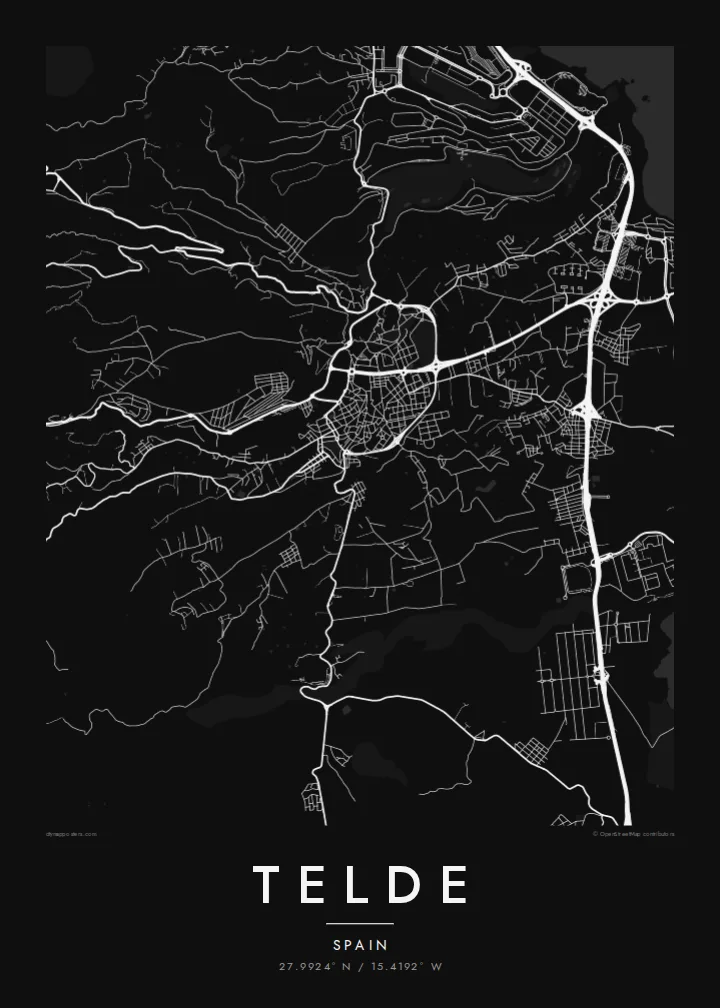
Gran Canaria's second city, spreading from two historic quarters down a slope of ravines to the eastern coast.



Tasi le aai, lagona e lima
Tapi se sitaili e vaai ai i luga o le puipui. E tutusa uma le tau o sitaili — pe lolomiina, faapipiiina, pe avea ma faila HD.
 Pika Moni · Faila Lolomi 24 × 36″
Manino mo le lolomi
O se vaega atoa (100%) lenei mai le faila lolomi moni. O posita uma — pe lolomiina, faapipiiina pe download mai — e faia i luga o a matou server i le 300 DPI, e oo atu i le 7,200 × 10,800 pika, ina ia manino pea auala laiti i luga o se lolomiga 24 × 36″.
I luga o le puipui


Le faʻafanua
Telde lies on the eastern side of Gran Canaria, between the island's central highlands and the Atlantic. It is the second-largest municipality on the island. Instead of one compact core it forms a string of districts. They spread across a gently sloping landscape cut by ravines, or barrancos, that run from the hills down to the shore.
Before the Castilian conquest, Telde was one of the island's two indigenous seats of power. Its oldest quarters, San Juan and San Francisco, keep narrow streets and low whitewashed houses, and the Basilica of San Juan Bautista stands at the centre of the former. The coastline includes beaches such as Melenara and La Garita, and Gran Canaria Airport lies just to the south.
A Telde map poster shows a scattered, layered city. There is a historic centre inland, with separate districts spreading across the slope, dry ravines between them, and a rocky coastline along the eastern edge. It is more complex than a typical grid, and that is its appeal.
The two oldest quarters form a tight knot of narrow, irregular streets. They are clearly distinguishable from the more regular modern districts around them.
Dry barrancos run down from the interior to the sea. They leave open corridors that separate the neighbourhoods and give the map strong diagonal lines.
The eastern coast is a series of small bays and headlands. It gives the poster an irregular, detailed edge, with the beach districts clustered along it.
Fai mo oe
Faʻaopoopo se aso, se igoa po o sau lava upu, sui le sitaili, lapoʻa po o le itu.
O le preview e leai se totogi e maualalo le resolution ma iai se watermark. O lolomi ma faila HD e faia i le 300 DPI, e oo atu i le 7,200 × 10,800 px, e aunoa ma se watermark.
Aisea Telde
Telde is home for many Canarians and a familiar stop for people who know Gran Canaria beyond the resorts. A print of its districts and ravines is a genuine piece of the island.
Personalise the title, subtitle and coordinates line. The Sand style suits the island's dry landscape, and Noir gives a more modern look. The HD files include six print sizes, and a free watermarked preview is available first.
Faatau le posita Telde| Lapoʻa lolomi | Manino | Faila |
|---|---|---|
| 30 × 40 cm (11.8 × 15.7″) | 3,543 × 4,724 px | PNG · PDF |
| 29.7 × 42 cm (A3, 11.7 × 16.5″) | 3,508 × 4,961 px | PNG · PDF |
| 42 × 59.4 cm (A2, 16.5 × 23.4″) | 4,961 × 7,016 px | PNG · PDF |
| 45.7 × 61 cm (18 × 24″) | 5,400 × 7,200 px | PNG · PDF |
| 50 × 70 cm (19.7 × 27.6″) | 5,906 × 8,268 px | PNG · PDF |
| 61 × 91.4 cm (24 × 36″) | 7,200 × 10,800 px | PNG · PDF |
Ae faʻatusatusa, o le faʻataʻitaʻiga e leai se totogi e 900 px le lautele, e iai le faʻailoga vai ma e mo mata. O faila HD e oʻo atu i le 8× le manino i itu taʻitasi ma e lolomi manino i le lapoʻa atoa o le posta.
Filifili se sitaili i le pito i luga o le itulau, ona filifili lea o le Posita Lolomi — se lapopoa ma, afai e te fiafia, se faavaa — po o Faila HD Numera. E na o le tasi laasaga o le Checkout, ma o le a fesuia'i lou itulau o oka i le taimi lava e mae'a ai le totogi.
E lolomiina i luga o pepa matte maualuga le tulaga e 200 gsm, i se tasi o lapopoa e ono, mai le 30 × 40 cm i le 24 × 36″. E amata le tau o posita lolomi mai le {printFrom}, aofia ai le auina atu.
Ioe. Filifili se faavaa laau malosi i le lanu uliuli, sina, oak masani, po o le laau pogisa. E aofia ai se tioata e le gau ma ua saunia e tautau i luga. E amata le tau o posita faavaa mai le {framedFrom}, aofia ai le auina atu.
E leai se totogi mo le uta i le lalolagi atoa. O poster ta'itasi e lolomi e le paaga lolomi e latalata mai i matou i atunuu e 30+, ma e masani ona taunuu i aso faigaluega e 3–7. E mafai ona e mulimuli i le tulaga ma le tracking i le "Aʻu Oka". O nisi atunuu e 2–5 vaiaso, ma i atunuu matou te lei tuuina atu ai, e taʻu atu e le saite iā te oe ae e te leʻi totogiina.
Auina mai se ata i totonu o le 14 aso talu ona taunuu, ma o le a matou toe lolomiina e leai se totogi po o le toe faafoi atu lau tupe.
Ioe. I totonu o le editor i lenei itulau, suia le ulutala, le ulutala laititi ma le laina o coordinates i soo se mea e te fiafia i ai, ma filifili se sitaili ma le lapopoa. O oka lolomi, faavaa ma numera e faaaoga uma lava lau mamanu.
Mo le $9 e te maua ai faila PNG 300 DPI ma PDF ua saunia mo le lolomi i lapopoa uma e ono, e aunoa ma se watermark, e mafai ona lolomi i soo se mea. Le mautinoa lava? Download muamua se preview e leai se totogi ma le watermark.
Latalata ane
