North Field
Four long, parallel runways cover the northern end of the island. Even today they form one of the most striking geometric patterns on any Pacific island map.
Posta faʻafanua faigofie · United States
15.0119° N / 145.6280° E
A low, flat island in the Northern Marianas, marked by vast wartime runways and a street grid named after Manhattan.



Tasi le aai, lagona e lima
Tapi se sitaili e vaai ai i luga o le puipui. E tutusa uma le tau o sitaili — pe lolomiina, faapipiiina, pe avea ma faila HD.
 Pika Moni · Faila Lolomi 24 × 36″
Manino mo le lolomi
O se vaega atoa (100%) lenei mai le faila lolomi moni. O posita uma — pe lolomiina, faapipiiina pe download mai — e faia i luga o a matou server i le 300 DPI, e oo atu i le 7,200 × 10,800 pika, ina ia manino pea auala laiti i luga o se lolomiga 24 × 36″.
I luga o le puipui


Le faʻafanua
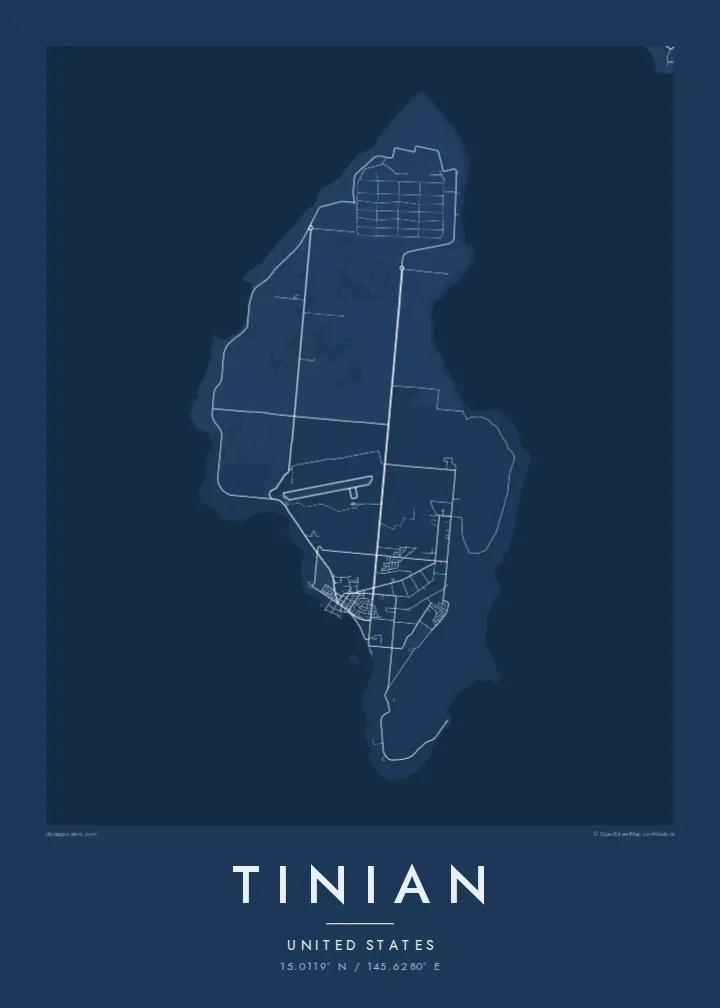
Tinian lies just south-west of Saipan in the Northern Mariana Islands. From above it is fairly flat and compact, longer from north to south, with a plateau ringed by cliffs and limestone terraces that step down toward the sea. The coast is mostly rugged, with only a few sandy beaches. Farmland and scrub cover much of the interior, and the island's one village sits near the harbour in the south-west.
The most remarkable feature is at the northern end: North Field, a wartime airbase whose long, parallel runways are still clearly visible. During the war, the island's roads were laid out in a rough grid. Because the island's outline was thought to resemble Manhattan, the roads were given names such as Broadway. A Tinian map poster makes these straight, deliberate lines stand out.
In 1945, the B-29 bombers that carried the atomic bombs to Hiroshima and Nagasaki took off from North Field, and the loading pits are now marked as a memorial. Long before that, Tinian was home to Chamorro communities. The large stone pillars of the House of Taga, in San Jose, are among the best-known ancient structures in the Marianas.
Four long, parallel runways cover the northern end of the island. Even today they form one of the most striking geometric patterns on any Pacific island map.
American planners laid out the island's roads in a wide grid and named them after New York streets, and the pattern is still visible across Tinian's interior.
The island's main village, near the harbour in the south-west, with a compact street pattern and the ancient latte stones of the House of Taga.
Fai mo oe
Faʻaopoopo se aso, se igoa po o sau lava upu, sui le sitaili, lapoʻa po o le itu.
O le preview e leai se totogi e maualalo le resolution ma iai se watermark. O lolomi ma faila HD e faia i le 300 DPI, e oo atu i le 7,200 × 10,800 px, e aunoa ma se watermark.
Aisea Tinian
Tinian is a map for historians, veterans' families and people with Chamorro and Carolinian roots on the island. Its runways and grid give it a bold, surprisingly graphic look for such a small place in the Pacific.
You can personalise the title, subtitle and coordinates line to mark a family history or a visit, and choose from five styles. Printed posters on matte paper ship from print partners in more than 30 countries.
Faatau le posita Tinian| Lapoʻa lolomi | Manino | Faila |
|---|---|---|
| 30 × 40 cm (11.8 × 15.7″) | 3,543 × 4,724 px | PNG · PDF |
| 29.7 × 42 cm (A3, 11.7 × 16.5″) | 3,508 × 4,961 px | PNG · PDF |
| 42 × 59.4 cm (A2, 16.5 × 23.4″) | 4,961 × 7,016 px | PNG · PDF |
| 45.7 × 61 cm (18 × 24″) | 5,400 × 7,200 px | PNG · PDF |
| 50 × 70 cm (19.7 × 27.6″) | 5,906 × 8,268 px | PNG · PDF |
| 61 × 91.4 cm (24 × 36″) | 7,200 × 10,800 px | PNG · PDF |
Ae faʻatusatusa, o le faʻataʻitaʻiga e leai se totogi e 900 px le lautele, e iai le faʻailoga vai ma e mo mata. O faila HD e oʻo atu i le 8× le manino i itu taʻitasi ma e lolomi manino i le lapoʻa atoa o le posta.
Filifili se sitaili i le pito i luga o le itulau, ona filifili lea o le Posita Lolomi — se lapopoa ma, afai e te fiafia, se faavaa — po o Faila HD Numera. E na o le tasi laasaga o le Checkout, ma o le a fesuia'i lou itulau o oka i le taimi lava e mae'a ai le totogi.
E lolomiina i luga o pepa matte maualuga le tulaga e 200 gsm, i se tasi o lapopoa e ono, mai le 30 × 40 cm i le 24 × 36″. E amata le tau o posita lolomi mai le {printFrom}, aofia ai le auina atu.
Ioe. Filifili se faavaa laau malosi i le lanu uliuli, sina, oak masani, po o le laau pogisa. E aofia ai se tioata e le gau ma ua saunia e tautau i luga. E amata le tau o posita faavaa mai le {framedFrom}, aofia ai le auina atu.
E leai se totogi mo le uta i le lalolagi atoa. O poster ta'itasi e lolomi e le paaga lolomi e latalata mai i matou i atunuu e 30+, ma e masani ona taunuu i aso faigaluega e 3–7. E mafai ona e mulimuli i le tulaga ma le tracking i le "Aʻu Oka". O nisi atunuu e 2–5 vaiaso, ma i atunuu matou te lei tuuina atu ai, e taʻu atu e le saite iā te oe ae e te leʻi totogiina.
Auina mai se ata i totonu o le 14 aso talu ona taunuu, ma o le a matou toe lolomiina e leai se totogi po o le toe faafoi atu lau tupe.
Ioe. I totonu o le editor i lenei itulau, suia le ulutala, le ulutala laititi ma le laina o coordinates i soo se mea e te fiafia i ai, ma filifili se sitaili ma le lapopoa. O oka lolomi, faavaa ma numera e faaaoga uma lava lau mamanu.
Mo le $9 e te maua ai faila PNG 300 DPI ma PDF ua saunia mo le lolomi i lapopoa uma e ono, e aunoa ma se watermark, e mafai ona lolomi i soo se mea. Le mautinoa lava? Download muamua se preview e leai se totogi ma le watermark.
