Planned street grid
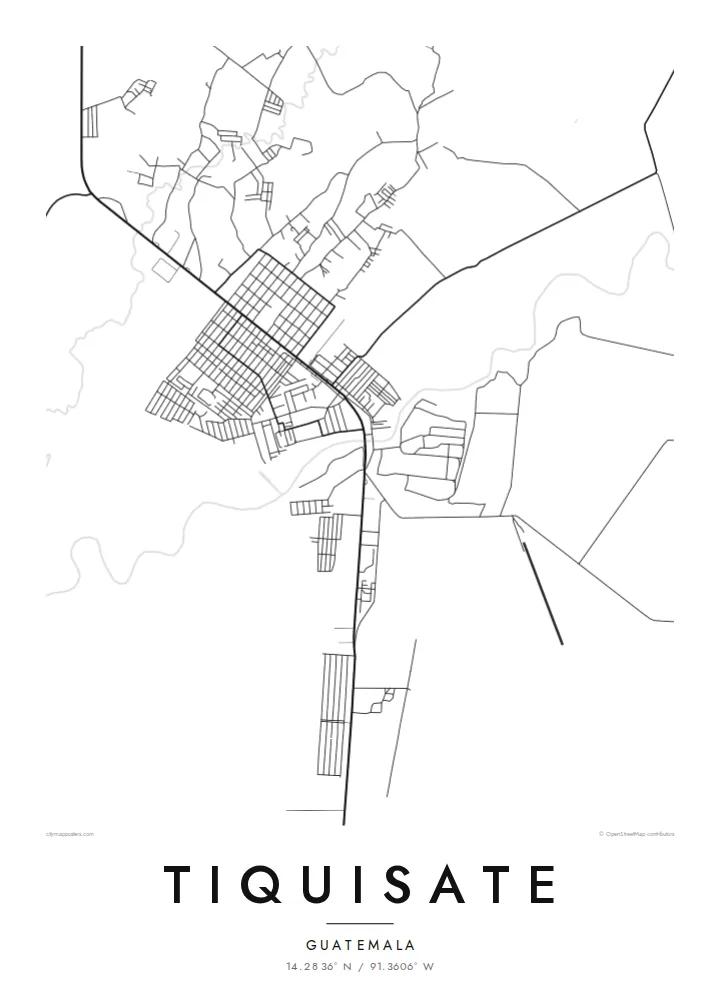
Straight, evenly spaced streets form the core of the town, left over from its planned growth in the plantation era. On paper they make a dense, regular pattern that anchors the whole composition.
Posta faʻafanua faigofie · Guatemala
14.2836° N / 91.3606° W
A planned lowland town laid out on a rectangular grid, surrounded by the flat farmland of Guatemala's Pacific coastal plain.


Tasi le aai, lagona e lima
Tapi se sitaili e vaai ai i luga o le puipui. E tutusa uma le tau o sitaili — pe lolomiina, faapipiiina, pe avea ma faila HD.
 Pika Moni · Faila Lolomi 24 × 36″
Manino mo le lolomi
O se vaega atoa (100%) lenei mai le faila lolomi moni. O posita uma — pe lolomiina, faapipiiina pe download mai — e faia i luga o a matou server i le 300 DPI, e oo atu i le 7,200 × 10,800 pika, ina ia manino pea auala laiti i luga o se lolomiga 24 × 36″.
I luga o le puipui


Le faʻafanua
Tiquisate sits on the coastal plain of Escuintla, where the land runs almost flat from the volcanic highlands down to the Pacific. From above, the town reads as a compact block of straight streets set among wide agricultural fields. Farm roads and drainage lines run out from it toward the sea. There are no hills to bend the plan, so its geometry stays clean and even at every scale.
The shape of the town owes much to its twentieth-century past. In the 1930s the United Fruit Company developed large banana plantations in this area, and Tiquisate grew as a working centre for that operation. This explains the orderly, planned feel of its streets. The municipality's official name is Pueblo Nuevo Tiquisate, and it still hints at the town's beginnings as a newly founded settlement.
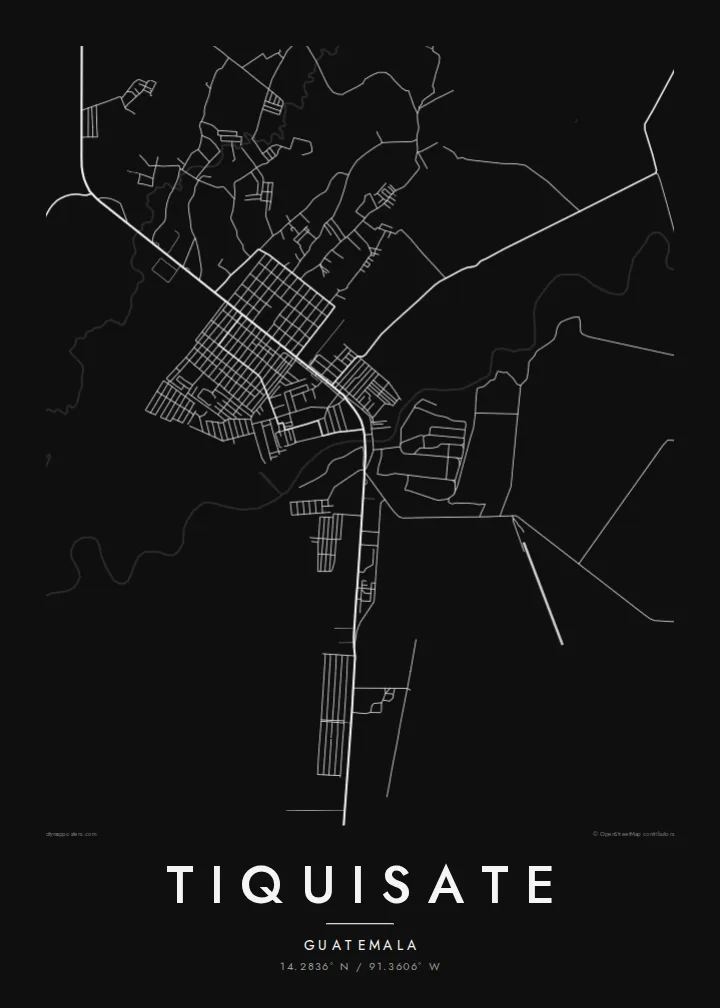
A Tiquisate map poster turns this regular plan into a calm graphic study. It shows blocks of equal weight, a few longer roads leading out of town and the open plain framing it all. In black and white the grid looks almost like woven cloth. It is a pattern that sits easily on a wall and is still clearly a real place on the Guatemalan coast.
Straight, evenly spaced streets form the core of the town, left over from its planned growth in the plantation era. On paper they make a dense, regular pattern that anchors the whole composition.
Around the built-up area the map opens into flat farmland crossed by long rural roads. This empty space gives the town room to breathe and brings out its compact outline.
Routes leading south across the plain point toward the Pacific shoreline. They tie the town to the coast and to the wider farming landscape of Escuintla.
Fai mo oe
Faʻaopoopo se aso, se igoa po o sau lava upu, sui le sitaili, lapoʻa po o le itu.
O le preview e leai se totogi e maualalo le resolution ma iai se watermark. O lolomi ma faila HD e faia i le 300 DPI, e oo atu i le 7,200 × 10,800 px, e aunoa ma se watermark.
Aisea Tiquisate
For people with family roots in Escuintla, or anyone who has spent time on Guatemala's Pacific side, this map is a precise and understated reminder of home. The grid carries the town's history without needing a caption. It also suits modern interiors, where a quiet graphic often works better than a photograph.
You can add your own title, a subtitle such as a family name or a meaningful date, and edit the coordinates line. There are five styles to choose from. You can then download the HD files for $9 or order a printed poster on matte paper, with an optional wooden frame.
Faatau le posita Tiquisate| Lapoʻa lolomi | Manino | Faila |
|---|---|---|
| 30 × 40 cm11.8 × 15.7″ | 3,543 × 4,724 px | PNG · PDF |
| 29.7 × 42 cm (A3)11.7 × 16.5″ | 3,508 × 4,961 px | PNG · PDF |
| 42 × 59.4 cm (A2)16.5 × 23.4″ | 4,961 × 7,016 px | PNG · PDF |
| 45.7 × 61 cm18 × 24″ | 5,400 × 7,200 px | PNG · PDF |
| 50 × 70 cm19.7 × 27.6″ | 5,906 × 8,268 px | PNG · PDF |
| 61 × 91.4 cm24 × 36″ | 7,200 × 10,800 px | PNG · PDF |
Ae faʻatusatusa, o le faʻataʻitaʻiga e leai se totogi e 900 px le lautele, e iai le faʻailoga vai ma e mo mata. O faila HD e oʻo atu i le 8× le manino i itu taʻitasi ma e lolomi manino i le lapoʻa atoa o le posta.
Filifili se sitaili i le pito i luga o le itulau, ona filifili lea o le Posita Lolomi — se lapopoa ma, afai e te fiafia, se faavaa — po o Faila HD Numera. E na o le tasi laasaga o le Checkout, ma o le a fesuia'i lou itulau o oka i le taimi lava e mae'a ai le totogi.
E lolomiina i luga o pepa matte maualuga le tulaga e 200 gsm, i se tasi o lapopoa e ono, mai le 30 × 40 cm i le 24 × 36″. E amata le tau o posita lolomi mai le $39, aofia ai le auina atu.
Ioe. Filifili se faavaa laau malosi i le lanu uliuli, sina, oak masani, po o le laau pogisa. E aofia ai se tioata e le gau ma ua saunia e tautau i luga. E amata le tau o posita faavaa mai le $99, aofia ai le auina atu.
E leai se totogi o le auina atu i atunuu e 60+. O pepa ata taʻitasi e lolomiina e le tasi o matou paaga lolomi e latalata mai i atunuu e 30+, ma e masani ona taunuu i le 3–7 aso faigaluega. E mafai ona e mulimulitaia le tulaga ma le sailiga i lalo o My Orders. O nisi atunuu e 2–5 vaiaso, ma i nofoaga e lei matou auina atu iai, e taʻu atu e le saite ia te oe a o lei totogi.
Auina mai se ata i totonu o le 14 aso talu ona taunuu, ma o le a matou toe lolomiina e leai se totogi po o le toe faafoi atu lau tupe.
Ioe. I totonu o le editor i lenei itulau, suia le ulutala, le ulutala laititi ma le laina o coordinates i soo se mea e te fiafia i ai, ma filifili se sitaili ma le lapopoa. O oka lolomi, faavaa ma numera e faaaoga uma lava lau mamanu.
Mo le $9 e te maua ai faila PNG 300 DPI ma PDF ua saunia mo le lolomi i lapopoa uma e ono, e aunoa ma se watermark, e mafai ona lolomi i soo se mea. Le mautinoa lava? Download muamua se preview e leai se totogi ma le watermark.
Latalata ane
