The hydroelectric dam
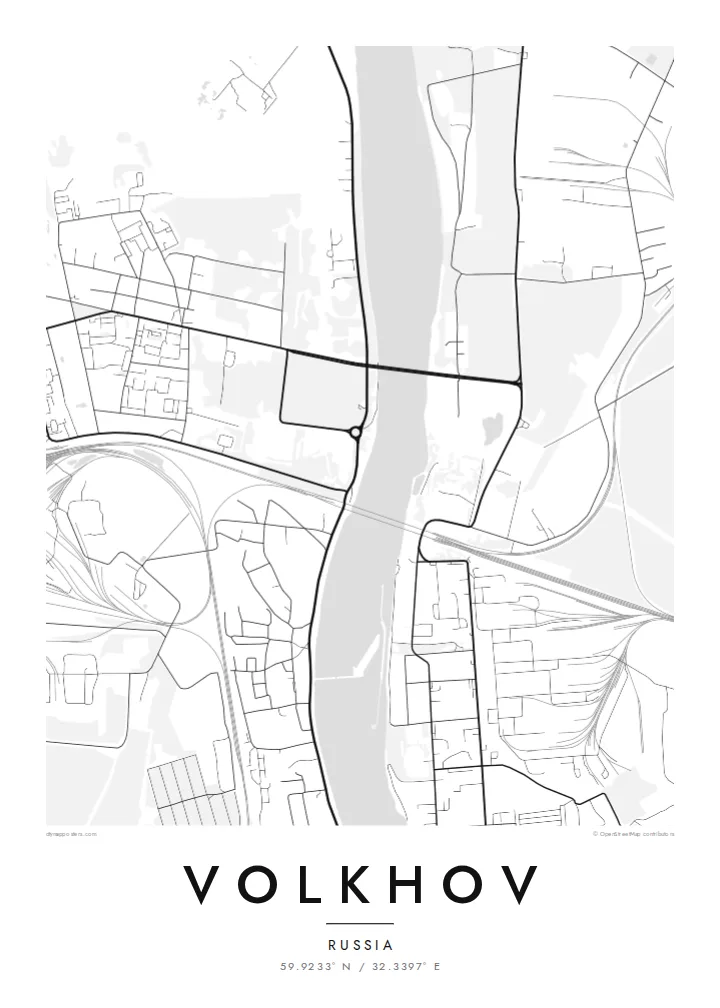
A straight concrete line across the Volkhov, dating from the 1920s. In black and white it reads as the town's anchor, the point where the river's curve meets industrial geometry.
Posta faʻafanua faigofie · Russia
59.9233° N / 32.3397° E
A river town split by the Volkhov, its two banks tied together by bridges, rail lines and the long line of a dam


Tasi le aai, lagona e lima
Tapi se sitaili e vaai ai i luga o le puipui. E tutusa uma le tau o sitaili — pe lolomiina, faapipiiina, pe avea ma faila HD.
 Pika Moni · Faila Lolomi 24 × 36″
Manino mo le lolomi
O se vaega atoa (100%) lenei mai le faila lolomi moni. O posita uma — pe lolomiina, faapipiiina pe download mai — e faia i luga o a matou server i le 300 DPI, e oo atu i le 7,200 × 10,800 pika, ina ia manino pea auala laiti i luga o se lolomiga 24 × 36″.
I luga o le puipui


Le faʻafanua
From above, Volkhov is organised around its river. The Volkhov runs north through the town toward Lake Ladoga, and the built-up area sits on both banks. Residential blocks, industrial sites and rail yards line the water, and the bridges between the two halves give the plan its structure. Outside the town the streets give way to forest, fields and the pale, winding line of the river.
The town grew around one of the first large hydroelectric stations of the Soviet era, built on the Volkhov in the 1920s as part of the national electrification plan. On a map the dam shows as a clean straight bar across the river, one of the few hard geometric lines in a landscape of soft curves. A Volkhov map poster puts that bar at the centre of the composition.
Railways matter here as much as the river. Volkhov grew up as a rail junction, and the tracks fan out across the plan in long parallel lines that cut between neighbourhoods. The mix of rail geometry, planned Soviet housing blocks and the curve of the river makes the town look engineered, but not rigid.
A straight concrete line across the Volkhov, dating from the 1920s. In black and white it reads as the town's anchor, the point where the river's curve meets industrial geometry.
The town sits on both sides of the Volkhov, so the river runs down the middle of the map, a wide pale ribbon between two dense halves of streets and blocks.
Tracks and sidings run in long parallel bundles across the plan, marking Volkhov's role as a rail hub and adding strong linear texture to the print.
Fai mo oe
Faʻaopoopo se aso, se igoa po o sau lava upu, sui le sitaili, lapoʻa po o le itu.
O le preview e leai se totogi e maualalo le resolution ma iai se watermark. O lolomi ma faila HD e faia i le 300 DPI, e oo atu i le 7,200 × 10,800 px, e aunoa ma se watermark.
Aisea Volkhov
For people who grew up here or worked at the plant, the map traces a town built around the river, the dam and the railway. It is an industrial place, and the print shows the logic behind it without decoration.
You can set the title and subtitle, and add a date or coordinates, then pick Classic black & white, Noir, Paper, Blueprint or Sand. Blueprint suits the engineering story particularly well. The HD files cost $9, or you can order a printed poster with an optional wooden frame.
Faatau le posita Volkhov| Lapoʻa lolomi | Manino | Faila |
|---|---|---|
| 30 × 40 cm11.8 × 15.7″ | 3,543 × 4,724 px | PNG · PDF |
| 29.7 × 42 cm (A3)11.7 × 16.5″ | 3,508 × 4,961 px | PNG · PDF |
| 42 × 59.4 cm (A2)16.5 × 23.4″ | 4,961 × 7,016 px | PNG · PDF |
| 45.7 × 61 cm18 × 24″ | 5,400 × 7,200 px | PNG · PDF |
| 50 × 70 cm19.7 × 27.6″ | 5,906 × 8,268 px | PNG · PDF |
| 61 × 91.4 cm24 × 36″ | 7,200 × 10,800 px | PNG · PDF |
Ae faʻatusatusa, o le faʻataʻitaʻiga e leai se totogi e 900 px le lautele, e iai le faʻailoga vai ma e mo mata. O faila HD e oʻo atu i le 8× le manino i itu taʻitasi ma e lolomi manino i le lapoʻa atoa o le posta.
Filifili se sitaili i le pito i luga o le itulau, ona filifili lea o le Posita Lolomi — se lapopoa ma, afai e te fiafia, se faavaa — po o Faila HD Numera. E na o le tasi laasaga o le Checkout, ma o le a fesuia'i lou itulau o oka i le taimi lava e mae'a ai le totogi.
E lolomiina i luga o pepa matte maualuga le tulaga e 200 gsm, i se tasi o lapopoa e ono, mai le 30 × 40 cm i le 24 × 36″. E amata le tau o posita lolomi mai le $39, aofia ai le auina atu.
Ioe. Filifili se faavaa laau malosi i le lanu uliuli, sina, oak masani, po o le laau pogisa. E aofia ai se tioata e le gau ma ua saunia e tautau i luga. E amata le tau o posita faavaa mai le $99, aofia ai le auina atu.
E leai se totogi o le auina atu i atunuu e 60+. O pepa ata taʻitasi e lolomiina e le tasi o matou paaga lolomi e latalata mai i atunuu e 30+, ma e masani ona taunuu i le 3–7 aso faigaluega. E mafai ona e mulimulitaia le tulaga ma le sailiga i lalo o My Orders. O nisi atunuu e 2–5 vaiaso, ma i nofoaga e lei matou auina atu iai, e taʻu atu e le saite ia te oe a o lei totogi.
Auina mai se ata i totonu o le 14 aso talu ona taunuu, ma o le a matou toe lolomiina e leai se totogi po o le toe faafoi atu lau tupe.
Ioe. I totonu o le editor i lenei itulau, suia le ulutala, le ulutala laititi ma le laina o coordinates i soo se mea e te fiafia i ai, ma filifili se sitaili ma le lapopoa. O oka lolomi, faavaa ma numera e faaaoga uma lava lau mamanu.
Mo le $9 e te maua ai faila PNG 300 DPI ma PDF ua saunia mo le lolomi i lapopoa uma e ono, e aunoa ma se watermark, e mafai ona lolomi i soo se mea. Le mautinoa lava? Download muamua se preview e leai se totogi ma le watermark.
Latalata ane
