Kasteel Wijchen
The moated castle in the town centre shows as a compact block ringed by water, a clear historic anchor among the surrounding streets and a rare sight in a Dutch commuter town.
Posta faʻafanua faigofie · Netherlands
51.8092° N / 5.7250° E
A green Gelderland town between Nijmegen and the Maas, with a castle moat, curving residential loops and a lake left by an old river bend.


Tasi le aai, lagona e lima
Tapi se sitaili e vaai ai i luga o le puipui. E tutusa uma le tau o sitaili — pe lolomiina, faapipiiina, pe avea ma faila HD.
 Pika Moni · Faila Lolomi 24 × 36″
Manino mo le lolomi
O se vaega atoa (100%) lenei mai le faila lolomi moni. O posita uma — pe lolomiina, faapipiiina pe download mai — e faia i luga o a matou server i le 300 DPI, e oo atu i le 7,200 × 10,800 pika, ina ia manino pea auala laiti i luga o se lolomiga 24 × 36″.
I luga o le puipui


Le faʻafanua
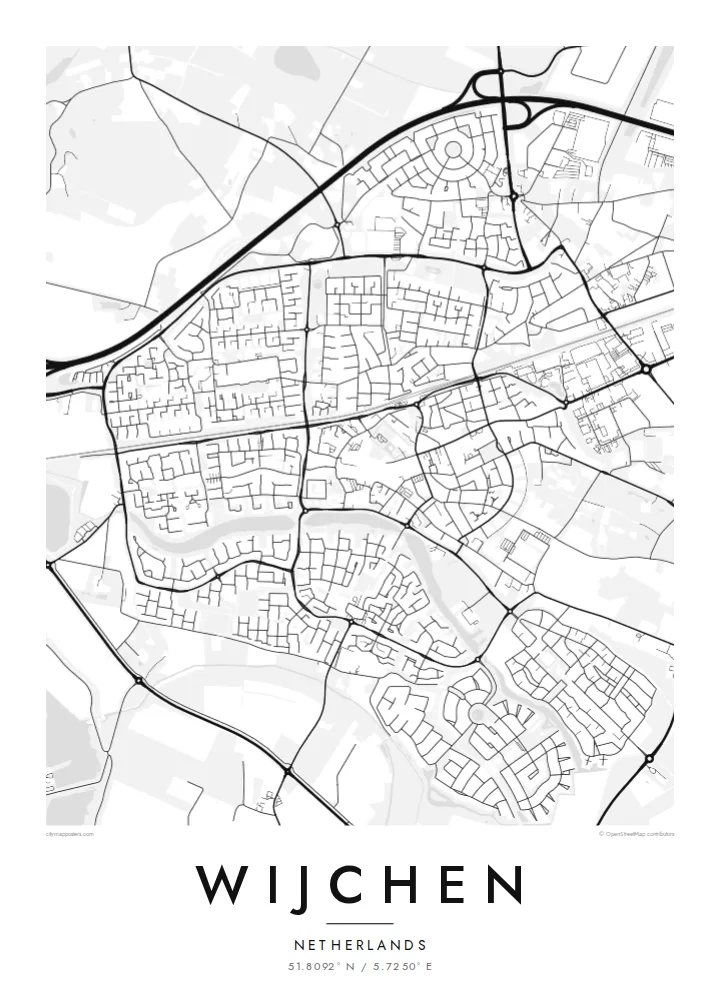
Wijchen lies just southwest of Nijmegen in the Dutch province of Gelderland, on the low land between the Waal and the Maas. The town grew around a small historic core, then spread outward in postwar neighbourhoods laid out as loops, crescents and cul-de-sacs, the kind of suburban pattern that looks almost like fingerprints when drawn in fine black line.
Its best-known landmark is Kasteel Wijchen, a moated castle in the centre that now houses the town hall. North of the town lies the Wijchense Meer, a curved lake that was once a meander of the Maas. The railway between Nijmegen and 's-Hertogenbosch cuts straight across the town, a hard line through all the soft residential curves.
A Wijchen map poster captures that contrast neatly. Around the castle, the old streets are short and irregular. Further out, the newer districts coil around green spaces and ponds, and beyond them the polder begins, with long straight field boundaries and drainage ditches running to the horizon. It is a small place with a surprisingly layered plan.
The moated castle in the town centre shows as a compact block ringed by water, a clear historic anchor among the surrounding streets and a rare sight in a Dutch commuter town.
This curved lake north of town is a former meander of the Maas, and its crescent outline records how the river once moved across the flat landscape.
Postwar neighbourhoods fan out in closes, rings and winding lanes, giving the outer town a dense, organic texture that contrasts with the straight rail line and polder ditches.
Fai mo oe
Faʻaopoopo se aso, se igoa po o sau lava upu, sui le sitaili, lapoʻa po o le itu.
O le preview e leai se totogi e maualalo le resolution ma iai se watermark. O lolomi ma faila HD e faia i le 300 DPI, e oo atu i le 7,200 × 10,800 px, e aunoa ma se watermark.
Aisea Wijchen
Wijchen is the kind of place people leave for Amsterdam or abroad and still describe as home. A map of the castle, the lake and the street where you grew up makes a thoughtful housewarming or leaving gift.
Personalise the title and subtitle, perhaps with a family name or moving date, and choose Classic black & white, Noir, Paper, Blueprint or Sand. Printed posters on matte paper, with an optional wooden frame, ship from partners in more than 30 countries.
Faatau le posita Wijchen| Lapoʻa lolomi | Manino | Faila |
|---|---|---|
| 30 × 40 cm (11.8 × 15.7″) | 3,543 × 4,724 px | PNG · PDF |
| 29.7 × 42 cm (A3, 11.7 × 16.5″) | 3,508 × 4,961 px | PNG · PDF |
| 42 × 59.4 cm (A2, 16.5 × 23.4″) | 4,961 × 7,016 px | PNG · PDF |
| 45.7 × 61 cm (18 × 24″) | 5,400 × 7,200 px | PNG · PDF |
| 50 × 70 cm (19.7 × 27.6″) | 5,906 × 8,268 px | PNG · PDF |
| 61 × 91.4 cm (24 × 36″) | 7,200 × 10,800 px | PNG · PDF |
Ae faʻatusatusa, o le faʻataʻitaʻiga e leai se totogi e 900 px le lautele, e iai le faʻailoga vai ma e mo mata. O faila HD e oʻo atu i le 8× le manino i itu taʻitasi ma e lolomi manino i le lapoʻa atoa o le posta.
Filifili se sitaili i le pito i luga o le itulau, ona filifili lea o le Posita Lolomi — se lapopoa ma, afai e te fiafia, se faavaa — po o Faila HD Numera. E na o le tasi laasaga o le Checkout, ma o le a fesuia'i lou itulau o oka i le taimi lava e mae'a ai le totogi.
E lolomiina i luga o pepa matte maualuga le tulaga e 200 gsm, i se tasi o lapopoa e ono, mai le 30 × 40 cm i le 24 × 36″. E amata le tau o posita lolomi mai le $39, aofia ai le auina atu.
Ioe. Filifili se faavaa laau malosi i le lanu uliuli, sina, oak masani, po o le laau pogisa. E aofia ai se tioata e le gau ma ua saunia e tautau i luga. E amata le tau o posita faavaa mai le $99, aofia ai le auina atu.
E leai se totogi mo le uta i le lalolagi atoa. O poster ta'itasi e lolomi e le paaga lolomi e latalata mai i matou i atunuu e 30+, ma e masani ona taunuu i aso faigaluega e 3–7. E mafai ona e mulimuli i le tulaga ma le tracking i le "Aʻu Oka". O nisi atunuu e 2–5 vaiaso, ma i atunuu matou te lei tuuina atu ai, e taʻu atu e le saite iā te oe ae e te leʻi totogiina.
Auina mai se ata i totonu o le 14 aso talu ona taunuu, ma o le a matou toe lolomiina e leai se totogi po o le toe faafoi atu lau tupe.
Ioe. I totonu o le editor i lenei itulau, suia le ulutala, le ulutala laititi ma le laina o coordinates i soo se mea e te fiafia i ai, ma filifili se sitaili ma le lapopoa. O oka lolomi, faavaa ma numera e faaaoga uma lava lau mamanu.
Mo le $9 e te maua ai faila PNG 300 DPI ma PDF ua saunia mo le lolomi i lapopoa uma e ono, e aunoa ma se watermark, e mafai ona lolomi i soo se mea. Le mautinoa lava? Download muamua se preview e leai se totogi ma le watermark.
Latalata ane
