Valley-floor town
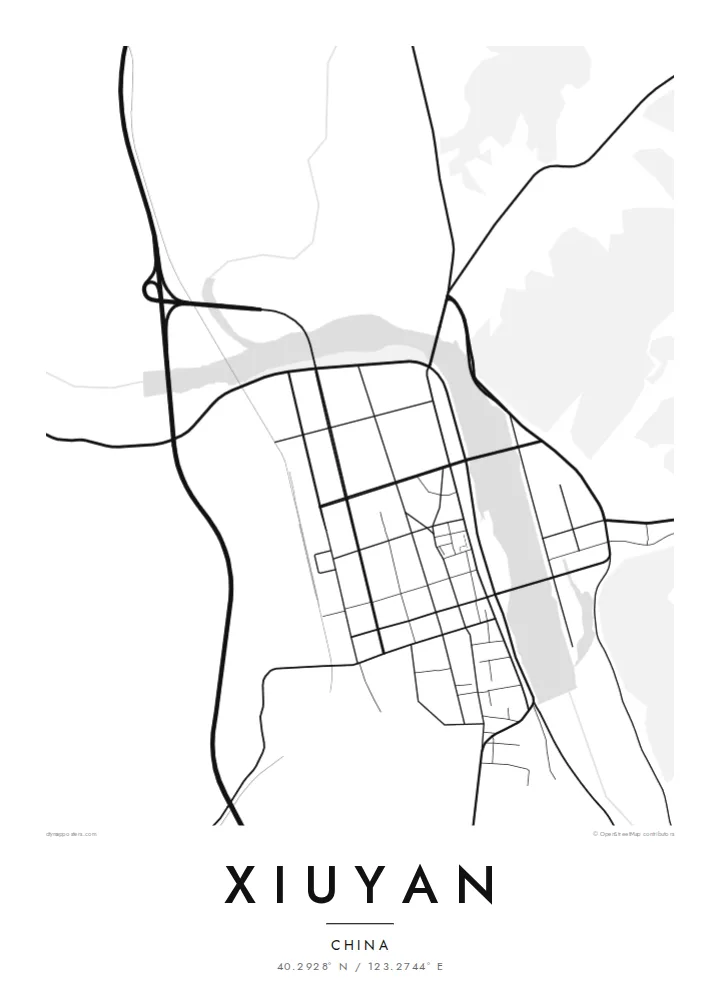
The streets are concentrated on the lower ground between hills, giving the centre an elongated, organic outline instead of a regular square grid.
Posta faʻafanua faigofie · China
40.2928° N / 123.2744° E
A county town threaded along narrow valleys in the hills of eastern Liaoning, far from the flat coastal plain


Tasi le aai, lagona e lima
Tapi se sitaili e vaai ai i luga o le puipui. E tutusa uma le tau o sitaili — pe lolomiina, faapipiiina, pe avea ma faila HD.
 Pika Moni · Faila Lolomi 24 × 36″
Manino mo le lolomi
O se vaega atoa (100%) lenei mai le faila lolomi moni. O posita uma — pe lolomiina, faapipiiina pe download mai — e faia i luga o a matou server i le 300 DPI, e oo atu i le 7,200 × 10,800 pika, ina ia manino pea auala laiti i luga o se lolomiga 24 × 36″.
I luga o le puipui


Le faʻafanua
Xiuyan is the seat of a Manchu autonomous county in Liaoning, set among the low, folded hills that run across the Liaodong Peninsula. Unlike the flat grids of the plains further west, the town has grown where the terrain allows it, so its streets gather along a valley floor and thin out quickly wherever the slopes begin.
The name is widely known in China through Xiuyan jade, a serpentine stone quarried in the county and carved for centuries. Beyond that, the town is a working regional centre, with a compact core of commercial streets, newer residential blocks at the edges and roads leading out towards villages in the surrounding hills.
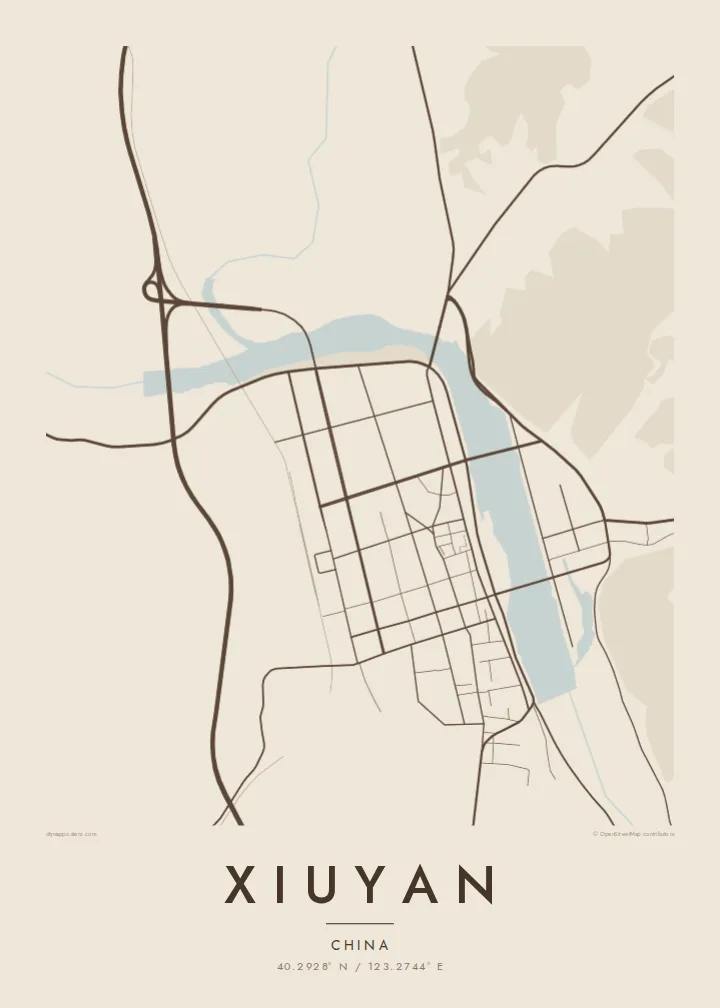
A Xiuyan map poster captures that contained shape well. The built-up area forms a denser patch in the middle of the frame, while the outer parts of the map are drawn with scattered lanes and winding roads following watercourses between the ridges. It reads as a town shaped by its setting rather than imposed on it.
The streets are concentrated on the lower ground between hills, giving the centre an elongated, organic outline instead of a regular square grid.
Outside the core, roads leave in several directions and bend along valleys, a pattern that makes the terrain legible even on a map without contour lines.
The county gives its name to one of China's best-known carving stones, and the quarrying tradition links the town to a much wider cultural history.
Fai mo oe
Faʻaopoopo se aso, se igoa po o sau lava upu, sui le sitaili, lapoʻa po o le itu.
O le preview e leai se totogi e maualalo le resolution ma iai se watermark. O lolomi ma faila HD e faia i le 300 DPI, e oo atu i le 7,200 × 10,800 px, e aunoa ma se watermark.
Aisea Xiuyan
Xiuyan is a meaningful print for people from the county, for those with family ties to the Manchu communities of eastern Liaoning, and for collectors who know the name through jade. The hilly setting gives the map an unforced, natural shape.
The title and subtitle can carry the name in any script you choose, and the coordinates line can mark the town precisely. Noir gives the valley streets a luminous quality, while Blueprint suits the network of roads spreading into the hills.
Faatau le posita Xiuyan| Lapoʻa lolomi | Manino | Faila |
|---|---|---|
| 30 × 40 cm11.8 × 15.7″ | 3,543 × 4,724 px | PNG · PDF |
| 29.7 × 42 cm (A3)11.7 × 16.5″ | 3,508 × 4,961 px | PNG · PDF |
| 42 × 59.4 cm (A2)16.5 × 23.4″ | 4,961 × 7,016 px | PNG · PDF |
| 45.7 × 61 cm18 × 24″ | 5,400 × 7,200 px | PNG · PDF |
| 50 × 70 cm19.7 × 27.6″ | 5,906 × 8,268 px | PNG · PDF |
| 61 × 91.4 cm24 × 36″ | 7,200 × 10,800 px | PNG · PDF |
Ae faʻatusatusa, o le faʻataʻitaʻiga e leai se totogi e 900 px le lautele, e iai le faʻailoga vai ma e mo mata. O faila HD e oʻo atu i le 8× le manino i itu taʻitasi ma e lolomi manino i le lapoʻa atoa o le posta.
Filifili se sitaili i le pito i luga o le itulau, ona filifili lea o le Posita Lolomi — se lapopoa ma, afai e te fiafia, se faavaa — po o Faila HD Numera. E na o le tasi laasaga o le Checkout, ma o le a fesuia'i lou itulau o oka i le taimi lava e mae'a ai le totogi.
E lolomiina i luga o pepa matte maualuga le tulaga e 200 gsm, i se tasi o lapopoa e ono, mai le 30 × 40 cm i le 24 × 36″. E amata le tau o posita lolomi mai le $39, aofia ai le auina atu.
Ioe. Filifili se faavaa laau malosi i le lanu uliuli, sina, oak masani, po o le laau pogisa. E aofia ai se tioata e le gau ma ua saunia e tautau i luga. E amata le tau o posita faavaa mai le $99, aofia ai le auina atu.
E leai se totogi o le auina atu i atunuu e 60+. O pepa ata taʻitasi e lolomiina e le tasi o matou paaga lolomi e latalata mai i atunuu e 30+, ma e masani ona taunuu i le 3–7 aso faigaluega. E mafai ona e mulimulitaia le tulaga ma le sailiga i lalo o My Orders. O nisi atunuu e 2–5 vaiaso, ma i nofoaga e lei matou auina atu iai, e taʻu atu e le saite ia te oe a o lei totogi.
Auina mai se ata i totonu o le 14 aso talu ona taunuu, ma o le a matou toe lolomiina e leai se totogi po o le toe faafoi atu lau tupe.
Ioe. I totonu o le editor i lenei itulau, suia le ulutala, le ulutala laititi ma le laina o coordinates i soo se mea e te fiafia i ai, ma filifili se sitaili ma le lapopoa. O oka lolomi, faavaa ma numera e faaaoga uma lava lau mamanu.
Mo le $9 e te maua ai faila PNG 300 DPI ma PDF ua saunia mo le lolomi i lapopoa uma e ono, e aunoa ma se watermark, e mafai ona lolomi i soo se mea. Le mautinoa lava? Download muamua se preview e leai se totogi ma le watermark.
Latalata ane
