Colonial street grid
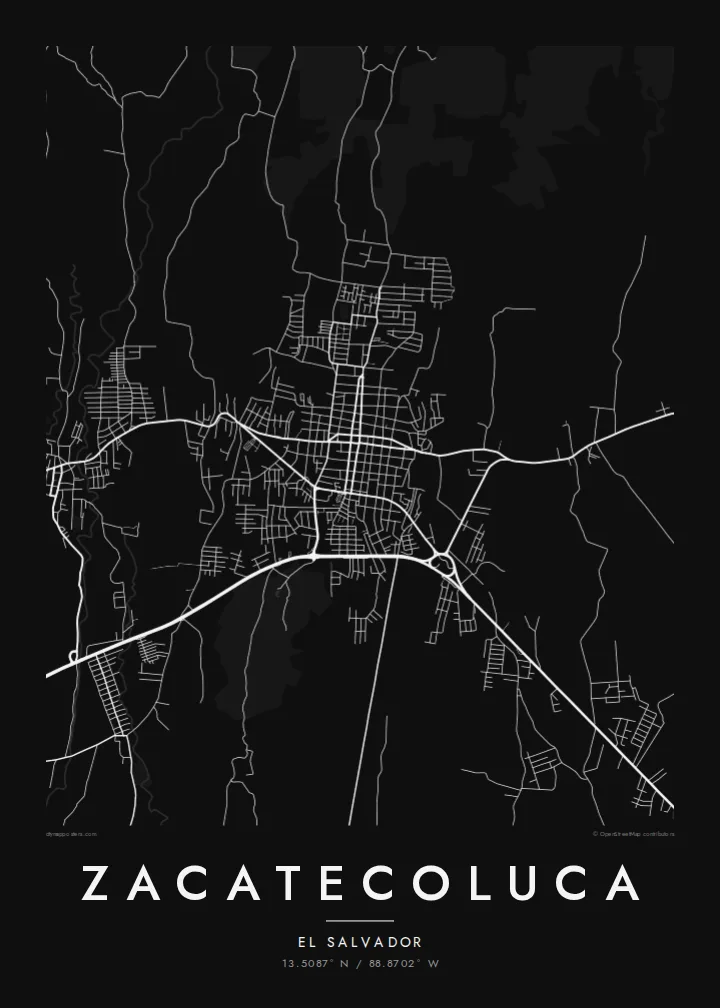
The historic centre follows a regular pattern of square blocks around the main plaza, a layout that prints as a clean, even lattice at the heart of the poster.
Posta faʻafanua faigofie · El Salvador
13.5087° N / 88.8702° W
A compact colonial grid on the Pacific lowlands, with volcanic slopes rising to the north and farmland opening toward the coast.

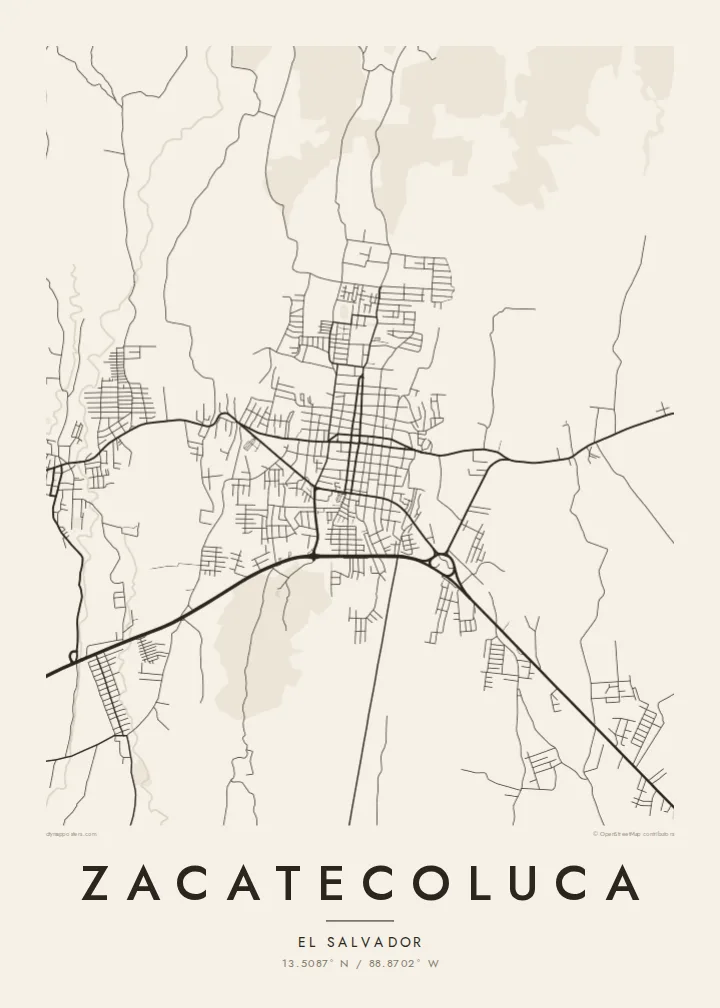


Tasi le aai, lagona e lima
Tapi se sitaili e vaai ai i luga o le puipui. E tutusa uma le tau o sitaili — pe lolomiina, faapipiiina, pe avea ma faila HD.
 Pika Moni · Faila Lolomi 24 × 36″
Manino mo le lolomi
O se vaega atoa (100%) lenei mai le faila lolomi moni. O posita uma — pe lolomiina, faapipiiina pe download mai — e faia i luga o a matou server i le 300 DPI, e oo atu i le 7,200 × 10,800 pika, ina ia manino pea auala laiti i luga o se lolomiga 24 × 36″.
I luga o le puipui


Le faʻafanua
Zacatecoluca is the capital of La Paz Department in south-central El Salvador. From above, the town reads as a tight rectangle of blocks laid out in the Spanish colonial manner, with a central square and church at its heart. The streets run in near-regular lines, and the edges loosen into irregular lanes as the built area meets fields and scattered settlements.
The setting explains much of the drawing. To the north the land climbs toward the flanks of the Chichontepec volcano, and the contour of that slope pushes the town's growth in other directions. To the south the terrain flattens into the coastal plain that runs toward the Pacific, crossed by the main road that links the western and eastern parts of the country along the littoral.
The town is known as the birthplace of José Simeón Cañas, the priest who argued before the Central American federal assembly for the abolition of slavery in 1824. A Zacatecoluca map poster keeps the plan without its noise: the central grid, the roads leading out to the plain, and the quiet space where built blocks give way to open farmland.
The historic centre follows a regular pattern of square blocks around the main plaza, a layout that prints as a clean, even lattice at the heart of the poster.
The slopes leading up toward Chichontepec lie to the north, and the way the streets stop against rising ground gives the northern edge of the map a distinct, uneven outline.
Routes heading south cross flat agricultural land toward the Pacific, drawing long, sparse lines that contrast with the dense grid of the town itself.
Fai mo oe
Faʻaopoopo se aso, se igoa po o sau lava upu, sui le sitaili, lapoʻa po o le itu.
O le preview e leai se totogi e maualalo le resolution ma iai se watermark. O lolomi ma faila HD e faia i le 300 DPI, e oo atu i le 7,200 × 10,800 px, e aunoa ma se watermark.
Aisea Zacatecoluca
For people from La Paz, or anyone with family roots in the region, this map is a way of keeping the town's plan close: the plaza, the familiar blocks, the roads out to the fields. It suits a hallway or study where a small, precise image works better than a large photograph.
The title, subtitle and coordinates line can be changed, so the poster can carry a family name, a year of departure or a wedding date. Choose from Classic black and white, Noir, Paper, Blueprint or Sand to match the room it will hang in.
Faatau le posita Zacatecoluca| Lapoʻa lolomi | Manino | Faila |
|---|---|---|
| 30 × 40 cm11.8 × 15.7″ | 3,543 × 4,724 px | PNG · PDF |
| 29.7 × 42 cm (A3)11.7 × 16.5″ | 3,508 × 4,961 px | PNG · PDF |
| 42 × 59.4 cm (A2)16.5 × 23.4″ | 4,961 × 7,016 px | PNG · PDF |
| 45.7 × 61 cm18 × 24″ | 5,400 × 7,200 px | PNG · PDF |
| 50 × 70 cm19.7 × 27.6″ | 5,906 × 8,268 px | PNG · PDF |
| 61 × 91.4 cm24 × 36″ | 7,200 × 10,800 px | PNG · PDF |
Ae faʻatusatusa, o le faʻataʻitaʻiga e leai se totogi e 900 px le lautele, e iai le faʻailoga vai ma e mo mata. O faila HD e oʻo atu i le 8× le manino i itu taʻitasi ma e lolomi manino i le lapoʻa atoa o le posta.
Filifili se sitaili i le pito i luga o le itulau, ona filifili lea o le Posita Lolomi — se lapopoa ma, afai e te fiafia, se faavaa — po o Faila HD Numera. E na o le tasi laasaga o le Checkout, ma o le a fesuia'i lou itulau o oka i le taimi lava e mae'a ai le totogi.
E lolomiina i luga o pepa matte maualuga le tulaga e 200 gsm, i se tasi o lapopoa e ono, mai le 30 × 40 cm i le 24 × 36″. E amata le tau o posita lolomi mai le $39, aofia ai le auina atu.
Ioe. Filifili se faavaa laau malosi i le lanu uliuli, sina, oak masani, po o le laau pogisa. E aofia ai se tioata e le gau ma ua saunia e tautau i luga. E amata le tau o posita faavaa mai le $99, aofia ai le auina atu.
E leai se totogi o le auina atu i atunuu e 60+. O pepa ata taʻitasi e lolomiina e le tasi o matou paaga lolomi e latalata mai i atunuu e 30+, ma e masani ona taunuu i le 3–7 aso faigaluega. E mafai ona e mulimulitaia le tulaga ma le sailiga i lalo o My Orders. O nisi atunuu e 2–5 vaiaso, ma i nofoaga e lei matou auina atu iai, e taʻu atu e le saite ia te oe a o lei totogi.
Auina mai se ata i totonu o le 14 aso talu ona taunuu, ma o le a matou toe lolomiina e leai se totogi po o le toe faafoi atu lau tupe.
Ioe. I totonu o le editor i lenei itulau, suia le ulutala, le ulutala laititi ma le laina o coordinates i soo se mea e te fiafia i ai, ma filifili se sitaili ma le lapopoa. O oka lolomi, faavaa ma numera e faaaoga uma lava lau mamanu.
Mo le $9 e te maua ai faila PNG 300 DPI ma PDF ua saunia mo le lolomi i lapopoa uma e ono, e aunoa ma se watermark, e mafai ona lolomi i soo se mea. Le mautinoa lava? Download muamua se preview e leai se totogi ma le watermark.
Latalata ane
