Great Mosque
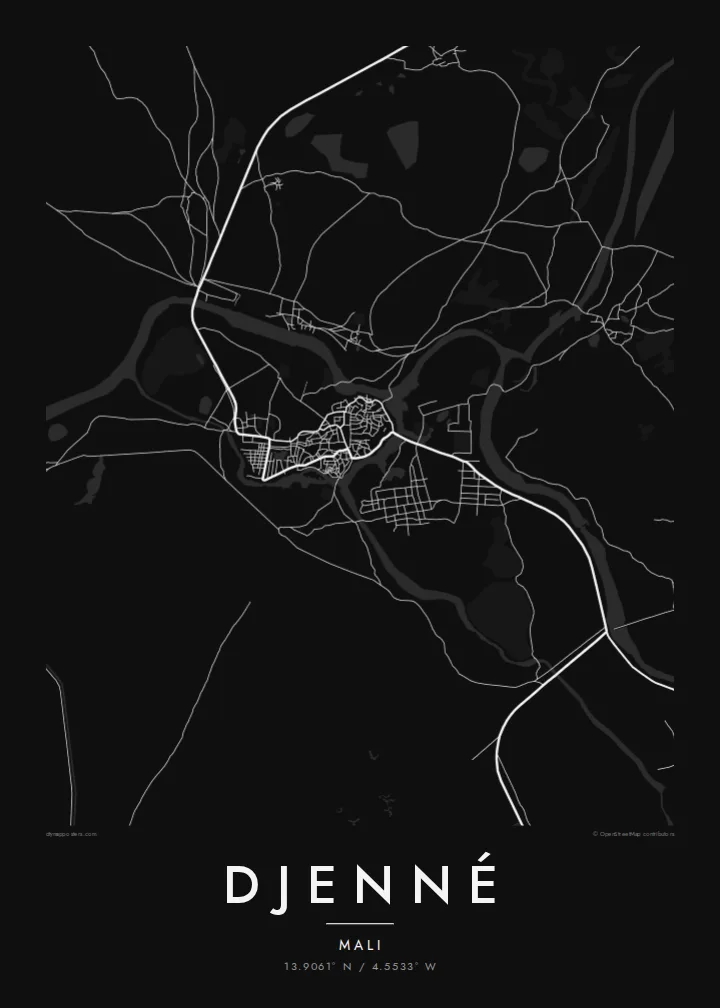
The mosque's broad rectangle and adjoining market square form the clearest landmark on the map, a calm geometric shape set within the dense fabric of the town.
Pōhita mape faigofie · Mali
13.9061° N / 4.5533° W
An ancient mud-brick town on a seasonal island in the Bani floodplain, its dense lanes gathered around the Great Mosque.



Taone e tahi, lagona e lima
Pa'i se ata ke va'ai ai i luga o te pā. E tutusa te tau o ata uma — i lomiga, fakapipi'i i faleata, pe ko faila HD.
 Pixels mo'i · Faila lomiga 24 × 36″
Manino mo te lomiga
Ko se kupega 100% mai te faila lomiga mo'i. Poster uma — pe lomiina, fakapipi'i i faleata, pe download-ina — e fakaatagia i luga o a matou setula i te 300 DPI, e oo atu ki te 7,200 × 10,800 pixels, ina ia mautinoa e ma'ai pea auala tuai foki i luga o se lomiga 24 × 36″.
I luga o te pa


Te mape
Djenné stands in the inland delta of the Niger in central Mali, on land that becomes an island when the Bani river and its channels flood each year. The old town is a compact, rounded mass of houses and courtyards, built almost entirely of sun-dried mud brick. From above, it appears as a tightly packed maze of narrow lanes, with no clear grid and very little open space.
At its heart lies the Great Mosque, the largest mud-brick building in the world, rebuilt in its present form in 1907, and the square in front of it, where a weekly Monday market gathers traders from across the region. A Djenné map poster shows the mosque's large rectangular footprint as the one clear, regular form within the intricate web of lanes.
The old towns of Djenné, together with nearby archaeological sites such as Djenné-Djeno, are listed as a UNESCO World Heritage Site, and Djenné-Djeno is regarded as one of the oldest known urban sites in sub-Saharan Africa. Around the town, the floodplain spreads out in channels, marshes and fields that change with the seasons, giving the map an open, watery frame.
The mosque's broad rectangle and adjoining market square form the clearest landmark on the map, a calm geometric shape set within the dense fabric of the town.
Narrow lanes twist between courtyard houses, producing an intricate, irregular street pattern that fills the old town and reads as fine texture in black and white.
Channels of the Bani floodplain surround the town, isolating it during high water and giving the map its distinctive enclosed, island-like outline.
Fai mo koe
Fakaopoopo he aho, he igoa pe he upu a koe, hui te faiga, te lahi pe te tūlaga.
Ko te va'aiga e leai se totogi e maualalo tona resolution ma iai se fakailoga vai. E fakaatagia lomiga ma faila HD i te 300 DPI, e oo atu ki te 7,200 × 10,800 px, e aunoa ma se fakailoga vai.
Aiheā Djenné
Djenné is one of the most recognisable towns in West Africa, and its plan carries many centuries of continuous settlement. For those who have visited, studied its architecture, or have roots in the Mopti region, a map of its lanes and waters is a meaningful piece.
The title, subtitle and coordinates can be personalised, so the poster can mark a journey, a research trip or a family connection. Choose Classic black & white, Noir, Paper, Blueprint or Sand, and download it for $9 or order a matte print.
Oka te poster Djenné| Lahi o te lomiga | Manino | Faila |
|---|---|---|
| 30 × 40 cm (11.8 × 15.7″) | 3,543 × 4,724 px | PNG · PDF |
| 29.7 × 42 cm (A3, 11.7 × 16.5″) | 3,508 × 4,961 px | PNG · PDF |
| 42 × 59.4 cm (A2, 16.5 × 23.4″) | 4,961 × 7,016 px | PNG · PDF |
| 45.7 × 61 cm (18 × 24″) | 5,400 × 7,200 px | PNG · PDF |
| 50 × 70 cm (19.7 × 27.6″) | 5,906 × 8,268 px | PNG · PDF |
| 61 × 91.4 cm (24 × 36″) | 7,200 × 10,800 px | PNG · PDF |
Mo te fakatatau, ko te fakaakoakoga e hē totogi e 900 px te lautele, e ihi te fakailoga ma mo te lau komipiuta. Ko nā faila HD e oko ki te 8× te manino i itū taki tahi ma e lomia lelei i te lahi kātoa o te pōhita.
Filifili se ata i te pito i luga o te itulau, ona filifili lea o te Poster Lomiina — se lapoa ma, ka manako ai koe, se faleata — pe ko Faila HD Fakaonaonaina. E tasi te laasaga o te ōkaina, ma ka fakafou loa lau itulau ōkaina pe a mae'a te totogi.
E lomiina i luga o se pepa matte kaliki maualuga e 200 gsm, i se tasi o ni lapoa e ono, mai le 30 × 40 cm ki te 24 × 36″. E kamata te tau o poster lomiina mai le $39, aofia ai te uta.
Ioe. Filifili se faleata lakau malō i te lanu uli, tea, oki masani pe lakau pouli. E aumai fakatasi mo se tioata e le gagamu ma ua sauni ke tautau. E kamata te tau o poster fakapipi'i i se faleata mai le $99, aofia ai te uta.
E leai se totogi o te ave i te lalolagi katoa. Ko te pepa ata taki tasi e lomi e te hoa lomi e latalata mai ki a matou i atunuku e 30+, ma e masani ona aulia i aso galuega e 3–7. E mafai ke e mulimuli i te tulaga ma te ala o tau poloaiga i lalo o Aku Poloaiga. E nai atunuku e 2–5 vaiaso te umi, ma i te mea e le i ave ai matou, e fakailoa atu e te initeneti a e le i totogi koe.
Auina mai se ata pikitia i loto o te 14 aso mai te taimi na oo mai ai, ka toe lomiina e matou e leai se totogi pe toe totogi atu lau tupe.
Ioe. I te mea fakasa'o i luga o lenei itulau, sui te ulutala, te ulutala lalo ma te laina fakamaoniga tulaga ki so se mea e manako ai koe, ona filifili lea o se ata ma se lapoa. Okaina lomiina, fakapipi'i i faleata, ma fakaonaonaina e fakaaogā uma i tau ata tonu.
Mo le $9 e maua e koe ni faila PNG 300 DPI ma PDF sauni-mo-lomiga i lapoa e ono uma, e aunoa ma se fakailoga vai, ke lomiina i so se mea. E le'i mautinoa? Download muamua se va'aiga fakailoga vai e leai se totogi.
