Paddy field grid
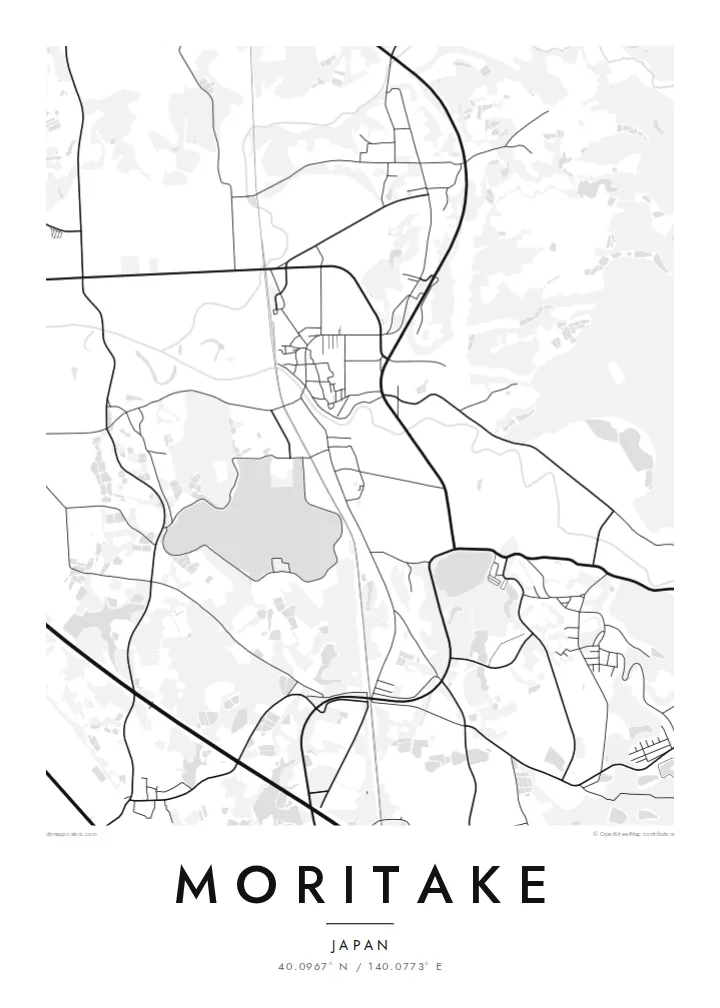
Rice paddies fill the lowlands in a precise grid of rectangles. It is the most striking pattern on the map and typical of the Akita plains.
Pōhita mape faigofie · Japan
40.0967° N / 140.0773° E
A rural settlement in northwest Akita, where village streets meet rice paddies between hills and the Sea of Japan coast


Taone e tahi, lagona e lima
Pa'i se ata ke va'ai ai i luga o te pā. E tutusa te tau o ata uma — i lomiga, fakapipi'i i faleata, pe ko faila HD.
 Pixels mo'i · Faila lomiga 24 × 36″
Manino mo te lomiga
Ko se kupega 100% mai te faila lomiga mo'i. Poster uma — pe lomiina, fakapipi'i i faleata, pe download-ina — e fakaatagia i luga o a matou setula i te 300 DPI, e oo atu ki te 7,200 × 10,800 pixels, ina ia mautinoa e ma'ai pea auala tuai foki i luga o se lomiga 24 × 36″.
I luga o te pa


Te mape
Moritake lies in Yamamoto district in the northwest of Akita Prefecture, in the town of Mitane, on the Sea of Japan side of northern Honshu. The landscape is quiet farming country. Flat rice paddies fill the lowlands, wooded hills rise inland, and the coast is not far to the west. Mitane is known throughout Japan for junsai, an aquatic plant grown in ponds and served as a delicacy.
On a map the settlement forms a narrow strip of houses and shops along the main road and railway. The land beyond is divided into a very regular grid of paddy fields. Their clean rectangles cover much of the lowland and stop where the forested hills begin. Irrigation ponds and small streams add scattered points of water.
A Moritake map poster shows the geometry of rural Japan: a line of settlement, the neat grid of paddies and the soft edges of the hills. In monochrome the paddy grid becomes a delicate pattern. The long, thin village runs through it as a single stroke, giving the print an unusually calm, graphic quality.
Rice paddies fill the lowlands in a precise grid of rectangles. It is the most striking pattern on the map and typical of the Akita plains.
Houses and shops line the main road and railway in a narrow strip. The settlement reads as one long line crossing the open fields.
Irrigation ponds dot the farmland, and forested hills rise at the edges. Together they frame the flat paddy grid with softer, irregular shapes.
Fai mo koe
Fakaopoopo he aho, he igoa pe he upu a koe, hui te faiga, te lahi pe te tūlaga.
Ko te va'aiga e leai se totogi e maualalo tona resolution ma iai se fakailoga vai. E fakaatagia lomiga ma faila HD i te 300 DPI, e oo atu ki te 7,200 × 10,800 px, e aunoa ma se fakailoga vai.
Aiheā Moritake
For people from Akita, and for anyone who has spent time in rural northern Japan, this map holds the calm order of the paddy fields and the village that runs through them. It works well in a simple, minimal room.
Personalise the title, subtitle and coordinates line, including Japanese script if you like. Paper and Sand suit the farmland, and Classic black & white brings out the paddy grid. Noir and Blueprint are also available.
Oka te poster Moritake| Lahi o te lomiga | Manino | Faila |
|---|---|---|
| 30 × 40 cm (11.8 × 15.7″) | 3,543 × 4,724 px | PNG · PDF |
| 29.7 × 42 cm (A3, 11.7 × 16.5″) | 3,508 × 4,961 px | PNG · PDF |
| 42 × 59.4 cm (A2, 16.5 × 23.4″) | 4,961 × 7,016 px | PNG · PDF |
| 45.7 × 61 cm (18 × 24″) | 5,400 × 7,200 px | PNG · PDF |
| 50 × 70 cm (19.7 × 27.6″) | 5,906 × 8,268 px | PNG · PDF |
| 61 × 91.4 cm (24 × 36″) | 7,200 × 10,800 px | PNG · PDF |
Mo te fakatatau, ko te fakaakoakoga e hē totogi e 900 px te lautele, e ihi te fakailoga ma mo te lau komipiuta. Ko nā faila HD e oko ki te 8× te manino i itū taki tahi ma e lomia lelei i te lahi kātoa o te pōhita.
Filifili se ata i te pito i luga o te itulau, ona filifili lea o te Poster Lomiina — se lapoa ma, ka manako ai koe, se faleata — pe ko Faila HD Fakaonaonaina. E tasi te laasaga o te ōkaina, ma ka fakafou loa lau itulau ōkaina pe a mae'a te totogi.
E lomiina i luga o se pepa matte kaliki maualuga e 200 gsm, i se tasi o ni lapoa e ono, mai le 30 × 40 cm ki te 24 × 36″. E kamata te tau o poster lomiina mai le {printFrom}, aofia ai te uta.
Ioe. Filifili se faleata lakau malō i te lanu uli, tea, oki masani pe lakau pouli. E aumai fakatasi mo se tioata e le gagamu ma ua sauni ke tautau. E kamata te tau o poster fakapipi'i i se faleata mai le {framedFrom}, aofia ai te uta.
E leai se totogi o te ave i te lalolagi katoa. Ko te pepa ata taki tasi e lomi e te hoa lomi e latalata mai ki a matou i atunuku e 30+, ma e masani ona aulia i aso galuega e 3–7. E mafai ke e mulimuli i te tulaga ma te ala o tau poloaiga i lalo o Aku Poloaiga. E nai atunuku e 2–5 vaiaso te umi, ma i te mea e le i ave ai matou, e fakailoa atu e te initeneti a e le i totogi koe.
Auina mai se ata pikitia i loto o te 14 aso mai te taimi na oo mai ai, ka toe lomiina e matou e leai se totogi pe toe totogi atu lau tupe.
Ioe. I te mea fakasa'o i luga o lenei itulau, sui te ulutala, te ulutala lalo ma te laina fakamaoniga tulaga ki so se mea e manako ai koe, ona filifili lea o se ata ma se lapoa. Okaina lomiina, fakapipi'i i faleata, ma fakaonaonaina e fakaaogā uma i tau ata tonu.
Mo le $9 e maua e koe ni faila PNG 300 DPI ma PDF sauni-mo-lomiga i lapoa e ono uma, e aunoa ma se fakailoga vai, ke lomiina i so se mea. E le'i mautinoa? Download muamua se va'aiga fakailoga vai e leai se totogi.
Latalata
