Moated palace
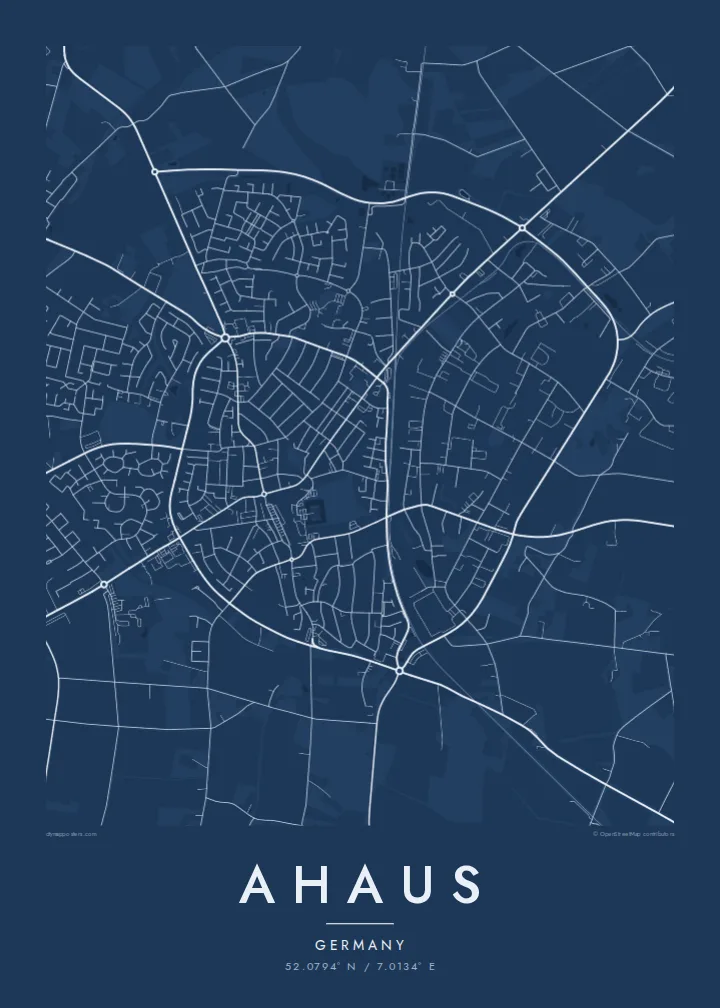
Schloss Ahaus sits within a water-filled moat and formal gardens, a crisp rectangular figure that anchors the town centre and is easy to pick out on the finished poster.
Fakatino mape mukamuka · Germany
52.0794° N / 7.0134° E
A Münsterland town gathered around a moated baroque palace, with a small river and field roads radiating outward.



Taha e taone, lima e onoonoaga
Tapaki e taha puhala ke kitia ai ki luga he puipui. Kua tatai e totogi he tau puhala oti — pete he lolomi, poloka, po ke faila HD.
 Tau pikselo mooli · faila lolomi 24 × 36″
Maama mitaki ke lolomi
Ko e 100% e fahi mooli mai he faila lolomi. Ko e tau poster oti — pete kua lolomi, poloka, po ke utu hifo — kua taute ke he ha mautolu a tau tokoluga (server) ke he 300 DPI, hokotia ke he 7,200 × 10,800 piksela, ke maeke ai e tau ala ikiiki tote ke maaliali fakamitaki he lolomi 24 × 36″.
He Pā


Ko e mape
Ahaus lies in the western Münsterland, close to the Dutch border, in a landscape of farms, hedgerows and small woods. The town centre is compact, with streets curving around the old core rather than following a strict grid. Beyond it the map breaks into the scattered pattern typical of the region: detached farmsteads, straight field lanes and villages such as Alstätte, Ottenstein, Wessum and Wüllen that now belong to the town.
The best-known landmark is Schloss Ahaus, a moated baroque palace built in the late seventeenth century for the prince-bishops of Münster. Its rectangular moat and formal grounds form one of the most geometric shapes in the town plan. Ahaus is also known nationally as the site of an interim storage facility for spent nuclear fuel, which lies on the outskirts of the town.
An Ahaus map poster renders the palace moat, the thin line of the Ahauser Aa and the web of roads toward Gronau, Stadtlohn and the border as fine black strokes. Because the surrounding land is so evenly patterned, the town centre stands out clearly, making for a balanced and quietly detailed print.
Schloss Ahaus sits within a water-filled moat and formal gardens, a crisp rectangular figure that anchors the town centre and is easy to pick out on the finished poster.
The small river threads through the town and on across the flat countryside, a narrow winding line that softens the otherwise regular pattern of lanes and plots.
Around the town, isolated farmsteads and straight agricultural roads create a fine, even texture, typical of the region and very different from the denser streets at the centre.
Taute ke ha hau
Lafi e aho, taha higoa po ke taha kupu haau, hiki e fakatino, lahi po ke tuaga.
Ko e kitiaaga nakai totogi kua tote e maaliali mo e fakamailoga vai. Ko e tau lolomi mo e tau faila HD kua taute ke he 300 DPI, hokotia ke he 7,200 × 10,800 px, nakai fai fakamailoga vai.
Ko e ha Ahaus
Ahaus is the kind of town people stay loyal to, whether they grew up in one of its villages or spent a few years there. A map of it is personal without being sentimental, and the palace moat gives the composition a clear focal point.
Personalise the title, add a subtitle such as a village name, and set a date or your own coordinates line. Five styles are available: Classic black and white, Noir, Paper, Blueprint and Sand. Paper and Sand suit the soft rural setting particularly well.
Talaage e poster Ahaus| Lahi he lolomi | Maama | Tau faila |
|---|---|---|
| 30 × 40 cm11.8 × 15.7″ | 3,543 × 4,724 px | PNG · PDF |
| 29.7 × 42 cm (A3)11.7 × 16.5″ | 3,508 × 4,961 px | PNG · PDF |
| 42 × 59.4 cm (A2)16.5 × 23.4″ | 4,961 × 7,016 px | PNG · PDF |
| 45.7 × 61 cm18 × 24″ | 5,400 × 7,200 px | PNG · PDF |
| 50 × 70 cm19.7 × 27.6″ | 5,906 × 8,268 px | PNG · PDF |
| 61 × 91.4 cm24 × 36″ | 7,200 × 10,800 px | PNG · PDF |
Ke fakatatai, ko e fakatino noa kua 900 px e laulahi, fai fakamailoga mo e mo e tau mata komipiuta ni. Ko e tau faila HD kua ato hoko ke he 8× e maama ke he tau faahi takitaha mo e lolomi mitaki he lahi katoa he fakatino.
Fifili e taha puhala i luga he kupega, ti fifili e Poster Lolomi — e lahi mo e, kaeke ke manako ai koe, taha poloka — po ke Tau Faila HD Fakaeletonika. Ko e fakaotiaga totogi ko e taha gahua ni, ti ko e kupega he hau a talaaga ka fakafou fakahaga i mua he fakaotiaga e totogi.
Kua lolomi ai ke he pepa mitaki 200 gsm matte he taha he tau lahi ono, mai he 30 × 40 cm ke hoko ke he 24 × 36″. Kamata e tau poster lolomi mai he $39, kua putoia ai e utaaga.
E. Fifili e poloka akau malolō ke he lanu uli, tea, akau oki mooli, po ke akau pouli. Kua fakalataha mo e sioga malolō nakai malepe ti kua mautali ke tautau. Kamata e tau poster poloka mai he $99, kua putoia ai e utaaga.
Nakai totogi e fakafano ke he motu 60+. Ko e fakatino taha kua lolomi he fenoga lolomi ha mautolu kua tata mo e tau motu 30+, kua hoko mai he tau aho gahua 3–7. Maeke ia koe ke kikite e tuaga mo e fakamuitua he lalo he Haku Tau Fakatonu. Ke he falu motu kua 2–5 e tau tapu, ti ka nakai fakafano a mautolu ki ai, to fakaha he api tupe ia ki mua he totogi.
Fakafano mai e taha ata ki a mautolu he loto he 14 e tau aho tali mai he hokoaga, ti to lolomi foki e mautolu nakai totogi po ke liu atu e totogi ki a koe.
E. He editor i luga he kupega nei, hikihiki e matakupu, e matakupu lalo mo e laini coordinates ke he taha mena kua manako a koe ki ai, ti fifili e puhala mo e lahi. Ko e tau talaaga lolomi, poloka mo e fakaeletonika oti kua fakaaoga tonu e hau a fakatino.
Ma e $9 ka moua e koe e tau faila PNG 300 DPI mo e PDF kua mautali ke lolomi he tau lahi ono oti, nakai fai fakamailoga vai, ke lolomi i fe mena. Nakai maopoopo agaia? Utu hifo fakamua e kitiaaga nakai totogi ne fai fakamailoga vai.
Tata mai
