Low, level plain
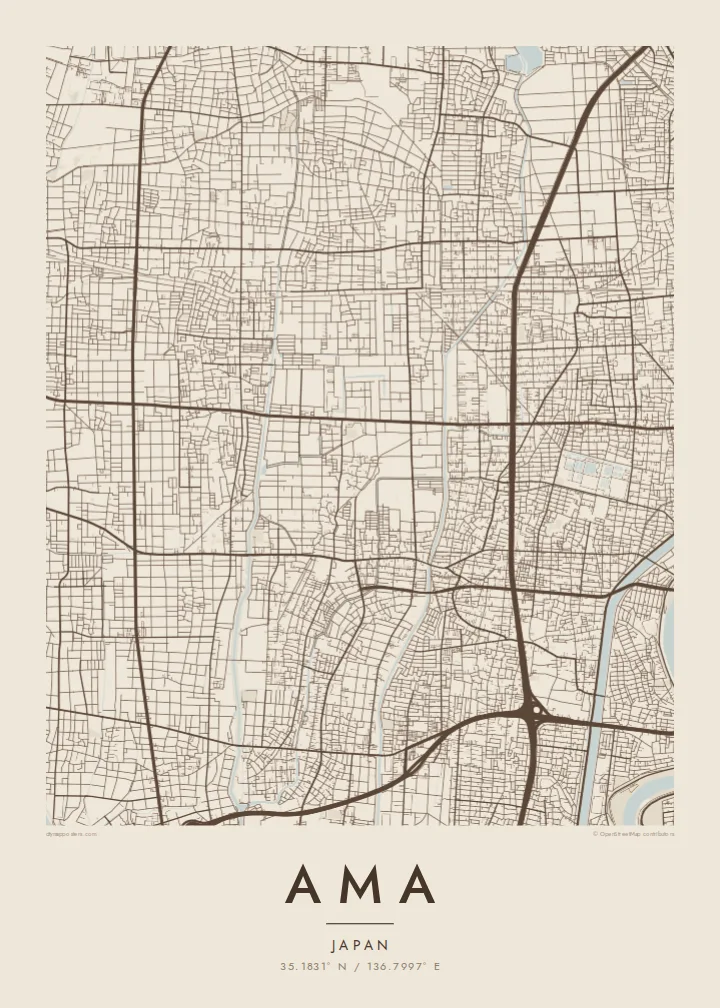
Ama lies on flat ground near sea level, so water channels and field boundaries shape the map instead of slopes. The result is an unusually even, finely detailed surface.
Fakatino mape mukamuka · Japan
35.1831° N / 136.7997° E
Flat, low-lying land west of Nagoya, where neighbourhoods, rice fields and water channels meet in a fine grain.


Taha e taone, lima e onoonoaga
Tapaki e taha puhala ke kitia ai ki luga he puipui. Kua tatai e totogi he tau puhala oti — pete he lolomi, poloka, po ke faila HD.
 Tau pikselo mooli · faila lolomi 24 × 36″
Maama mitaki ke lolomi
Ko e 100% e fahi mooli mai he faila lolomi. Ko e tau poster oti — pete kua lolomi, poloka, po ke utu hifo — kua taute ke he ha mautolu a tau tokoluga (server) ke he 300 DPI, hokotia ke he 7,200 × 10,800 piksela, ke maeke ai e tau ala ikiiki tote ke maaliali fakamitaki he lolomi 24 × 36″.
He Pā


Ko e mape
Ama is a city in western Aichi Prefecture, just beyond the edge of Nagoya on the flat Nōbi Plain. It was formed in 2010 when the towns of Shippō, Miwa and Jimokuji merged, and its map still reflects those older centres. Several clusters of streets are connected by rail lines and roads, with farmland and housing filling the space between them.
The land is almost completely level, much of it close to sea level, so drainage channels and small rivers shape the pattern rather than hills. Rectangular rice fields, straight irrigation lines and tight residential lanes combine into a fine, even texture. Commuter railways run through the city towards central Nagoya and tie Ama closely to the wider metropolitan area.
The name Shippō refers to cloisonné enamel, a craft long associated with the area, and Jimokuji is known for its old Buddhist temple of the same name. An Ama map poster shows this quiet suburban landscape clearly: the grain of fields and houses, the lines of rail and water, and the gentle rhythm of a low plain.
Ama lies on flat ground near sea level, so water channels and field boundaries shape the map instead of slopes. The result is an unusually even, finely detailed surface.
The older cores of Shippō, Miwa and Jimokuji appear as denser clusters of streets. They give the city several focal points instead of a single downtown.
Commuter lines cut across the city towards central Nagoya. They draw clean, straight strokes through the fields and neighbourhoods and connect Ama to the wider region.
Taute ke ha hau
Lafi e aho, taha higoa po ke taha kupu haau, hiki e fakatino, lahi po ke tuaga.
Ko e kitiaaga nakai totogi kua tote e maaliali mo e fakamailoga vai. Ko e tau lolomi mo e tau faila HD kua taute ke he 300 DPI, hokotia ke he 7,200 × 10,800 px, nakai fai fakamailoga vai.
Ko e ha Ama
Many people in Ama commute into Nagoya and come home each evening to a quieter place of fields and temples. A map of the city captures that balance and makes a thoughtful gift for a new home or for a family moving away.
You can change the title, subtitle and coordinates line to mark a neighbourhood, a date or a name. Pick from five styles: Classic black & white, Noir, Paper, Blueprint and Sand. The fine field pattern looks particularly good in Paper and Blueprint.
Talaage e poster Ama| Lahi he lolomi | Maama | Tau faila |
|---|---|---|
| 30 × 40 cm11.8 × 15.7″ | 3,543 × 4,724 px | PNG · PDF |
| 29.7 × 42 cm (A3)11.7 × 16.5″ | 3,508 × 4,961 px | PNG · PDF |
| 42 × 59.4 cm (A2)16.5 × 23.4″ | 4,961 × 7,016 px | PNG · PDF |
| 45.7 × 61 cm18 × 24″ | 5,400 × 7,200 px | PNG · PDF |
| 50 × 70 cm19.7 × 27.6″ | 5,906 × 8,268 px | PNG · PDF |
| 61 × 91.4 cm24 × 36″ | 7,200 × 10,800 px | PNG · PDF |
Ke fakatatai, ko e fakatino noa kua 900 px e laulahi, fai fakamailoga mo e mo e tau mata komipiuta ni. Ko e tau faila HD kua ato hoko ke he 8× e maama ke he tau faahi takitaha mo e lolomi mitaki he lahi katoa he fakatino.
Fifili e taha puhala i luga he kupega, ti fifili e Poster Lolomi — e lahi mo e, kaeke ke manako ai koe, taha poloka — po ke Tau Faila HD Fakaeletonika. Ko e fakaotiaga totogi ko e taha gahua ni, ti ko e kupega he hau a talaaga ka fakafou fakahaga i mua he fakaotiaga e totogi.
Kua lolomi ai ke he pepa mitaki 200 gsm matte he taha he tau lahi ono, mai he 30 × 40 cm ke hoko ke he 24 × 36″. Kamata e tau poster lolomi mai he $39, kua putoia ai e utaaga.
E. Fifili e poloka akau malolō ke he lanu uli, tea, akau oki mooli, po ke akau pouli. Kua fakalataha mo e sioga malolō nakai malepe ti kua mautali ke tautau. Kamata e tau poster poloka mai he $99, kua putoia ai e utaaga.
Nakai totogi e fakafano ke he motu 60+. Ko e fakatino taha kua lolomi he fenoga lolomi ha mautolu kua tata mo e tau motu 30+, kua hoko mai he tau aho gahua 3–7. Maeke ia koe ke kikite e tuaga mo e fakamuitua he lalo he Haku Tau Fakatonu. Ke he falu motu kua 2–5 e tau tapu, ti ka nakai fakafano a mautolu ki ai, to fakaha he api tupe ia ki mua he totogi.
Fakafano mai e taha ata ki a mautolu he loto he 14 e tau aho tali mai he hokoaga, ti to lolomi foki e mautolu nakai totogi po ke liu atu e totogi ki a koe.
E. He editor i luga he kupega nei, hikihiki e matakupu, e matakupu lalo mo e laini coordinates ke he taha mena kua manako a koe ki ai, ti fifili e puhala mo e lahi. Ko e tau talaaga lolomi, poloka mo e fakaeletonika oti kua fakaaoga tonu e hau a fakatino.
Ma e $9 ka moua e koe e tau faila PNG 300 DPI mo e PDF kua mautali ke lolomi he tau lahi ono oti, nakai fai fakamailoga vai, ke lolomi i fe mena. Nakai maopoopo agaia? Utu hifo fakamua e kitiaaga nakai totogi ne fai fakamailoga vai.
Tata mai
