Planned business blocks
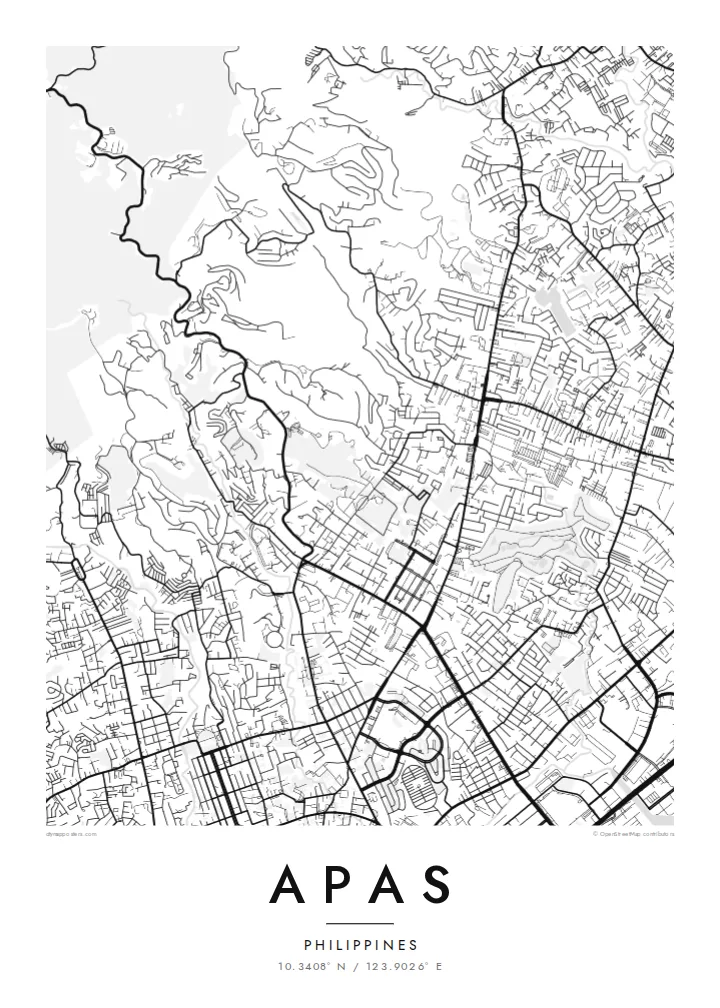
The area around Cebu IT Park shows up as a set of larger, regular blocks with straighter roads. It is the most geometric part of the map and stands out against the looser residential fabric around it.
Fakatino mape mukamuka · Philippines
10.3408° N / 123.9026° E
A compact uptown district of Cebu City, where dense streets climb gently from the coastal plain toward the green hills behind



Taha e taone, lima e onoonoaga
Tapaki e taha puhala ke kitia ai ki luga he puipui. Kua tatai e totogi he tau puhala oti — pete he lolomi, poloka, po ke faila HD.
 Tau pikselo mooli · faila lolomi 24 × 36″
Maama mitaki ke lolomi
Ko e 100% e fahi mooli mai he faila lolomi. Ko e tau poster oti — pete kua lolomi, poloka, po ke utu hifo — kua taute ke he ha mautolu a tau tokoluga (server) ke he 300 DPI, hokotia ke he 7,200 × 10,800 piksela, ke maeke ai e tau ala ikiiki tote ke maaliali fakamitaki he lolomi 24 × 36″.
He Pā


Ko e mape
Apas is a barangay in the uptown part of Cebu City, on the island of Cebu in Central Visayas. From above it is a tight weave of short streets, lanes and residential blocks. Newer office and commercial blocks along wider roads sit next to older neighbourhoods. The terrain rises as it runs inland, so the grid loosens and bends where the city starts climbing toward the hills.
The district is closely linked to Cebu IT Park, the business and technology zone that has changed this part of the city over recent decades. On a map the contrast is easy to see. Broad, orderly blocks around the park give way to the finer and less regular pattern of the surrounding barangay, where lanes branch off main roads and wind between houses.
An Apas map poster shows a piece of a large metropolitan city at close range, rather than the whole urban sprawl of Metro Cebu. The small scale brings out detail that a regional map loses: the density of the lanes, the junctions where major roads meet, and the gradual shift from planned blocks to organic streets as the land rises.
The area around Cebu IT Park shows up as a set of larger, regular blocks with straighter roads. It is the most geometric part of the map and stands out against the looser residential fabric around it.
Away from the main roads, narrow lanes branch and loop between homes. On the poster they form a fine, almost textile pattern, the most intricate part of the composition.
Inland, the street network thins and follows the rising ground behind Cebu City. The edge of the drawing hints at the change from dense city to hilly terrain.
Taute ke ha hau
Lafi e aho, taha higoa po ke taha kupu haau, hiki e fakatino, lahi po ke tuaga.
Ko e kitiaaga nakai totogi kua tote e maaliali mo e fakamailoga vai. Ko e tau lolomi mo e tau faila HD kua taute ke he 300 DPI, hokotia ke he 7,200 × 10,800 px, nakai fai fakamailoga vai.
Ko e ha Apas
For people who have lived, studied or worked in uptown Cebu, the lines of Apas carry daily routes: the walk to the office, the jeepney stop, the street where a first apartment stood. A clean black-and-white print keeps those memories without the noise of a photograph.
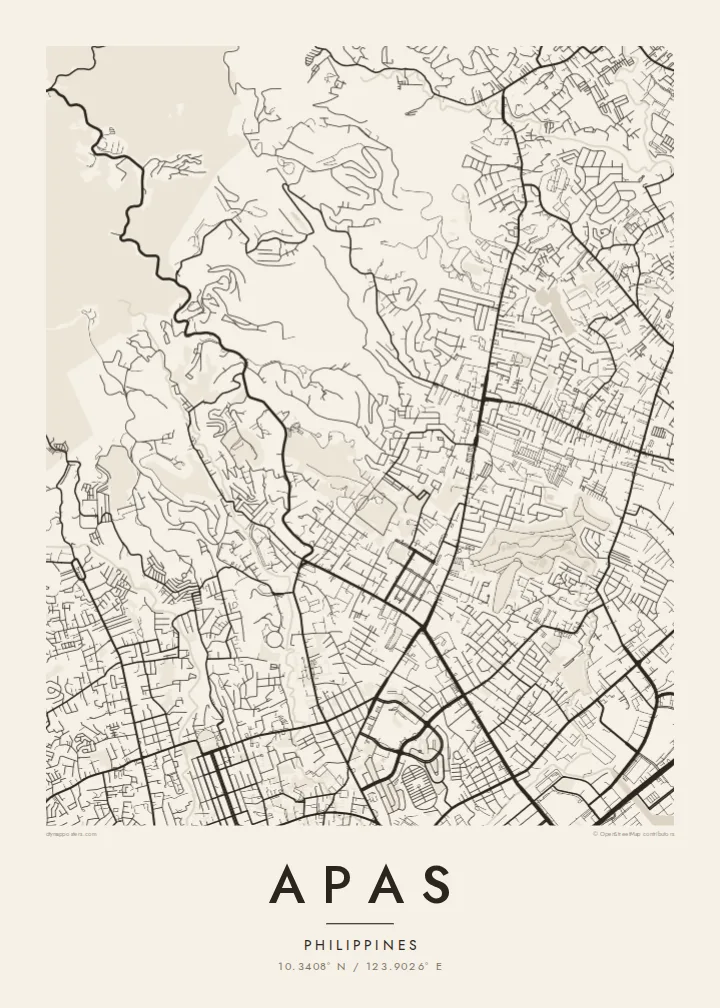
The poster can be personalised with your own title, a subtitle such as a date or a name, and a coordinates line. Choose between Classic black & white, Noir, Paper, Blueprint and Sand to suit the room it will hang in.
Talaage e poster Apas| Lahi he lolomi | Maama | Tau faila |
|---|---|---|
| 30 × 40 cm11.8 × 15.7″ | 3,543 × 4,724 px | PNG · PDF |
| 29.7 × 42 cm (A3)11.7 × 16.5″ | 3,508 × 4,961 px | PNG · PDF |
| 42 × 59.4 cm (A2)16.5 × 23.4″ | 4,961 × 7,016 px | PNG · PDF |
| 45.7 × 61 cm18 × 24″ | 5,400 × 7,200 px | PNG · PDF |
| 50 × 70 cm19.7 × 27.6″ | 5,906 × 8,268 px | PNG · PDF |
| 61 × 91.4 cm24 × 36″ | 7,200 × 10,800 px | PNG · PDF |
Ke fakatatai, ko e fakatino noa kua 900 px e laulahi, fai fakamailoga mo e mo e tau mata komipiuta ni. Ko e tau faila HD kua ato hoko ke he 8× e maama ke he tau faahi takitaha mo e lolomi mitaki he lahi katoa he fakatino.
Fifili e taha puhala i luga he kupega, ti fifili e Poster Lolomi — e lahi mo e, kaeke ke manako ai koe, taha poloka — po ke Tau Faila HD Fakaeletonika. Ko e fakaotiaga totogi ko e taha gahua ni, ti ko e kupega he hau a talaaga ka fakafou fakahaga i mua he fakaotiaga e totogi.
Kua lolomi ai ke he pepa mitaki 200 gsm matte he taha he tau lahi ono, mai he 30 × 40 cm ke hoko ke he 24 × 36″. Kamata e tau poster lolomi mai he $39, kua putoia ai e utaaga.
E. Fifili e poloka akau malolō ke he lanu uli, tea, akau oki mooli, po ke akau pouli. Kua fakalataha mo e sioga malolō nakai malepe ti kua mautali ke tautau. Kamata e tau poster poloka mai he $99, kua putoia ai e utaaga.
Nakai totogi e fakafano ke he motu 60+. Ko e fakatino taha kua lolomi he fenoga lolomi ha mautolu kua tata mo e tau motu 30+, kua hoko mai he tau aho gahua 3–7. Maeke ia koe ke kikite e tuaga mo e fakamuitua he lalo he Haku Tau Fakatonu. Ke he falu motu kua 2–5 e tau tapu, ti ka nakai fakafano a mautolu ki ai, to fakaha he api tupe ia ki mua he totogi.
Fakafano mai e taha ata ki a mautolu he loto he 14 e tau aho tali mai he hokoaga, ti to lolomi foki e mautolu nakai totogi po ke liu atu e totogi ki a koe.
E. He editor i luga he kupega nei, hikihiki e matakupu, e matakupu lalo mo e laini coordinates ke he taha mena kua manako a koe ki ai, ti fifili e puhala mo e lahi. Ko e tau talaaga lolomi, poloka mo e fakaeletonika oti kua fakaaoga tonu e hau a fakatino.
Ma e $9 ka moua e koe e tau faila PNG 300 DPI mo e PDF kua mautali ke lolomi he tau lahi ono oti, nakai fai fakamailoga vai, ke lolomi i fe mena. Nakai maopoopo agaia? Utu hifo fakamua e kitiaaga nakai totogi ne fai fakamailoga vai.
Tata mai
