The Boardwalk
The historic Boardwalk runs for miles along the ocean edge of the island, forming the city's strongest single line on the map.
Fakatino mape mukamuka · United States
39.3642° N / 74.4231° W
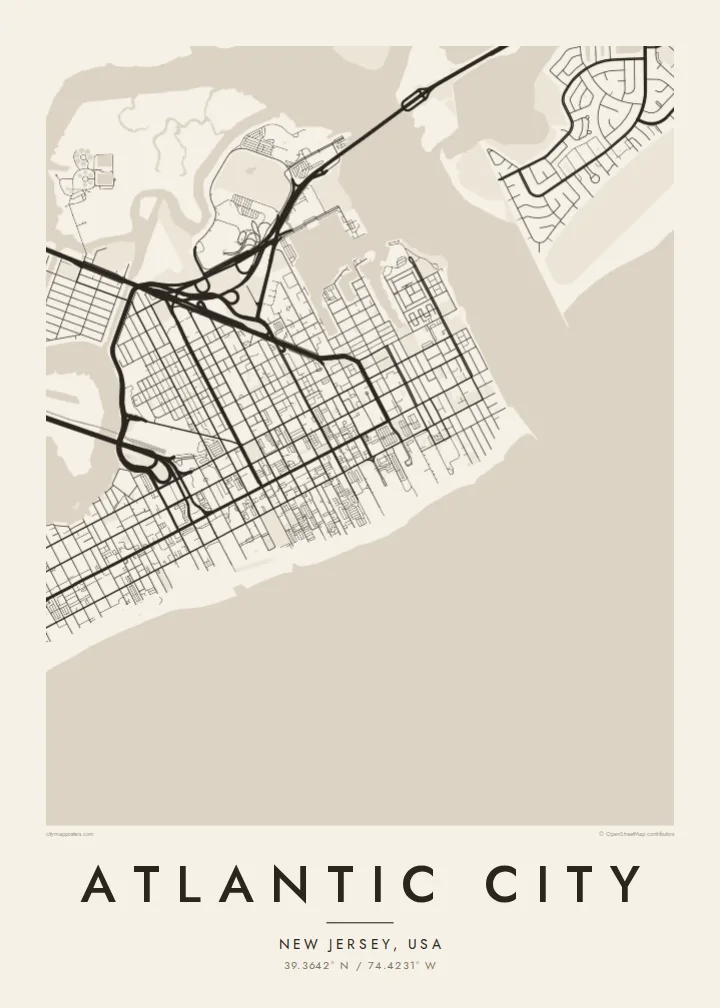
A long barrier-island grid between ocean and bay, with the Boardwalk tracing the whole Atlantic edge.




Taha e taone, lima e onoonoaga
Tapaki e taha puhala ke kitia ai ki luga he puipui. Kua tatai e totogi he tau puhala oti — pete he lolomi, poloka, po ke faila HD.
 Tau pikselo mooli · faila lolomi 24 × 36″
Maama mitaki ke lolomi
Ko e 100% e fahi mooli mai he faila lolomi. Ko e tau poster oti — pete kua lolomi, poloka, po ke utu hifo — kua taute ke he ha mautolu a tau tokoluga (server) ke he 300 DPI, hokotia ke he 7,200 × 10,800 piksela, ke maeke ai e tau ala ikiiki tote ke maaliali fakamitaki he lolomi 24 × 36″.
He Pā


Ko e mape
Atlantic City occupies the northern part of Absecon Island, a narrow barrier island on the New Jersey shore. On a map, the Atlantic Ocean runs along one side and a maze of tidal marshes, channels and bays along the other. Between them lies a regular street grid: avenues run parallel to the beach, and cross streets, many named after states, run from the sand back to the bay.
Those street names became famous far beyond New Jersey after the original American Monopoly board borrowed Boardwalk, Park Place, Ventnor Avenue and others from the city. The Boardwalk itself, first built in 1870, was the first of its kind in the United States. Casino towers now line much of the oceanfront, and the Absecon Lighthouse stands near the island's northern inlet.
An Atlantic City map poster turns this seaside grid into a clean graphic pattern. The Boardwalk makes a long, straight line against the empty ocean, and the regular blocks behind it give way to the irregular channels and marsh islands of the back bays. The contrast between the ordered grid and the loose tidal shapes makes the city's position on its island easy to read.
The historic Boardwalk runs for miles along the ocean edge of the island, forming the city's strongest single line on the map.
Streets named after states cross the island from beach to bay at regular intervals, and the grid carries the names that later appeared on the Monopoly board.
Behind the city, tidal channels, marsh islands and open bays separate Absecon Island from the mainland, crossed by a few causeway roads.
Taute ke ha hau
Lafi e aho, taha higoa po ke taha kupu haau, hiki e fakatino, lahi po ke tuaga.
Ko e kitiaaga nakai totogi kua tote e maaliali mo e fakamailoga vai. Ko e tau lolomi mo e tau faila HD kua taute ke he 300 DPI, hokotia ke he 7,200 × 10,800 px, nakai fai fakamailoga vai.
Ko e ha Atlantic City
Atlantic City means summer trips to the shore, nights on the Boardwalk, or a family that has lived on the island for generations. For board-game fans, the poster also shows the real streets behind a familiar set of names.
Choose from five styles, Classic black & white, Noir, Paper, Blueprint or Sand, and personalise the title, subtitle and coordinates line. A date in the subtitle can mark a wedding on the shore or a first visit to the city.
Talaage e poster Atlantic City| Lahi he lolomi | Maama | Tau faila |
|---|---|---|
| 30 × 40 cm11.8 × 15.7″ | 3,543 × 4,724 px | PNG · PDF |
| 29.7 × 42 cm (A3)11.7 × 16.5″ | 3,508 × 4,961 px | PNG · PDF |
| 42 × 59.4 cm (A2)16.5 × 23.4″ | 4,961 × 7,016 px | PNG · PDF |
| 45.7 × 61 cm18 × 24″ | 5,400 × 7,200 px | PNG · PDF |
| 50 × 70 cm19.7 × 27.6″ | 5,906 × 8,268 px | PNG · PDF |
| 61 × 91.4 cm24 × 36″ | 7,200 × 10,800 px | PNG · PDF |
Ke fakatatai, ko e fakatino noa kua 900 px e laulahi, fai fakamailoga mo e mo e tau mata komipiuta ni. Ko e tau faila HD kua ato hoko ke he 8× e maama ke he tau faahi takitaha mo e lolomi mitaki he lahi katoa he fakatino.
Fifili e taha puhala i luga he kupega, ti fifili e Poster Lolomi — e lahi mo e, kaeke ke manako ai koe, taha poloka — po ke Tau Faila HD Fakaeletonika. Ko e fakaotiaga totogi ko e taha gahua ni, ti ko e kupega he hau a talaaga ka fakafou fakahaga i mua he fakaotiaga e totogi.
Kua lolomi ai ke he pepa mitaki 200 gsm matte he taha he tau lahi ono, mai he 30 × 40 cm ke hoko ke he 24 × 36″. Kamata e tau poster lolomi mai he $39, kua putoia ai e utaaga.
E. Fifili e poloka akau malolō ke he lanu uli, tea, akau oki mooli, po ke akau pouli. Kua fakalataha mo e sioga malolō nakai malepe ti kua mautali ke tautau. Kamata e tau poster poloka mai he $99, kua putoia ai e utaaga.
Nakai totogi e fakafano ke he motu 60+. Ko e fakatino taha kua lolomi he fenoga lolomi ha mautolu kua tata mo e tau motu 30+, kua hoko mai he tau aho gahua 3–7. Maeke ia koe ke kikite e tuaga mo e fakamuitua he lalo he Haku Tau Fakatonu. Ke he falu motu kua 2–5 e tau tapu, ti ka nakai fakafano a mautolu ki ai, to fakaha he api tupe ia ki mua he totogi.
Fakafano mai e taha ata ki a mautolu he loto he 14 e tau aho tali mai he hokoaga, ti to lolomi foki e mautolu nakai totogi po ke liu atu e totogi ki a koe.
E. He editor i luga he kupega nei, hikihiki e matakupu, e matakupu lalo mo e laini coordinates ke he taha mena kua manako a koe ki ai, ti fifili e puhala mo e lahi. Ko e tau talaaga lolomi, poloka mo e fakaeletonika oti kua fakaaoga tonu e hau a fakatino.
Ma e $9 ka moua e koe e tau faila PNG 300 DPI mo e PDF kua mautali ke lolomi he tau lahi ono oti, nakai fai fakamailoga vai, ke lolomi i fe mena. Nakai maopoopo agaia? Utu hifo fakamua e kitiaaga nakai totogi ne fai fakamailoga vai.
Tata mai
