Dense street weave
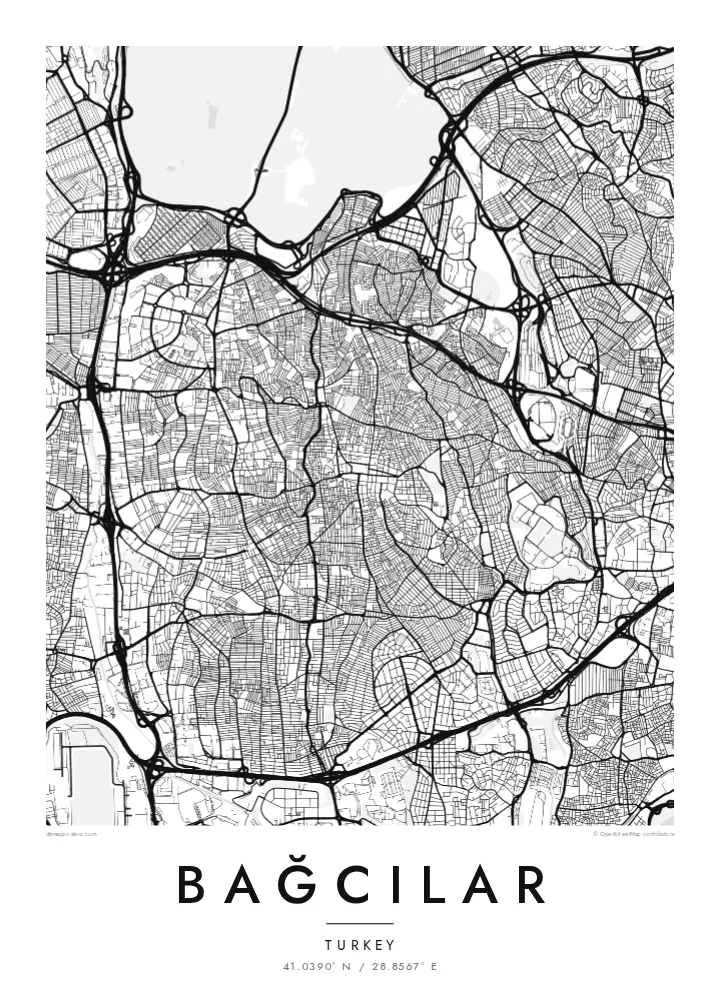
Narrow, irregular streets lined with apartment blocks fill almost the entire district, producing one of the most detailed textures of any Istanbul map.
Fakatino mape mukamuka · Türkiye
41.0390° N / 28.8567° E
A dense residential district on Istanbul's European side, a tight weave of streets bounded by motorways and industrial zones.


Taha e taone, lima e onoonoaga
Tapaki e taha puhala ke kitia ai ki luga he puipui. Kua tatai e totogi he tau puhala oti — pete he lolomi, poloka, po ke faila HD.
 Tau pikselo mooli · faila lolomi 24 × 36″
Maama mitaki ke lolomi
Ko e 100% e fahi mooli mai he faila lolomi. Ko e tau poster oti — pete kua lolomi, poloka, po ke utu hifo — kua taute ke he ha mautolu a tau tokoluga (server) ke he 300 DPI, hokotia ke he 7,200 × 10,800 piksela, ke maeke ai e tau ala ikiiki tote ke maaliali fakamitaki he lolomi 24 × 36″.
He Pā


Ko e mape
Bağcılar is a district on the European side of Istanbul, well inland from both the Bosphorus and the Sea of Marmara. It is one of the most populous districts in the city, and its map shows why: block after block of apartment buildings packed into a close, irregular street network, with only occasional parks and open squares breaking the density.
Much of the district grew quickly in the second half of the twentieth century, as people moved to Istanbul from across Turkey and settled around the city's expanding industrial edge. The name comes from the vineyards that once covered the area. Today major roads, metro and tram lines tie it to the rest of the city, their straight lines cutting across the finer grain of the neighbourhoods.
A Bağcılar map poster makes a strong graphic piece precisely because it is so dense. In black and white the streets become a fine texture, almost like woven fabric, framed by the broad bands of the motorways. It is a map for people who grew up here, whose families arrived here, or who know Istanbul beyond the postcard districts.
Narrow, irregular streets lined with apartment blocks fill almost the entire district, producing one of the most detailed textures of any Istanbul map.
The T1 tram line ends in Bağcılar and metro lines run through the district, linking it with the historic peninsula and the rest of the city.
Wide highways and interchanges run along and through the district, their long curves standing out clearly against the small-scale neighbourhood grid.
Taute ke ha hau
Lafi e aho, taha higoa po ke taha kupu haau, hiki e fakatino, lahi po ke tuaga.
Ko e kitiaaga nakai totogi kua tote e maaliali mo e fakamailoga vai. Ko e tau lolomi mo e tau faila HD kua taute ke he 300 DPI, hokotia ke he 7,200 × 10,800 px, nakai fai fakamailoga vai.
Ko e ha Bağcılar
Bağcılar is where many Istanbul stories begin: families arriving from Anatolia, first apartments, first jobs. A map of the district honours a part of the city that rarely gets the attention given to Sultanahmet or the Bosphorus shore.
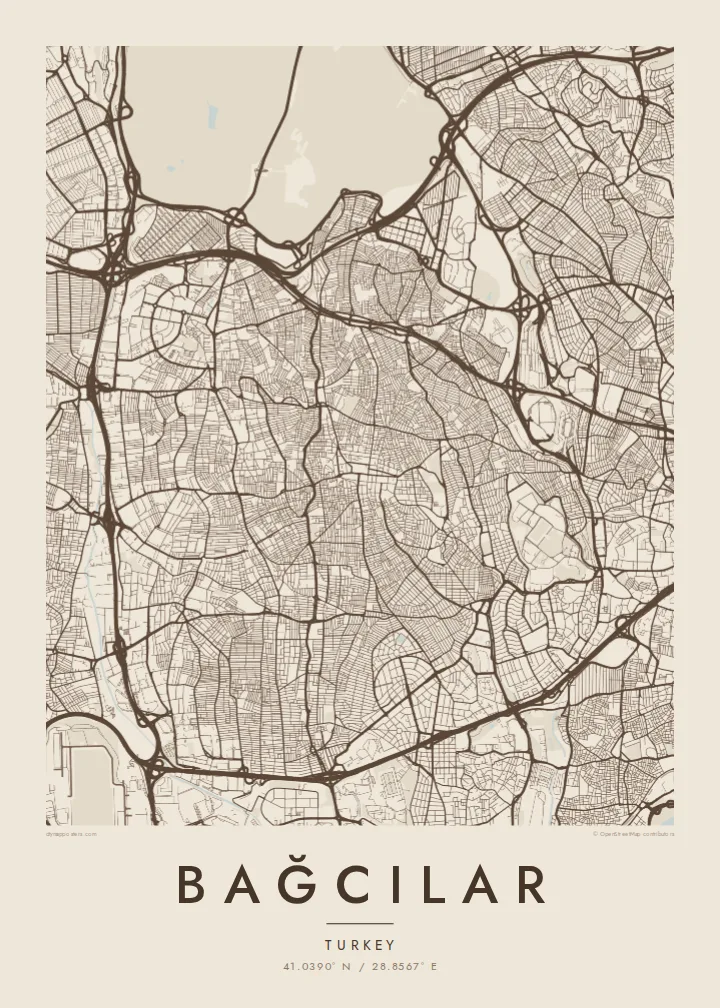
Personalise the title, subtitle and coordinates line with a mahalle, a family name or a date, and choose from five styles: Classic black & white, Noir, Paper, Blueprint and Sand. Get the digital files for $9 or order a matte print.
Talaage e poster Bağcılar| Lahi he lolomi | Maama | Tau faila |
|---|---|---|
| 30 × 40 cm11.8 × 15.7″ | 3,543 × 4,724 px | PNG · PDF |
| 29.7 × 42 cm (A3)11.7 × 16.5″ | 3,508 × 4,961 px | PNG · PDF |
| 42 × 59.4 cm (A2)16.5 × 23.4″ | 4,961 × 7,016 px | PNG · PDF |
| 45.7 × 61 cm18 × 24″ | 5,400 × 7,200 px | PNG · PDF |
| 50 × 70 cm19.7 × 27.6″ | 5,906 × 8,268 px | PNG · PDF |
| 61 × 91.4 cm24 × 36″ | 7,200 × 10,800 px | PNG · PDF |
Ke fakatatai, ko e fakatino noa kua 900 px e laulahi, fai fakamailoga mo e mo e tau mata komipiuta ni. Ko e tau faila HD kua ato hoko ke he 8× e maama ke he tau faahi takitaha mo e lolomi mitaki he lahi katoa he fakatino.
Fifili e taha puhala i luga he kupega, ti fifili e Poster Lolomi — e lahi mo e, kaeke ke manako ai koe, taha poloka — po ke Tau Faila HD Fakaeletonika. Ko e fakaotiaga totogi ko e taha gahua ni, ti ko e kupega he hau a talaaga ka fakafou fakahaga i mua he fakaotiaga e totogi.
Kua lolomi ai ke he pepa mitaki 200 gsm matte he taha he tau lahi ono, mai he 30 × 40 cm ke hoko ke he 24 × 36″. Kamata e tau poster lolomi mai he $39, kua putoia ai e utaaga.
E. Fifili e poloka akau malolō ke he lanu uli, tea, akau oki mooli, po ke akau pouli. Kua fakalataha mo e sioga malolō nakai malepe ti kua mautali ke tautau. Kamata e tau poster poloka mai he $99, kua putoia ai e utaaga.
Nakai totogi e fakafano ke he motu 60+. Ko e fakatino taha kua lolomi he fenoga lolomi ha mautolu kua tata mo e tau motu 30+, kua hoko mai he tau aho gahua 3–7. Maeke ia koe ke kikite e tuaga mo e fakamuitua he lalo he Haku Tau Fakatonu. Ke he falu motu kua 2–5 e tau tapu, ti ka nakai fakafano a mautolu ki ai, to fakaha he api tupe ia ki mua he totogi.
Fakafano mai e taha ata ki a mautolu he loto he 14 e tau aho tali mai he hokoaga, ti to lolomi foki e mautolu nakai totogi po ke liu atu e totogi ki a koe.
E. He editor i luga he kupega nei, hikihiki e matakupu, e matakupu lalo mo e laini coordinates ke he taha mena kua manako a koe ki ai, ti fifili e puhala mo e lahi. Ko e tau talaaga lolomi, poloka mo e fakaeletonika oti kua fakaaoga tonu e hau a fakatino.
Ma e $9 ka moua e koe e tau faila PNG 300 DPI mo e PDF kua mautali ke lolomi he tau lahi ono oti, nakai fai fakamailoga vai, ke lolomi i fe mena. Nakai maopoopo agaia? Utu hifo fakamua e kitiaaga nakai totogi ne fai fakamailoga vai.
Tata mai
