Villa avenues
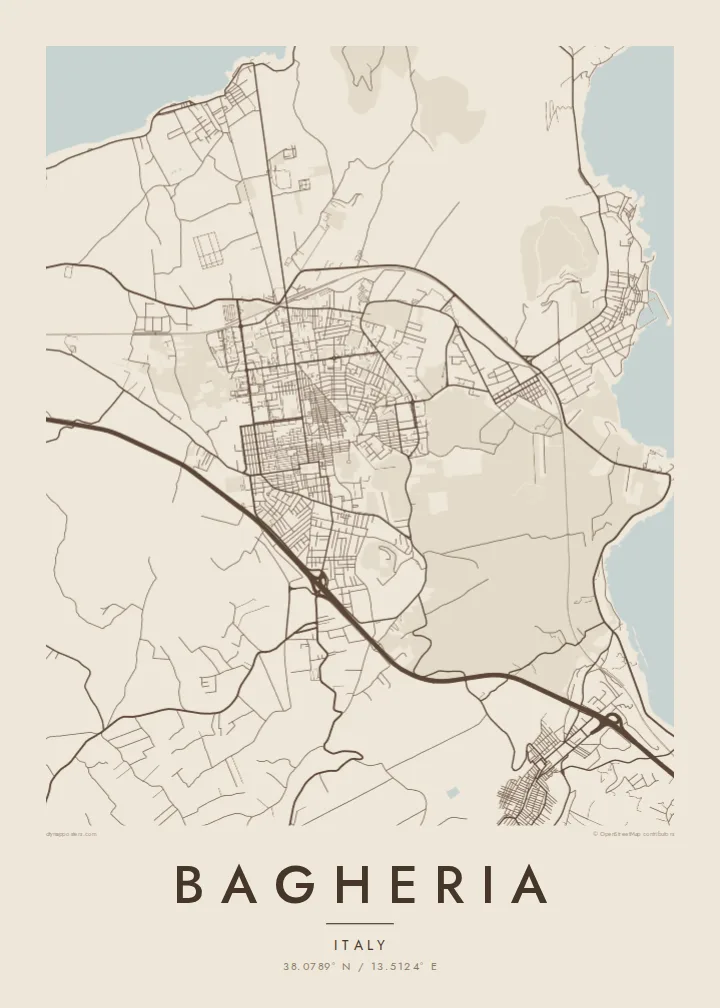
Long, straight roads laid out to approach the baroque villas still run through the town and stand out clearly against the irregular blocks that grew up around them.
Fakatino mape mukamuka · Italy
38.0789° N / 13.5124° E
A compact Sicilian town spreading between Mount Catalfano and the sea, its villa estates set into a tight street grid


Taha e taone, lima e onoonoaga
Tapaki e taha puhala ke kitia ai ki luga he puipui. Kua tatai e totogi he tau puhala oti — pete he lolomi, poloka, po ke faila HD.
 Tau pikselo mooli · faila lolomi 24 × 36″
Maama mitaki ke lolomi
Ko e 100% e fahi mooli mai he faila lolomi. Ko e tau poster oti — pete kua lolomi, poloka, po ke utu hifo — kua taute ke he ha mautolu a tau tokoluga (server) ke he 300 DPI, hokotia ke he 7,200 × 10,800 piksela, ke maeke ai e tau ala ikiiki tote ke maaliali fakamitaki he lolomi 24 × 36″.
He Pā


Ko e mape
Bagheria lies a short distance east of Palermo, on a strip of level ground between the Tyrrhenian coast and the limestone bulk of Mount Catalfano. From above, the town is a dense block of streets that stops sharply where the slopes begin. Toward the shore, the grid loosens into lower-density housing and small plots before meeting the coastline near the fishing village of Aspra.
What sets Bagheria apart on a map is the pattern its aristocratic past left behind. From the seventeenth and eighteenth centuries, Palermo's noble families built summer villas here, and the long, straight avenues that once led to their gates still organise parts of the town. Villa Palagonia, known for its grotesque stone figures, is the most famous of them. The villas sit as larger rectangles among the smaller blocks around them.
A Bagheria map poster shows the tension between the planned axes and the fine grain of streets that later filled in around them. The town is also linked to two well-known artists. The painter Renato Guttuso was born here, and so was the director Giuseppe Tornatore, whose film Baarìa takes its title from the local name for the town.
Long, straight roads laid out to approach the baroque villas still run through the town and stand out clearly against the irregular blocks that grew up around them.
The mountain rises at the edge of town and gives the map a clear boundary. Dense streets stop where the slope starts, leaving an empty contour on the poster.
To the north, the land runs down to the sea at Aspra, a small harbour settlement where the street pattern meets the curve of the Tyrrhenian coast.
Taute ke ha hau
Lafi e aho, taha higoa po ke taha kupu haau, hiki e fakatino, lahi po ke tuaga.
Ko e kitiaaga nakai totogi kua tote e maaliali mo e fakamailoga vai. Ko e tau lolomi mo e tau faila HD kua taute ke he 300 DPI, hokotia ke he 7,200 × 10,800 px, nakai fai fakamailoga vai.
Ko e ha Bagheria
Bagheria draws people with ties to Palermo's hinterland, admirers of the baroque villas, and anyone who knows the town through Tornatore's films. The mix of noble avenues and ordinary streets looks good in plain line work.
The title, subtitle and coordinates line can all be changed, for example to add a family name or a year spent in Sicily. The five styles are Classic black & white, Noir, Paper, Blueprint and Sand. Paper and Sand both suit the warm stone of the villas.
Talaage e poster Bagheria| Lahi he lolomi | Maama | Tau faila |
|---|---|---|
| 30 × 40 cm11.8 × 15.7″ | 3,543 × 4,724 px | PNG · PDF |
| 29.7 × 42 cm (A3)11.7 × 16.5″ | 3,508 × 4,961 px | PNG · PDF |
| 42 × 59.4 cm (A2)16.5 × 23.4″ | 4,961 × 7,016 px | PNG · PDF |
| 45.7 × 61 cm18 × 24″ | 5,400 × 7,200 px | PNG · PDF |
| 50 × 70 cm19.7 × 27.6″ | 5,906 × 8,268 px | PNG · PDF |
| 61 × 91.4 cm24 × 36″ | 7,200 × 10,800 px | PNG · PDF |
Ke fakatatai, ko e fakatino noa kua 900 px e laulahi, fai fakamailoga mo e mo e tau mata komipiuta ni. Ko e tau faila HD kua ato hoko ke he 8× e maama ke he tau faahi takitaha mo e lolomi mitaki he lahi katoa he fakatino.
Fifili e taha puhala i luga he kupega, ti fifili e Poster Lolomi — e lahi mo e, kaeke ke manako ai koe, taha poloka — po ke Tau Faila HD Fakaeletonika. Ko e fakaotiaga totogi ko e taha gahua ni, ti ko e kupega he hau a talaaga ka fakafou fakahaga i mua he fakaotiaga e totogi.
Kua lolomi ai ke he pepa mitaki 200 gsm matte he taha he tau lahi ono, mai he 30 × 40 cm ke hoko ke he 24 × 36″. Kamata e tau poster lolomi mai he $39, kua putoia ai e utaaga.
E. Fifili e poloka akau malolō ke he lanu uli, tea, akau oki mooli, po ke akau pouli. Kua fakalataha mo e sioga malolō nakai malepe ti kua mautali ke tautau. Kamata e tau poster poloka mai he $99, kua putoia ai e utaaga.
Nakai totogi e fakafano ke he motu 60+. Ko e fakatino taha kua lolomi he fenoga lolomi ha mautolu kua tata mo e tau motu 30+, kua hoko mai he tau aho gahua 3–7. Maeke ia koe ke kikite e tuaga mo e fakamuitua he lalo he Haku Tau Fakatonu. Ke he falu motu kua 2–5 e tau tapu, ti ka nakai fakafano a mautolu ki ai, to fakaha he api tupe ia ki mua he totogi.
Fakafano mai e taha ata ki a mautolu he loto he 14 e tau aho tali mai he hokoaga, ti to lolomi foki e mautolu nakai totogi po ke liu atu e totogi ki a koe.
E. He editor i luga he kupega nei, hikihiki e matakupu, e matakupu lalo mo e laini coordinates ke he taha mena kua manako a koe ki ai, ti fifili e puhala mo e lahi. Ko e tau talaaga lolomi, poloka mo e fakaeletonika oti kua fakaaoga tonu e hau a fakatino.
Ma e $9 ka moua e koe e tau faila PNG 300 DPI mo e PDF kua mautali ke lolomi he tau lahi ono oti, nakai fai fakamailoga vai, ke lolomi i fe mena. Nakai maopoopo agaia? Utu hifo fakamua e kitiaaga nakai totogi ne fai fakamailoga vai.
Tata mai
