Shatt al-Arab
The broad waterway formed by the Tigris and Euphrates runs along the city's eastern edge, a wide, steady line that anchors the entire composition.
Fakatino mape mukamuka · Iraq
30.5085° N / 47.7804° E
A river port along the Shatt al-Arab, threaded by old canals and edged by wide groves of date palms



Taha e taone, lima e onoonoaga
Tapaki e taha puhala ke kitia ai ki luga he puipui. Kua tatai e totogi he tau puhala oti — pete he lolomi, poloka, po ke faila HD.
 Tau pikselo mooli · faila lolomi 24 × 36″
Maama mitaki ke lolomi
Ko e 100% e fahi mooli mai he faila lolomi. Ko e tau poster oti — pete kua lolomi, poloka, po ke utu hifo — kua taute ke he ha mautolu a tau tokoluga (server) ke he 300 DPI, hokotia ke he 7,200 × 10,800 piksela, ke maeke ai e tau ala ikiiki tote ke maaliali fakamitaki he lolomi 24 × 36″.
He Pā


Ko e mape
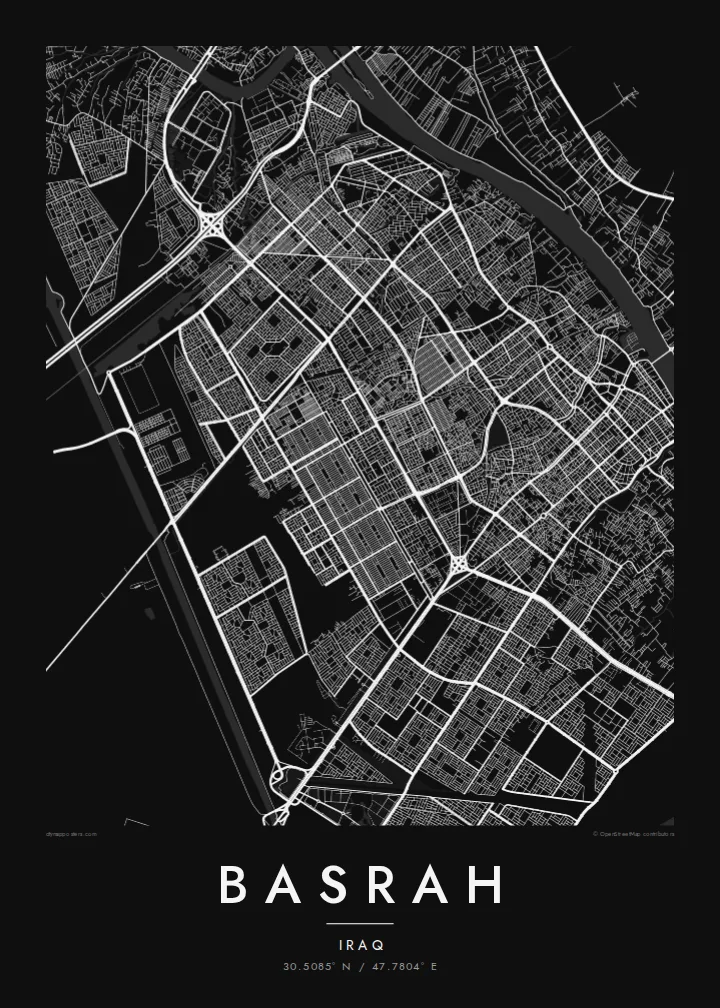
Basrah lies on the Shatt al-Arab, the waterway formed where the Tigris and the Euphrates join upstream at Qurna. On the map, the river runs along the eastern side of the city toward the Gulf, and a network of canals branches off it through the urban area, which once earned Basrah the nickname the Venice of the East. Palm groves line the banks beyond the city.
Founded in 636 as a garrison town, Basrah became one of the great cities of the early Islamic world, known for its scholars and particularly for the school of Arabic grammar that developed here. It is also associated with the tales of Sinbad the Sailor, who set out on his voyages from its port, according to the stories.
A Basrah map poster traces the Shatt al-Arab, the canals and the pattern of streets between them, with the corniche following the river through the centre. Today Basrah is Iraq's main port city and a centre of its oil industry, but on the map it remains what it has always been: a city shaped by rivers, water and trade.
The broad waterway formed by the Tigris and Euphrates runs along the city's eastern edge, a wide, steady line that anchors the entire composition.
Canals branch off the river and wind through the city, fine lines of water that recall the network behind Basrah's old nickname, the Venice of the East.
Beyond the built-up area, date palm groves follow the riverbanks. On the map they appear as a softer, more open texture framing the dense streets of the city.
Taute ke ha hau
Lafi e aho, taha higoa po ke taha kupu haau, hiki e fakatino, lahi po ke tuaga.
Ko e kitiaaga nakai totogi kua tote e maaliali mo e fakamailoga vai. Ko e tau lolomi mo e tau faila HD kua taute ke he 300 DPI, hokotia ke he 7,200 × 10,800 px, nakai fai fakamailoga vai.
Ko e ha Basrah
Basrah is a map for Iraqis at home and abroad, for those who have worked in its port and oil fields and for anyone who knows the city from literature and history. Its river and canals give the poster a strong and immediately readable structure.
Add a title in Arabic or English, a subtitle with a date or family name, and edit the coordinates line. Choose from five styles: Classic black & white, Noir, Paper, Blueprint or Sand. Sand reflects the colours of the southern plain and the river.
Talaage e poster Basrah| Lahi he lolomi | Maama | Tau faila |
|---|---|---|
| 30 × 40 cm11.8 × 15.7″ | 3,543 × 4,724 px | PNG · PDF |
| 29.7 × 42 cm (A3)11.7 × 16.5″ | 3,508 × 4,961 px | PNG · PDF |
| 42 × 59.4 cm (A2)16.5 × 23.4″ | 4,961 × 7,016 px | PNG · PDF |
| 45.7 × 61 cm18 × 24″ | 5,400 × 7,200 px | PNG · PDF |
| 50 × 70 cm19.7 × 27.6″ | 5,906 × 8,268 px | PNG · PDF |
| 61 × 91.4 cm24 × 36″ | 7,200 × 10,800 px | PNG · PDF |
Ke fakatatai, ko e fakatino noa kua 900 px e laulahi, fai fakamailoga mo e mo e tau mata komipiuta ni. Ko e tau faila HD kua ato hoko ke he 8× e maama ke he tau faahi takitaha mo e lolomi mitaki he lahi katoa he fakatino.
Fifili e taha puhala i luga he kupega, ti fifili e Poster Lolomi — e lahi mo e, kaeke ke manako ai koe, taha poloka — po ke Tau Faila HD Fakaeletonika. Ko e fakaotiaga totogi ko e taha gahua ni, ti ko e kupega he hau a talaaga ka fakafou fakahaga i mua he fakaotiaga e totogi.
Kua lolomi ai ke he pepa mitaki 200 gsm matte he taha he tau lahi ono, mai he 30 × 40 cm ke hoko ke he 24 × 36″. Kamata e tau poster lolomi mai he $39, kua putoia ai e utaaga.
E. Fifili e poloka akau malolō ke he lanu uli, tea, akau oki mooli, po ke akau pouli. Kua fakalataha mo e sioga malolō nakai malepe ti kua mautali ke tautau. Kamata e tau poster poloka mai he $99, kua putoia ai e utaaga.
Nakai totogi e fakafano ke he motu 60+. Ko e fakatino taha kua lolomi he fenoga lolomi ha mautolu kua tata mo e tau motu 30+, kua hoko mai he tau aho gahua 3–7. Maeke ia koe ke kikite e tuaga mo e fakamuitua he lalo he Haku Tau Fakatonu. Ke he falu motu kua 2–5 e tau tapu, ti ka nakai fakafano a mautolu ki ai, to fakaha he api tupe ia ki mua he totogi.
Fakafano mai e taha ata ki a mautolu he loto he 14 e tau aho tali mai he hokoaga, ti to lolomi foki e mautolu nakai totogi po ke liu atu e totogi ki a koe.
E. He editor i luga he kupega nei, hikihiki e matakupu, e matakupu lalo mo e laini coordinates ke he taha mena kua manako a koe ki ai, ti fifili e puhala mo e lahi. Ko e tau talaaga lolomi, poloka mo e fakaeletonika oti kua fakaaoga tonu e hau a fakatino.
Ma e $9 ka moua e koe e tau faila PNG 300 DPI mo e PDF kua mautali ke lolomi he tau lahi ono oti, nakai fai fakamailoga vai, ke lolomi i fe mena. Nakai maopoopo agaia? Utu hifo fakamua e kitiaaga nakai totogi ne fai fakamailoga vai.
