The Corniche
The seafront promenade follows the coast from downtown around Ras Beirut, forming the long curving edge of the city and the most recognisable line on the poster.
Fakatino mape mukamuka · Lebanon
33.8933° N / 35.5016° E
A headland city on the Mediterranean, its streets climbing from the Corniche and the port toward the mountains


Taha e taone, lima e onoonoaga
Tapaki e taha puhala ke kitia ai ki luga he puipui. Kua tatai e totogi he tau puhala oti — pete he lolomi, poloka, po ke faila HD.
 Tau pikselo mooli · faila lolomi 24 × 36″
Maama mitaki ke lolomi
Ko e 100% e fahi mooli mai he faila lolomi. Ko e tau poster oti — pete kua lolomi, poloka, po ke utu hifo — kua taute ke he ha mautolu a tau tokoluga (server) ke he 300 DPI, hokotia ke he 7,200 × 10,800 piksela, ke maeke ai e tau ala ikiiki tote ke maaliali fakamitaki he lolomi 24 × 36″.
He Pā

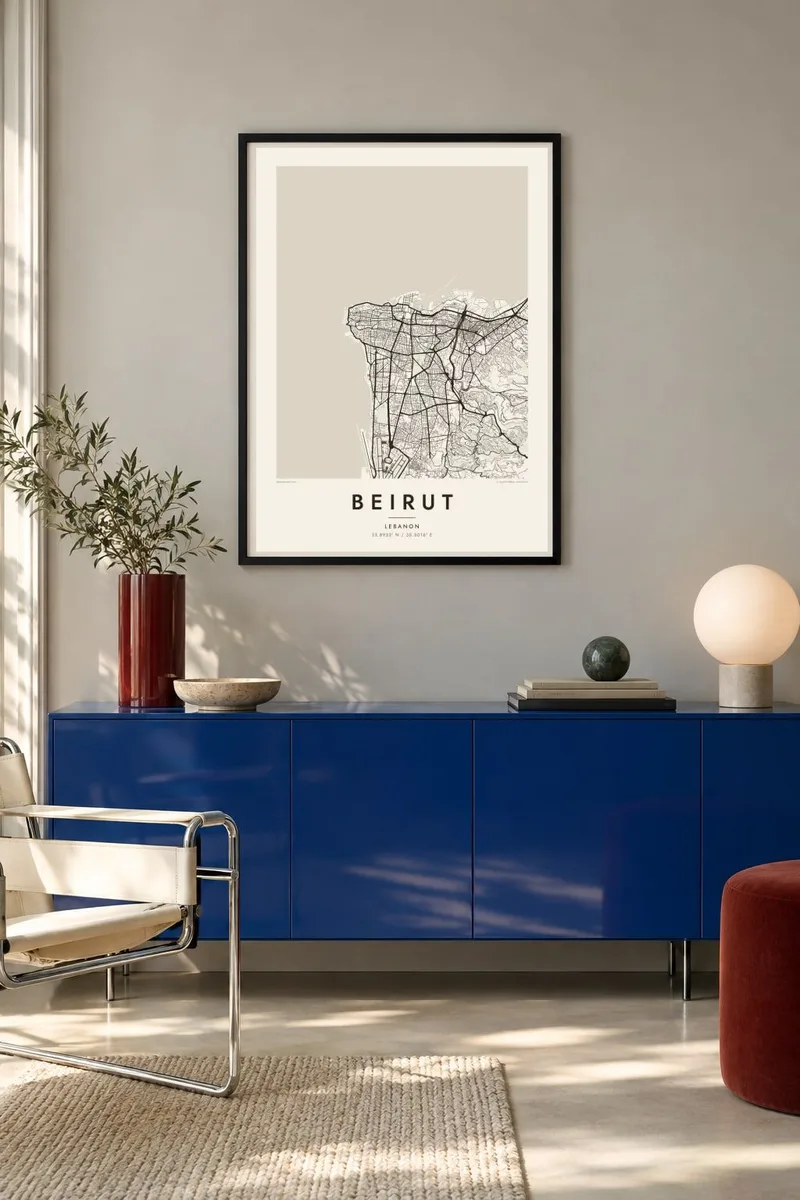

Ko e mape
Beirut occupies a triangular headland on Lebanon's Mediterranean coast, and on the map the sea wraps around it on two sides. The Corniche traces the western and northern shore, the port fills the north-east, and the Beirut River marks the eastern edge. Behind the city the ground rises steadily, and the dense streets thin out as they climb towards the slopes of Mount Lebanon.
The rocky tip of Ras Beirut holds the American University of Beirut campus and, further along, the Pigeon Rocks at Raouché standing just offshore. The downtown area, rebuilt after the civil war, has a formal pattern of streets around the Place de l'Étoile, while older neighbourhoods such as Gemmayze and Achrafieh keep their narrow lanes and stairways.
A Beirut map poster captures a city pressed between sea and hills. The curve of the coast, the compact grain of the old districts and the green block of the university campus make a detailed, varied composition. In black and white, the many layers of the city's past show through clearly in the pattern of its streets.
The seafront promenade follows the coast from downtown around Ras Beirut, forming the long curving edge of the city and the most recognisable line on the poster.
Two limestone rocks stand just off the cliffs at Raouché, small isolated shapes in the sea that mark the western tip of the headland.
The American University of Beirut campus spreads down the slope towards the sea as a green, open block with winding paths among the dense surrounding streets.
Taute ke ha hau
Lafi e aho, taha higoa po ke taha kupu haau, hiki e fakatino, lahi po ke tuaga.
Ko e kitiaaga nakai totogi kua tote e maaliali mo e fakamailoga vai. Ko e tau lolomi mo e tau faila HD kua taute ke he 300 DPI, hokotia ke he 7,200 × 10,800 px, nakai fai fakamailoga vai.
Ko e ha Beirut
Beirut is one of the most loved cities in the region, by those who live there and by a large diaspora around the world. A map of its coastline and neighbourhoods makes a thoughtful gift for anyone who calls it home.
Add a title in your own words, a subtitle such as a neighbourhood or a date, and adjust the coordinates line. Choose from Classic black & white, Noir, Paper, Blueprint and Sand, as a digital file or a printed poster.
Talaage e poster Beirut| Lahi he lolomi | Maama | Tau faila |
|---|---|---|
| 30 × 40 cm11.8 × 15.7″ | 3,543 × 4,724 px | PNG · PDF |
| 29.7 × 42 cm (A3)11.7 × 16.5″ | 3,508 × 4,961 px | PNG · PDF |
| 42 × 59.4 cm (A2)16.5 × 23.4″ | 4,961 × 7,016 px | PNG · PDF |
| 45.7 × 61 cm18 × 24″ | 5,400 × 7,200 px | PNG · PDF |
| 50 × 70 cm19.7 × 27.6″ | 5,906 × 8,268 px | PNG · PDF |
| 61 × 91.4 cm24 × 36″ | 7,200 × 10,800 px | PNG · PDF |
Ke fakatatai, ko e fakatino noa kua 900 px e laulahi, fai fakamailoga mo e mo e tau mata komipiuta ni. Ko e tau faila HD kua ato hoko ke he 8× e maama ke he tau faahi takitaha mo e lolomi mitaki he lahi katoa he fakatino.
Fifili e taha puhala i luga he kupega, ti fifili e Poster Lolomi — e lahi mo e, kaeke ke manako ai koe, taha poloka — po ke Tau Faila HD Fakaeletonika. Ko e fakaotiaga totogi ko e taha gahua ni, ti ko e kupega he hau a talaaga ka fakafou fakahaga i mua he fakaotiaga e totogi.
Kua lolomi ai ke he pepa mitaki 200 gsm matte he taha he tau lahi ono, mai he 30 × 40 cm ke hoko ke he 24 × 36″. Kamata e tau poster lolomi mai he $39, kua putoia ai e utaaga.
E. Fifili e poloka akau malolō ke he lanu uli, tea, akau oki mooli, po ke akau pouli. Kua fakalataha mo e sioga malolō nakai malepe ti kua mautali ke tautau. Kamata e tau poster poloka mai he $99, kua putoia ai e utaaga.
Nakai totogi e fakafano ke he motu 60+. Ko e fakatino taha kua lolomi he fenoga lolomi ha mautolu kua tata mo e tau motu 30+, kua hoko mai he tau aho gahua 3–7. Maeke ia koe ke kikite e tuaga mo e fakamuitua he lalo he Haku Tau Fakatonu. Ke he falu motu kua 2–5 e tau tapu, ti ka nakai fakafano a mautolu ki ai, to fakaha he api tupe ia ki mua he totogi.
Fakafano mai e taha ata ki a mautolu he loto he 14 e tau aho tali mai he hokoaga, ti to lolomi foki e mautolu nakai totogi po ke liu atu e totogi ki a koe.
E. He editor i luga he kupega nei, hikihiki e matakupu, e matakupu lalo mo e laini coordinates ke he taha mena kua manako a koe ki ai, ti fifili e puhala mo e lahi. Ko e tau talaaga lolomi, poloka mo e fakaeletonika oti kua fakaaoga tonu e hau a fakatino.
Ma e $9 ka moua e koe e tau faila PNG 300 DPI mo e PDF kua mautali ke lolomi he tau lahi ono oti, nakai fai fakamailoga vai, ke lolomi i fe mena. Nakai maopoopo agaia? Utu hifo fakamua e kitiaaga nakai totogi ne fai fakamailoga vai.
Tata mai
