Straight Street
The Roman Via Recta crosses the Old City from east to west, a single straight line cutting through a web of narrow, irregular lanes and courtyards.
Fakatino mape mukamuka · Syria
33.5102° N / 36.2913° E
An ancient walled city below a mountain slope, its long straight street still running through a maze of old lanes.


Taha e taone, lima e onoonoaga
Tapaki e taha puhala ke kitia ai ki luga he puipui. Kua tatai e totogi he tau puhala oti — pete he lolomi, poloka, po ke faila HD.
 Tau pikselo mooli · faila lolomi 24 × 36″
Maama mitaki ke lolomi
Ko e 100% e fahi mooli mai he faila lolomi. Ko e tau poster oti — pete kua lolomi, poloka, po ke utu hifo — kua taute ke he ha mautolu a tau tokoluga (server) ke he 300 DPI, hokotia ke he 7,200 × 10,800 piksela, ke maeke ai e tau ala ikiiki tote ke maaliali fakamitaki he lolomi 24 × 36″.
He Pā


Ko e mape
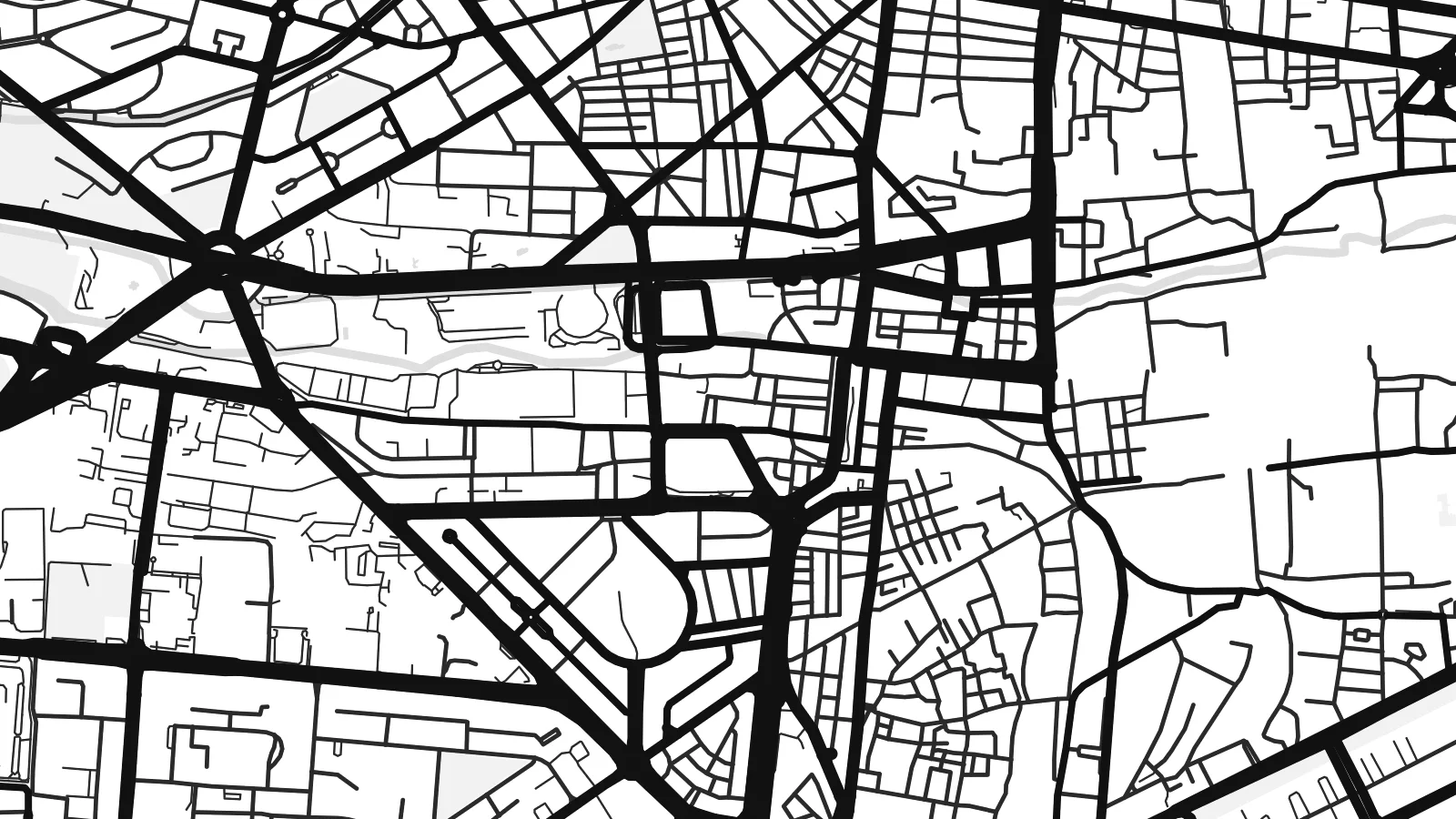
Damascus is often cited as one of the oldest continuously inhabited cities in the world. It grew at the foot of Mount Qasioun, which rises steeply to the northwest, and beside the Barada River, whose waters once fed the surrounding Ghouta oasis. From above, the city spreads across the plain below the mountain, with newer districts climbing its lower slopes.
The Old City, a UNESCO World Heritage Site, is enclosed by walls in a rough oval. Through it runs Straight Street, the Via Recta of Roman times, mentioned in the Acts of the Apostles, while the Umayyad Mosque occupies a large rectangle in the northern part. Around them, a dense tangle of lanes and courtyard houses gives the core its intricate texture.
Outside the walls, twentieth-century boulevards, squares and planned quarters extend west and north, and the course of the Barada is marked by a thin line of water and greenery. A Damascus map poster shows these layers side by side: the fine-grained ancient core, the broader modern streets and the dark mass of Qasioun above.
The Roman Via Recta crosses the Old City from east to west, a single straight line cutting through a web of narrow, irregular lanes and courtyards.
Its large rectangular courtyard and prayer hall form one of the clearest shapes inside the walls, set among the covered markets of the northern Old City.
The mountain rises sharply above the northwest of the city, and streets stop where the slope becomes too steep, giving the map a firm upper edge.
Taute ke ha hau
Lafi e aho, taha higoa po ke taha kupu haau, hiki e fakatino, lahi po ke tuaga.
Ko e kitiaaga nakai totogi kua tote e maaliali mo e fakamailoga vai. Ko e tau lolomi mo e tau faila HD kua taute ke he 300 DPI, hokotia ke he 7,200 × 10,800 px, nakai fai fakamailoga vai.
Ko e ha Damascus
For Syrians at home and abroad, Damascus carries family memory across generations, from a childhood street in the Old City to a neighbourhood on the slopes of Qasioun. A map is a way to keep that geography close, whatever the distance.
The title, subtitle and coordinates line can hold a family name, a quarter of the city or a meaningful date. Choose one of five styles, Classic black & white, Noir, Paper, Blueprint or Sand, as a high-resolution file or a printed poster.
Talaage e poster Damascus| Lahi he lolomi | Maama | Tau faila |
|---|---|---|
| 30 × 40 cm11.8 × 15.7″ | 3,543 × 4,724 px | PNG · PDF |
| 29.7 × 42 cm (A3)11.7 × 16.5″ | 3,508 × 4,961 px | PNG · PDF |
| 42 × 59.4 cm (A2)16.5 × 23.4″ | 4,961 × 7,016 px | PNG · PDF |
| 45.7 × 61 cm18 × 24″ | 5,400 × 7,200 px | PNG · PDF |
| 50 × 70 cm19.7 × 27.6″ | 5,906 × 8,268 px | PNG · PDF |
| 61 × 91.4 cm24 × 36″ | 7,200 × 10,800 px | PNG · PDF |
Ke fakatatai, ko e fakatino noa kua 900 px e laulahi, fai fakamailoga mo e mo e tau mata komipiuta ni. Ko e tau faila HD kua ato hoko ke he 8× e maama ke he tau faahi takitaha mo e lolomi mitaki he lahi katoa he fakatino.
Fifili e taha puhala i luga he kupega, ti fifili e Poster Lolomi — e lahi mo e, kaeke ke manako ai koe, taha poloka — po ke Tau Faila HD Fakaeletonika. Ko e fakaotiaga totogi ko e taha gahua ni, ti ko e kupega he hau a talaaga ka fakafou fakahaga i mua he fakaotiaga e totogi.
Kua lolomi ai ke he pepa mitaki 200 gsm matte he taha he tau lahi ono, mai he 30 × 40 cm ke hoko ke he 24 × 36″. Kamata e tau poster lolomi mai he $39, kua putoia ai e utaaga.
E. Fifili e poloka akau malolō ke he lanu uli, tea, akau oki mooli, po ke akau pouli. Kua fakalataha mo e sioga malolō nakai malepe ti kua mautali ke tautau. Kamata e tau poster poloka mai he $99, kua putoia ai e utaaga.
Nakai totogi e fakafano ke he motu 60+. Ko e fakatino taha kua lolomi he fenoga lolomi ha mautolu kua tata mo e tau motu 30+, kua hoko mai he tau aho gahua 3–7. Maeke ia koe ke kikite e tuaga mo e fakamuitua he lalo he Haku Tau Fakatonu. Ke he falu motu kua 2–5 e tau tapu, ti ka nakai fakafano a mautolu ki ai, to fakaha he api tupe ia ki mua he totogi.
Fakafano mai e taha ata ki a mautolu he loto he 14 e tau aho tali mai he hokoaga, ti to lolomi foki e mautolu nakai totogi po ke liu atu e totogi ki a koe.
E. He editor i luga he kupega nei, hikihiki e matakupu, e matakupu lalo mo e laini coordinates ke he taha mena kua manako a koe ki ai, ti fifili e puhala mo e lahi. Ko e tau talaaga lolomi, poloka mo e fakaeletonika oti kua fakaaoga tonu e hau a fakatino.
Ma e $9 ka moua e koe e tau faila PNG 300 DPI mo e PDF kua mautali ke lolomi he tau lahi ono oti, nakai fai fakamailoga vai, ke lolomi i fe mena. Nakai maopoopo agaia? Utu hifo fakamua e kitiaaga nakai totogi ne fai fakamailoga vai.
Tata mai
