Valley basin
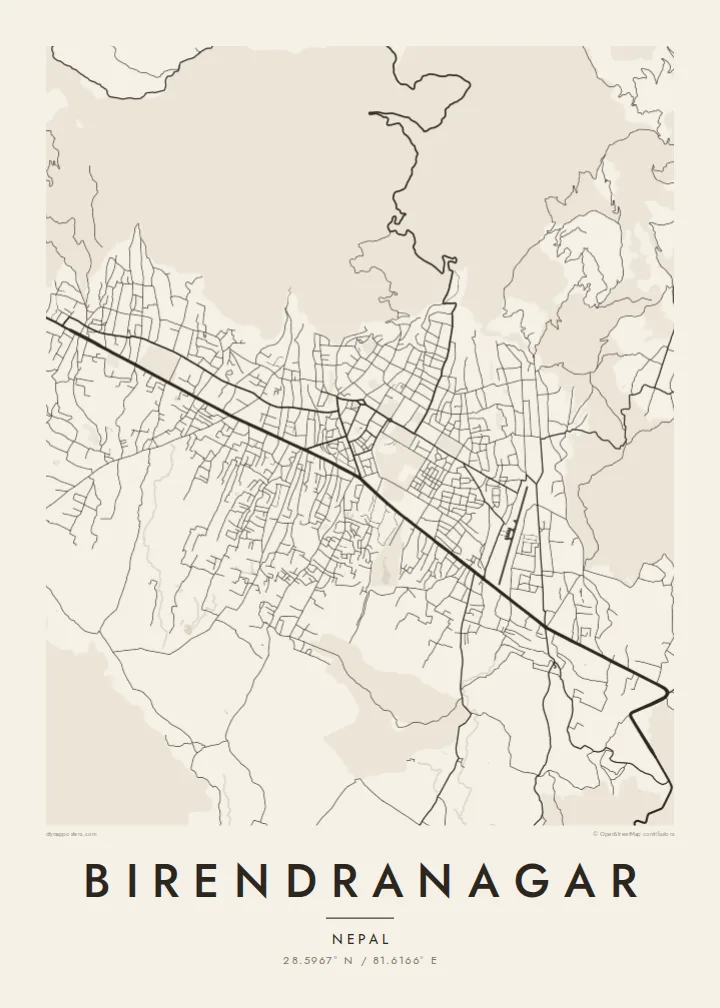
The town spreads across a level valley floor, and the surrounding hills form a natural edge that frames the whole map like a bowl seen from above.
Fakatino mape mukamuka · Nepal
28.5967° N / 81.6166° E
The capital of Karnali Province, spread across the flat floor of the Surkhet Valley and ringed by forested hills




Taha e taone, lima e onoonoaga
Tapaki e taha puhala ke kitia ai ki luga he puipui. Kua tatai e totogi he tau puhala oti — pete he lolomi, poloka, po ke faila HD.
 Tau pikselo mooli · faila lolomi 24 × 36″
Maama mitaki ke lolomi
Ko e 100% e fahi mooli mai he faila lolomi. Ko e tau poster oti — pete kua lolomi, poloka, po ke utu hifo — kua taute ke he ha mautolu a tau tokoluga (server) ke he 300 DPI, hokotia ke he 7,200 × 10,800 piksela, ke maeke ai e tau ala ikiiki tote ke maaliali fakamitaki he lolomi 24 × 36″.
He Pā


Ko e mape
Birendranagar occupies the Surkhet Valley in mid-western Nepal, a broad, flat basin enclosed by forested ridges of the Siwalik and Mahabharat ranges. On a map this setting is unmistakable. The town fills the valley floor with a relatively orderly street pattern, while the surrounding slopes remain largely unbuilt, their contours pressing in from every side. Roads climb out of the basin toward the hills and the plains beyond.
Named after King Birendra, the town has become the administrative capital of Karnali Province, the country's largest and most mountainous province. That role has brought government offices, schools and steady growth, and the valley is an important crossroads between the lowlands and the remote districts further north. Many journeys into the Karnali region begin or pass through here.
A Birendranagar map poster shows a planned town held within a natural frame. The flat valley allows longer, straighter streets than most Himalayan settlements, and the ring of hills at the edge gives the composition a clear boundary. The result is a map that feels contained and balanced, a settlement shaped as much by its basin as by the people who built it.
The town spreads across a level valley floor, and the surrounding hills form a natural edge that frames the whole map like a bowl seen from above.
Thanks to the flat ground, the central streets are more regular than in most hill towns, giving the centre an orderly, readable pattern.
Main routes wind out of the valley toward the plains and the northern districts, their curves contrasting with the straight lines of the town.
Taute ke ha hau
Lafi e aho, taha higoa po ke taha kupu haau, hiki e fakatino, lahi po ke tuaga.
Ko e kitiaaga nakai totogi kua tote e maaliali mo e fakamailoga vai. Ko e tau lolomi mo e tau faila HD kua taute ke he 300 DPI, hokotia ke he 7,200 × 10,800 px, nakai fai fakamailoga vai.
Ko e ha Birendranagar
Birendranagar is a place people often arrive in for work, study or government service, and many come to call it home. A map of the valley keeps that chapter of life on the wall, simple and clear, without needing words to explain it.
Personalise the title and subtitle, perhaps with a date or a family name, and adjust the coordinates line. Choose from Classic black and white, Noir, Paper, Blueprint or Sand, as $9 digital files or a printed poster.
Talaage e poster Birendranagar| Lahi he lolomi | Maama | Tau faila |
|---|---|---|
| 30 × 40 cm11.8 × 15.7″ | 3,543 × 4,724 px | PNG · PDF |
| 29.7 × 42 cm (A3)11.7 × 16.5″ | 3,508 × 4,961 px | PNG · PDF |
| 42 × 59.4 cm (A2)16.5 × 23.4″ | 4,961 × 7,016 px | PNG · PDF |
| 45.7 × 61 cm18 × 24″ | 5,400 × 7,200 px | PNG · PDF |
| 50 × 70 cm19.7 × 27.6″ | 5,906 × 8,268 px | PNG · PDF |
| 61 × 91.4 cm24 × 36″ | 7,200 × 10,800 px | PNG · PDF |
Ke fakatatai, ko e fakatino noa kua 900 px e laulahi, fai fakamailoga mo e mo e tau mata komipiuta ni. Ko e tau faila HD kua ato hoko ke he 8× e maama ke he tau faahi takitaha mo e lolomi mitaki he lahi katoa he fakatino.
Fifili e taha puhala i luga he kupega, ti fifili e Poster Lolomi — e lahi mo e, kaeke ke manako ai koe, taha poloka — po ke Tau Faila HD Fakaeletonika. Ko e fakaotiaga totogi ko e taha gahua ni, ti ko e kupega he hau a talaaga ka fakafou fakahaga i mua he fakaotiaga e totogi.
Kua lolomi ai ke he pepa mitaki 200 gsm matte he taha he tau lahi ono, mai he 30 × 40 cm ke hoko ke he 24 × 36″. Kamata e tau poster lolomi mai he $39, kua putoia ai e utaaga.
E. Fifili e poloka akau malolō ke he lanu uli, tea, akau oki mooli, po ke akau pouli. Kua fakalataha mo e sioga malolō nakai malepe ti kua mautali ke tautau. Kamata e tau poster poloka mai he $99, kua putoia ai e utaaga.
Nakai totogi e fakafano ke he motu 60+. Ko e fakatino taha kua lolomi he fenoga lolomi ha mautolu kua tata mo e tau motu 30+, kua hoko mai he tau aho gahua 3–7. Maeke ia koe ke kikite e tuaga mo e fakamuitua he lalo he Haku Tau Fakatonu. Ke he falu motu kua 2–5 e tau tapu, ti ka nakai fakafano a mautolu ki ai, to fakaha he api tupe ia ki mua he totogi.
Fakafano mai e taha ata ki a mautolu he loto he 14 e tau aho tali mai he hokoaga, ti to lolomi foki e mautolu nakai totogi po ke liu atu e totogi ki a koe.
E. He editor i luga he kupega nei, hikihiki e matakupu, e matakupu lalo mo e laini coordinates ke he taha mena kua manako a koe ki ai, ti fifili e puhala mo e lahi. Ko e tau talaaga lolomi, poloka mo e fakaeletonika oti kua fakaaoga tonu e hau a fakatino.
Ma e $9 ka moua e koe e tau faila PNG 300 DPI mo e PDF kua mautali ke lolomi he tau lahi ono oti, nakai fai fakamailoga vai, ke lolomi i fe mena. Nakai maopoopo agaia? Utu hifo fakamua e kitiaaga nakai totogi ne fai fakamailoga vai.
Tata mai
