Bluefields Bay
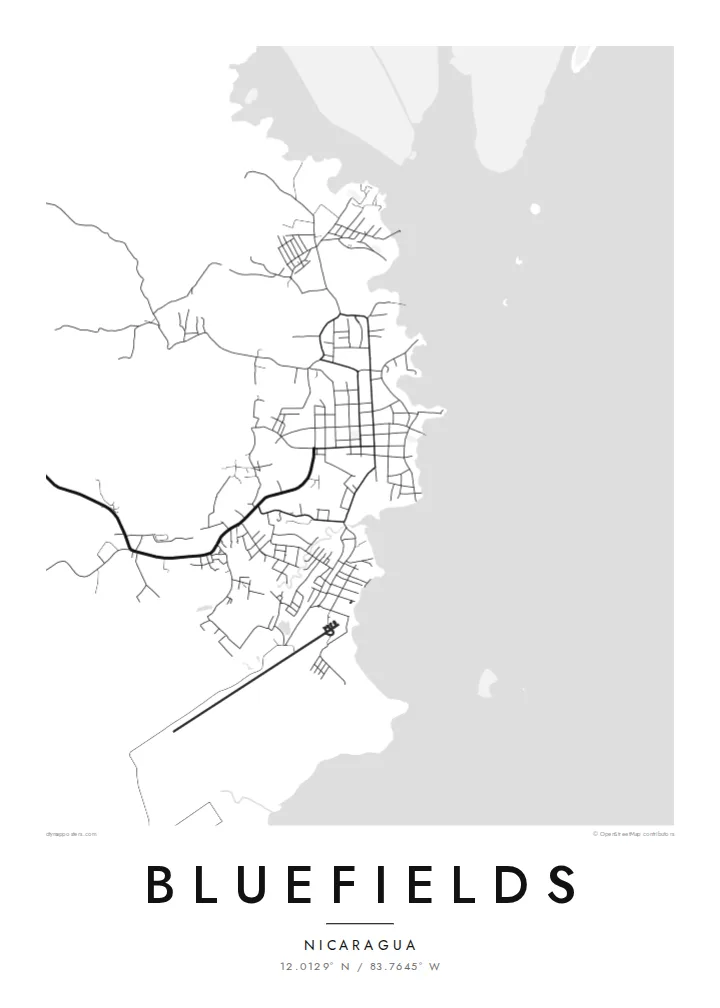
The lagoon occupies a large part of the frame, its calm water enclosed by narrow barrier islands that separate it from the open Caribbean.
Fakatino mape mukamuka · Nicaragua
12.0129° N / 83.7645° W
A Caribbean port town on the shore of a sheltered lagoon, where river channels and islands meet the sea.


Taha e taone, lima e onoonoaga
Tapaki e taha puhala ke kitia ai ki luga he puipui. Kua tatai e totogi he tau puhala oti — pete he lolomi, poloka, po ke faila HD.
 Tau pikselo mooli · faila lolomi 24 × 36″
Maama mitaki ke lolomi
Ko e 100% e fahi mooli mai he faila lolomi. Ko e tau poster oti — pete kua lolomi, poloka, po ke utu hifo — kua taute ke he ha mautolu a tau tokoluga (server) ke he 300 DPI, hokotia ke he 7,200 × 10,800 piksela, ke maeke ai e tau ala ikiiki tote ke maaliali fakamitaki he lolomi 24 × 36″.
He Pā


Ko e mape
Bluefields stands on the western shore of Bluefields Bay, a large lagoon on Nicaragua's Caribbean coast. A line of low islands and spits protects the lagoon from the open sea, and the Escondido River enters the bay nearby. On a map the town forms a compact grid on the waterfront, facing a broad expanse of water rather than the ocean itself.
Streets run down to the shore and the docks, where boats connect Bluefields with river communities and the Corn Islands offshore. Inland, the town grades into scattered housing, swamp and forest, with few roads reaching the rest of the country. A Bluefields map poster captures this sense of a place oriented to water rather than highways.
The town's name is usually traced to the Dutch privateer Abraham Blauvelt, who used the bay in the seventeenth century. Bluefields is home to Creole, Miskitu, Garifuna, Rama and Mestizo communities, and it is known for the Palo de Mayo festival each May. The town was rebuilt after Hurricane Joan struck it in 1988.
The lagoon occupies a large part of the frame, its calm water enclosed by narrow barrier islands that separate it from the open Caribbean.
The town's streets form a small, regular grid tipped towards the shore, with piers and landings along the edge of the bay.
The river arrives from the interior and opens into the bay near the town. It is the main water route linking Bluefields with the rest of Nicaragua.
Taute ke ha hau
Lafi e aho, taha higoa po ke taha kupu haau, hiki e fakatino, lahi po ke tuaga.
Ko e kitiaaga nakai totogi kua tote e maaliali mo e fakamailoga vai. Ko e tau lolomi mo e tau faila HD kua taute ke he 300 DPI, hokotia ke he 7,200 × 10,800 px, nakai fai fakamailoga vai.
Ko e ha Bluefields
Bluefields suits anyone with roots on Nicaragua's Caribbean coast, or a traveller who passed through on the way to the Corn Islands. The lagoon and the town's small grid make a composition that is simple, balanced and unmistakably coastal.
Choose a title, a subtitle perhaps in Spanish or Creole English, and your coordinates, then pick Classic black & white, Noir, Paper, Blueprint or Sand. Download the HD files for $9 or order a printed poster.
Talaage e poster Bluefields| Lahi he lolomi | Maama | Tau faila |
|---|---|---|
| 30 × 40 cm11.8 × 15.7″ | 3,543 × 4,724 px | PNG · PDF |
| 29.7 × 42 cm (A3)11.7 × 16.5″ | 3,508 × 4,961 px | PNG · PDF |
| 42 × 59.4 cm (A2)16.5 × 23.4″ | 4,961 × 7,016 px | PNG · PDF |
| 45.7 × 61 cm18 × 24″ | 5,400 × 7,200 px | PNG · PDF |
| 50 × 70 cm19.7 × 27.6″ | 5,906 × 8,268 px | PNG · PDF |
| 61 × 91.4 cm24 × 36″ | 7,200 × 10,800 px | PNG · PDF |
Ke fakatatai, ko e fakatino noa kua 900 px e laulahi, fai fakamailoga mo e mo e tau mata komipiuta ni. Ko e tau faila HD kua ato hoko ke he 8× e maama ke he tau faahi takitaha mo e lolomi mitaki he lahi katoa he fakatino.
Fifili e taha puhala i luga he kupega, ti fifili e Poster Lolomi — e lahi mo e, kaeke ke manako ai koe, taha poloka — po ke Tau Faila HD Fakaeletonika. Ko e fakaotiaga totogi ko e taha gahua ni, ti ko e kupega he hau a talaaga ka fakafou fakahaga i mua he fakaotiaga e totogi.
Kua lolomi ai ke he pepa mitaki 200 gsm matte he taha he tau lahi ono, mai he 30 × 40 cm ke hoko ke he 24 × 36″. Kamata e tau poster lolomi mai he $39, kua putoia ai e utaaga.
E. Fifili e poloka akau malolō ke he lanu uli, tea, akau oki mooli, po ke akau pouli. Kua fakalataha mo e sioga malolō nakai malepe ti kua mautali ke tautau. Kamata e tau poster poloka mai he $99, kua putoia ai e utaaga.
Nakai totogi e fakafano ke he motu 60+. Ko e fakatino taha kua lolomi he fenoga lolomi ha mautolu kua tata mo e tau motu 30+, kua hoko mai he tau aho gahua 3–7. Maeke ia koe ke kikite e tuaga mo e fakamuitua he lalo he Haku Tau Fakatonu. Ke he falu motu kua 2–5 e tau tapu, ti ka nakai fakafano a mautolu ki ai, to fakaha he api tupe ia ki mua he totogi.
Fakafano mai e taha ata ki a mautolu he loto he 14 e tau aho tali mai he hokoaga, ti to lolomi foki e mautolu nakai totogi po ke liu atu e totogi ki a koe.
E. He editor i luga he kupega nei, hikihiki e matakupu, e matakupu lalo mo e laini coordinates ke he taha mena kua manako a koe ki ai, ti fifili e puhala mo e lahi. Ko e tau talaaga lolomi, poloka mo e fakaeletonika oti kua fakaaoga tonu e hau a fakatino.
Ma e $9 ka moua e koe e tau faila PNG 300 DPI mo e PDF kua mautali ke lolomi he tau lahi ono oti, nakai fai fakamailoga vai, ke lolomi i fe mena. Nakai maopoopo agaia? Utu hifo fakamua e kitiaaga nakai totogi ne fai fakamailoga vai.
Tata mai
